Showing posts with label Science. Show all posts

Sunday, February 12, 2012

Happy 203rd Birthday, Charles Darwin!


It is instructive to look at the work of Darwin, and recognize that careful observation, interpretation and analysis form the basis of his body of work -- ideas which are still relevant to the science of Biology and all the disciplines that stem from it.

There have been many detractors, particularly in education, in the presentation and teaching of the science of evolutionary biology. The most famous of these cases perhaps being the "Scopes Monkey Trial" of 1925, and the more recent case of the Dover School Board provide an overview of how thinking on evolution has progressed. Interestingly, I know of no equivalent attempts in Canada to mandate the exclusive teaching of a creationist perspective.

In more recent times, mainstream religious institutions, including such entities as the Roman Catholic Church, have incorporated Darwinian ideas of biological evolution into their belief structures. But there are still some holdouts, as this critique makes clear:
"...the list of churches that have signed up for Evolution Weekend are mainly theologically liberal churches, and I added, with an inordinate number of women clergy. The particular Sacramento-area church the writer reported on has a woman pastor—who obviously doesn’t understand the difference between operational (observational) science and historical science. When clergy like this make the comment “science and faith,” they really mean that “biological, geological, and cosmological evolutionary belief” is supposedly compatible with God’s Word. "

The condemnation is clear -- only "theologically liberal" churches would advocate any co-existence with what I would call the real world. And of those churches, it is the women clergy who are at fault, presumably because they don't conform to the patriarchal model that the author of this piece would like to be the universal norm. The "Evolution Weekend" reference is to an event which encourages religious institutions to discuss the co-existence of faith and science on the weekend closest to February 12. The fact that I find this ironic will undoubtedly cause the creationist author of the critique to insist that I burn in hell.

Tuesday, December 21, 2010

Sunday, December 19, 2010

Dark Matter Ring

This question came up in a family discussion recently: if dark matter is, well, dark and current theory says it doesn't interact with normal matter, then how can it actually be detected? And the answer is that the dark matter isn't detected -- it is inferred from other obser- vations. This photo [Credit: NASA/ESA, M. J. Jee & H. Ford et al. (Johns Hopkins University)] of the galaxy cluster CL0024+17 in the constellation Pisces shows, in addition to galaxies that are part of the cluster, a series of repeated images of background galaxies that were created by gravitational lensing.

This lensing effect is caused by light being bent by travelling through a region where there is strong gravity before reaching us. Some analogies can be set up using everyday objects, such as looking at distant streetlights through a wine glass.

In the case of the cluster in the photograph, the lensing does not occur immediately around the edge of the cluster itself, as one might expect, but in a ring some distance away from the centre of the cluster itself. The lensing (bending of light) is being done by the gravitation associated with unseen mass. Based on the amount of lensing, a computer model was developed to determine the location of the unseen mass, which has been coloured blue in the photograph.

Here is a video which explains further, including some discussion on the origin of the ring (which at 2.5 million light years across is comparable to the distance from the Milky Way to Andromeda):

Saturday, December 18, 2010

The Amazing Story of Quantum Mechanics

A post today on the science blog Pharyngula introduced me to Dr. Jim Kakalios and his Youtube video series The Amazing Story of Quantum Mechanics. These are promotional videos which are intended to complement the book of the same title, which is subtitled "A Math-Free Exploration of the Science that Made Our World". Kakalios uses comic book and SF pulp magazine imagery to illustrate concepts of quantum physics.

Lesson 1 - The World of Tomorrow


Lesson 4 - It's All Done With Magnets (incomplete)


Lesson 6 - The Laser, Death Rays, and DVDs


My Google-Fu is inadequate to the task of locating episodes 2, 3, and 5, or a complete Lesson 4. Perhaps they don't exist? But based on the videos, it appears to be a great book, especially for a younger readership.

Monday, November 22, 2010

Extraordinary Claims Require Extraordinary Evidence

I found out about this from The Skeptic's Dictionary Facebook posting. The Centre For Inquiry Canada started their "Extraordinary Claims" advertising campaign a couple of days ago, on the 19th. Here is a video from CFI which explains the basis of the message:


Educational initiatives like this are important and meaningful, and the fact that the campaign pays tribute to the late Carl Sagan doesn't hurt, either. On the assumption that critical thinking can't be started too early, Skeptical Dictionary has a list of resources for younger readers that all geek parents (or the parents of geek children) should find useful. Applying the principle of seeking extraordinary evidence for extraordinary claims is a great place to start.

Friday, October 01, 2010

Contest!


NASA's Goddard Space Flight Center, through its podcast website called Blueshift, has a contest on this week. The prize is a beachball, which has been printed with the WMAP sky image, and signed by Nobel laureate John Mather. How cool is that??

I am a sucker for this sort of thing, so naturally, I entered. I only found out about this today, and the deadline is 5 o'clock ET today. If I win, I will hold the beach ball in my hand and cackle maniacally, something along the lines of "The universe! It's mine, all mine!"

Saturday, April 24, 2010

Hubble is 20 Years Old!

I've been married for almost as long as the Hubble Space Telescope has been in orbit.

But talk about schedule creep. After delays in construction on a project conceived in 1969 as the "Large Space Telescope", and approved in 1977, the Hubble space telescope was finally completed by the mid 1980's, and scheduled for launch in October 1986. But then the Challenger disaster happened in January 1986 and the shuttle fleet was grounded in the aftermath of Challenger's loss. Over four years after the accident, space shuttle Discovery finally took the Hubble Space Telescope into orbit on April 24, 1990 -- twenty years ago today.

Mission STS-31 was the tenth launch of the shuttle Discovery. On board were Mission Commander Loren Shriver (replacing John Young, the originally assigned commander), Pilot Charles Bolden, and Mission Specialists Bruce McCandless, Steven Hawley, and Kathryn Sullivan. Hubble was deployed in a 380 statute mile (612 km) orbit, a record orbital altitude for shuttle missions, in order that the HST could be released near its operational altitude well above the atmosphere. The height ensured that there would be no atmospheric interference for its optics, and minimal atmospheric resistance to affect its orbit.

Shortly after the telescope was launched and saw first light in orbit, it became clear that there was a serious problem with the main mirror. Manufactured by Perkin-Elmer Corporation, the mirror had a flaw called "spherical aberration" that caused all images to be fuzzy. This problem was fixed on the first servicing mission in 1994 with a device called COSTAR -- Corrective Optics Space Telescope Axial Replacement -- which remained in place until the fourth servicing mission in 2009, by which time all Hubble instruments had built-in corrective optics. [Note: There were four servicing missions, but five actual servicing mission shuttle flights, since servicing mission 3 was performed over the course of two flights.]

During the telescope's lifetime, perhaps one of the most important images obtained by Hubble was the so-called "Deep Field" composite.


This material was presented to the 187th meeting of the American Astronomical Society in San Antonio, Texas on January 15, 1996.

Several hundred never before seen galaxies are visible in this "deepest-ever" view of the universe. Besides the classical spiral and elliptical shaped galaxies, there is a bewildering variety of other galaxy shapes and colors that are important clues to understanding the evolution of the universe. Some of the galaxies may have formed less that one billion years after the Big Bang.

Representing a narrow "keyhole" view all the way to the visible horizon of the universe, the HDF image covers a speck of sky 1/30th the diameter of the full Moon (about 25% of the entire HDF is shown in the image above). This is so narrow, just a few foreground stars in our Milky Way galaxy are visible and are vastly outnumbered by the menagerie of far more distant galaxies, some nearly as faint as 30th magnitude, or nearly four billion times fainter than the limits of human vision. (The relatively bright object with diffraction spikes just left of center may be a 20th magnitude star.) Though the field is a very small sample of sky area it is considered representative of the typical distribution of galaxies in space because the universe, statistically, looks the same in all directions.

The image was assembled from many separate exposures (342 frames total were taken, 276 were fully processed and used for this picture in 1996) with the Wide Field and Planetary Camera 2 (WFPC2), for ten consecutive days between December 18 to 28, 1995. This picture is from one of three wide-field CCD (Charged Coupled Device) detectors on the WFPC2. This "true-color" view was assembled from separate images were taken in blue, red, and infrared light. By combining these separate images into a single color picture, astronomers will be able to infer — at least statistically — the distance, age, and composition of galaxies in the field. Bluer objects contain young stars and/or are relatively close, while redder objects contain older stellar populations and/or farther away.

In 2007, while doing routine mapping of the distribution of dark matter within the galaxy cluster Cl 0024+17 (ZwCl 0024+1652), located 5 billion light-years from Earth, astronomers got an unexpected first-hand view of how dark matter behaves during a titanic collision between two galaxy clusters. The interaction created a ripple of dark matter, which is somewhat similar to a ripple formed in a pond when a rock hits the water. The ring's discovery is among the strongest evidence yet that dark matter exists.

Credit: NASA, ESA, M.J. Jee and H. Ford (Johns Hopkins University)

Astronomers have long suspected the existence of dark matter -- a hypothesized invisible substance -- as being the source of the additional gravity that is needed to hold together galaxies and galaxy clusters. Such objects would fly apart if they relied only on the gravity from their visible stars. Although astronomers don't know what dark matter is made of, they believe that it is a type of elementary particle that pervades the universe. Over the next decade, results from the Large Hadron Collider will provide more insight into this question.

A ring-like structure is evident in a composite image of the cluster made from Hubble observations. The ring can be seen in the blue map of the cluster’s dark matter distribution, which is superimposed on an image of the cluster. This is the first time that dark matter was detected, having a unique structure different from the gas and galaxies in the cluster.The ring measures 2.6 million light-years across.

The last photo below was taken after the fourth and final servicing mission in 2009, which repaired and upgraded Hubble so that it is expected to be functional until at least 2013, and likely much later. Although NASA originally intended to return the telescope to Earth for display in the Smithsonian, Hubble will actually outlast the remaining service lifetime of the shuttle fleet, now expected to end in September of this year.


So happy 20th birthday, Hubble! We hope you can provide us with many more years of incredible imagery out to the edge of the Universe.

Update:
BoingBoing has a review of a stunning new book -- Hubble: A Journey Through Space and Time by Edward J. Weiler, published by Abrams in collaboration with NASA. Much better pictures there.

Thursday, January 14, 2010

Passing in the Night

An object designated 2010 AL30 was discovered on January 10, earlier this week, headed in our direction at high speed. It zipped by yesterday on January 13 at a distance of about 130,000 kilometers -- roughly a third of the distance from the Earth to the Moon. The object was discovered by the MIT-affiliated, NASA-funded LINEAR project. LINEAR is an acronym for the LIncoln Near Earth Asteroid Research program, run by MIT's Lincoln Laboratory.


You can see on the fine print on the image that it was constructed from "stacking" a series of ten images to obtain this result.

When I wrote the first paragraph above, I had some indecision about writing 126,000 versus 130,000 kilometers, because this was after all just a rough estimate. Note that my indecision represented a distance spanning a goodly fraction of the width of North America, for a chunk of space debris about the size of a moderate living room. This thing was tiny -- but still moving so fast that it would potentially have been unpleasant if it had hit the Earth.

I have no idea of the composition of 2010 AL30, but it is not much smaller than the object which is thought to have precipitated the Tunguska Event. The Tunguska precursor object, believed to be "a few tens of meters" in size, did not actually make it all the way down to the ground, but disintegrated and in so doing caused an impact explosion in the atmosphere that was a thousand times more powerful than the nuclear weapons used at Hiroshima and Nagasaki. It flattened trees over 2,150 square kilometers, and would certainly have devastated a city.

Research programs such as LINEAR are part of a loose international association of asteroid monitors called Spaceguard. The American objectives were to catalogue 90% all Near Earth Objects (NEOs) larger than 1 km in diameter by 2008, with a proposed follow-on program whose objective would be to detect 90% of all near-earth asteroids 140 meters and larger by 2028.

NOTE - The above photo was lifted from the blog of the observer team of the Remanzacco Observatory in Italy.

Sunday, December 20, 2009

The Known Universe in Six Minutes

The American Museum of Natural History has updated one of my favourite movies with their presentation of The Known Universe (suggestion - use the Fullscreen button which is the second button brom the right on the Youtube playback bar):


The Known Universe movie is based on visualization of current astronomical and astrophysical data which the American Museum of Natural History maintains through the affiliated Hayden Planetarium as part of its Digital Universe Atlas.

The favourite movie that I referred to earlier is Powers of Ten, made by Charles and Ray Eames in the 1970s. For many years, the film made as a proposal (in the late 1960s) for the final Powers of Ten film was shown in the Ontario Science Centre.

The final Powers of Ten film is a short documentary, lasting under ten minutes. Narrated by Philip Morrison, it has what I think of as a cosmic part and a quantum part. The cosmic part zooms out from a height of one meter above a couple at a picnic. Every ten seconds, the scale increases by a factor of ten. At one hundred million light years, the perspective is reversed back to the starting point one meter above the couple. At that point, the scale zooms inward, until it ends up focused on the nucleus of a carbon atom in the hand of one of the picnickers. Forty orders of magnitude are covered, and in a very compact way, the movie shows the continuity of the physical world from everyday experience to both the cosmic and quantum.


Unlike Powers of Ten, The Known Universe does not stop at 100 million light years, but instead goes all the way out to the horizon of the known universe at 13.7 billion light years -- two and a fraction orders of magnitude farther out.

Those extra orders of magnitude are due to the advances in the 32 years between the two films. The work that had been done by Allan Sandage in calibrating the cosmic distance scale had allowed distances to be derived for galaxies out to 25 and 50 million light years with objects like M100 and M101 in the 70s and 80s, more tentatively for objects at greater distances. For the state of the art in 1977, 100 million light years was a pretty substantial distance.

The revolution in available data and knowledge that came with the advent of the Hubble Space Telescope, the other Great Observatories space missions, and COBE, allowed the distance scale and the Hubble Constant to be much more firmly nailed down, and this in turn made possible the truly awesome visualization that the AMNH has done.

Thursday, July 30, 2009

Transparent Aluminum

Those of us who understand the True and Secret Star Trek History of The World also understand that transparent aluminum first appeared at a small manufacturing company in San Francisco in the early 1990s. In some (very confused) accounts, credit for the transparent aluminum process is sometimes attributed to a Professor Montgomery Scott of Edinburgh. However, no such individual with such knowledge of materials science was at the University of Edinburgh, or for that matter, in Scotland during the relevant time period.

Now, nearly twenty years later, Physorg.com reports that transparent aluminum was created by bombarding aluminum with a high intensity x-ray laser, causing an electron to be simultaneously knocked out of every aluminum atom in the sample, without disrupting the crystalline structure. You can think of this as the atomic equivalent of whipping a table cloth off the table so quickly and deftly that none of the place settings are affected.

According to the researchers, this is an exotic state of matter never before observed. It is as if all the aluminum atoms were suddenly changed to silicon, at least with respect to their electron properties. As you might expect, this state of matter was very unstable and fleeting.

It is possible that further work with this may provide some insight into the physics of planetary cores, stellar interiors,or nuclear fusion.

I, however, want transparent aluminum for viewports on the hull of my starship.

Sunday, July 19, 2009

Alien encounter - the Chmido

At yesterday's Chandra event, in the Alien By Design workshop that Julie Czerneda ran, I worked with Chris and Michael to construct an alien that would live in an environment specified by Julie.

These were Julie's conditions:
- Daytime temperatures up to +50C, nighttime down to -10C
- Strong and gusty winds up to 100 kn/hr
- extreme dryness for months at a time, followed by a brief interval of heavy rain and flooding
- gravity about 0.75 Earth normal

And, with a table filled with goodies that Julie supplied, the additional requirement was that we had to build a model of the creature as well. This is what we came up with:


The Chmido (first two letters of each of our three names) has a vaguely manta-ray shaped body plan. They are omnivorous aerial predators, hunting in small packs during the day. At night, Chmido family groups and individuals seek shelter in caves on high cliff faces close to the ocean. Chmido wings are integrated, manta-like, into their body. They have a total of 8 limbs. They can stand upright on two rear appendages. The next set of two appendages have a cluster of fleshy manipulator digits at the end. There are two pairs of appendages with an attached web like structure next to the sharklike mouth, allowing a chmido to capture prey (or aerial plant life) in flight.

Chmido have four eyes, which point groundward and ahead while they are in flight, and which point forward when they stand on the ground. They also have two photosensitive spots on their back which allow them to react to predators behind or above them. They breathe through gill slits on their back, moving air through a pumping action. They breathe out through orifices along the trailing edge of their wings. There are specialized organs that produce sound for communication.

Because they are flying creatures, Chmido are quite light for their size, but they are very strong.


Chmido mating rituals involve 3 sexes participating in a complex aerial dance. The three particpants have specialized functions - one to produce sperm, one to produce ova, and one optimized to gestate the fertilized ovum. They bear live young.

Culturally, the Chmido are at a mid-industrial tech level, so no spaceships yet. They understand machines, but have religious objections against building machines that fly. However, their culture is based on striving to be higher than the rest of the pack -- an urge that will eventually drive them into space, once they get over their religion-imposed limits.

The most desirable caves are the ones on the leeward side of cliffs. Because these are rare, the first Chmido forays into technology involved channeling the flood waters during the wet season to use in carving out additional habitats. Through the generations, they have become accomplished hydraulic engineers.

For the model that we built, much of the allotted time was spent discussing the basic creature and agreeing on details. Michael constructed the outer layer, I carved the internal sponge that gave the body shape, Chris did the finicky job of making and attaching the limbs.

Having designed the alien, Julie threw a curve at us. Matching up two groups at random, we were to come up with a First Contact scnario. Michael, Chris, and I were paired up with Lindsay, one of Lorna's staff members, and her partner for this exercise.

In our scenario, the Chmido, in the course of exploring another continent on the same planet, encounter a sentient species which moves through several different forms during its life cycle. A flying form is a juvenile stage which the Chmido initially encounter. Because the Chmido are pack hunters, this probably doesn't end well for the peaceful, telepathic, solitary flying creature. It is likely that the initial Chmido response is "lunch". However, the subterranean-dwelling elders with their enhanced telepathy will allow both species to eventually communicate and reach an understanding. The ability of the others to tunnel deeply into the ground and extract metals is something the Chmido are not well suited for -- this is a partnership which will act to drive both species' technological capability.


And of course, in the process of working through their interspecies cooperation issues over generations, the Chmido and their partners achieve something which could be described as a culturally hard-wrired propensity toward diversity. It is this which allow the Chmido and their partners to get past the serious errors made by human merchants 200 years later when a Chmido starship is mistakenly attacked.

Chandra X-Ray Observatory event at Merril


The Merril Collection hosted a triple barrelled event on Friday evening and Saturday involving a presentation from the Chandra X-Ray Observatory, a book launch for Julie Czerneda, and a space art retrospective by Jean-Pierre Normand.


Friday's science summary of the work done by Chandra for the last ten years was presented by the Observatory's Lead Education Officer, Donna L. Young, an enthusiastic and knowledgeable speaker. One of the hightlights for me was the composite photo of M101 in Ursa Major -- a giant spiral galaxy seen nearly head-on from our vantage point, and historically used as a marker for establishing the cosmic distance scale.


Photo credit -- X-ray: NASA/CXC/JHU/K.Kuntz et al.; Optical: NASA/ESA/STScI/JHU/K. Kuntz et al; IR: NASA/JPL-Caltech/STScI/K. Gordon. Image Scale -- Image is 18 arcmin (114,000 light years) across


The second half of Friday was a book launch and book signing, with a reading from Julie Czerneda, for her novel Rift In The Sky, the third book in a three book series written as a prequel to her Trade Pact Chronicles. Julie had some insightful things to say about the difficulties and pitfalls in writing a prequel trilogy for a trilogy that had already been written and published. I wish Geotge Lucas had considered these things with the same degree of care.

Saturday morning's activities started shortly after 9:30 with some introductory remarks by Professor John R. Percy of U of T and the RASC. Donna spoke some more, and then turned things over to Jean-Pierre for a space art retrospective.

Shortly after this began, Corwin experienced severe stomach cramping and vomiting, and had to be taken home by Jill. I carried him out of the building and across the street, until my arms gave out. Jill took over, while I tried to retrieve the car, from its parking spot underneath the Addiction Research Foundation north across College Street. What I discovered was that there were no regular entrances that allowed one back down to the parking garage, so I circled the building and walked down using the vehicle ramp. Jill and Corwin headed home, and I went back to the library.

Whatever Norwalk-like stomach bug had gotten Corwin continued to make him periodically sick over the next four or five hours until it subsided in the afternoon. By evening he was keeping down liquids and able to eat the official Lum family sick rations of macaroni and soy sauce.

Back at the library, Jean-Pierre concluded his space art slide show, and Donna ran a Stellar Evolution workshop, highlighting the various pathways along which stars could be born and evolve and end.

In the afternoon, Julie ran an Alien By Design workshop session. The lesson of evolution is that life adapts to its environment, and adapts again when things change. The physiological features that we see in life forms are there for valid environment-related reasons. For purposes of the workshop, Julie specified some environmental conditions, and our task was to design an alien being that could plausibly live in that environment and develop intelligence. I did this in conjunction with Michael and Chris, two of the Usual Suspects who also attended this event.

After the Alien By Design workshop, Jean-Pierre did a truly amazing retrospective of his cover and illustration art over nearly thirty years.

In the course of the afternoon, I got Corwin's copy of Orbiter signed by Julie, by Jean-Pierre, and by Eric Choi, author of one of the stories in the collection. I also got a couple of copies of Jean-Pierre's book of artwork, Science Fiction Illustrations, again signed, one of which will go to our friend Hicaru in Japan.

At the end of the day, Julie sent a package of alien-making materials for Corwin. By the time I got home, Corwin was well enough to appreciate it. It will be interesting to see what he comes up with when we (or he by himself) does this exercise.

Monday, April 27, 2009

Tracking Swine Flu using Google Maps


View H1N1 Swine Flu in a larger map

Infectious cases of the H1N1 Swine Flu—a mutation of a pork virus that jumped from pigs to humans—happened in Mexico City in March, and are spreading over the world thanks to the ubiquity of modern air travel.

On the map, the pink markers are suspect, the purple markers are confirmed, and deaths don't have a black dot in the marker. The yellow markers are negative.

People in Toronto are all too familiar with this, having gone through the SARS near-pandemic from 2002 to 2003. As of today, the number of swine flu cases worldwide exceed 2,000 -- a substantial percentage of the total SARS cases (over 8,000).

SARS had a pretty significant negative impact on the economy of the city of Toronto, and more generally, the world. The current swine flu outbreak is happening in the midst of a global recession, so I expect it will be a force acting to make the overall economic impact worse.

I have no idea who the creator of the map is, although the profile of the anonymous creator shows a reference to biomedical research.

Tuesday, February 24, 2009

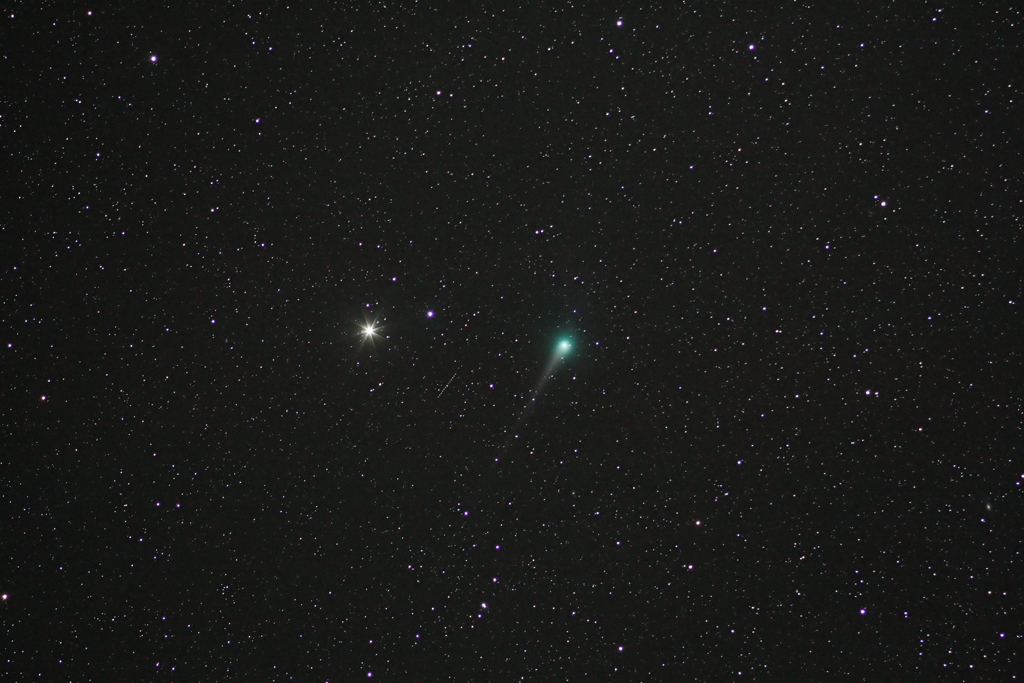
Comet Lulin Appears

Comet Lulin (C/2007 N3) is a comet discovered by Quanzhi Ye, a student at Sun Yat Sen Universty from sky photos taken at Taiwan's Lulin Observatory. About 20 hours ago around 0300 ET in the early morning of Feb 24, the comet made its closest approach to Earth at a distance of 0.41 AU.

The comet appears to be a first time visitor to the inner solar system. The NASA Swift Ultraviolet and X-Ray Explorer has been used to get images of the comet at ultraviolet and x-ray wavelengths. The data from Swift shows that it is shedding water at a rate of 3,000 litres per second (enough to fill an Olympic-sized swimming pool in about 15 minutes), and surrounded by a Jupiter-sized cloud of cyanogen and diatomic carbon, glowing green as these compounds fluoresces in sunlight.


This amazing photo was taken by Joe Wheelock of Fort Davis, Texas, USA, a couple of hours before the closest approach. He has the following notes:

I think I caught a tumbling satellite in between Comet Lulin and Saturn in this picture. Photo Details: Comet Lulin and Saturn Taken on Feb. 24, 2009 (12:05 A.M. CST) with 105mm Sigma telephoto piggybacked on my 16inch F/4.5 Newtonian Telescope Canon XSi DSLR 120sec. exp @ISO 1600 f/3.5. Image processed with Adobe Photoshop CS3, Digital Photo Professional, Blackframe Noise Reduction and Neat Image. In between Saturn and the comet appears to be a tumbling satellite?


The orbital path of Comet Lulin can also be visualized using the small body database maintained by JPL.

Comet Lulin currently has a brightness of visual magnitude +5.5. This level of brightness will drop over time for two reasons - first, due to increasing distance as the comet gets farther away from us. The second reason for a drop in brightness is a change in the amount of light reflected by the comet. As the comet reaches perihelion and starts moving farther from the sun, the amount of material blown off by heat and solar radiation will decrease, and the comet's extended halo and tail will decrease in size resulting in less light being reflected.

At +5.5, Comet Lulin will be difficult to spot in Toronto with the naked eye, although it should be fairly easy to see with binoculars for the next few days. Darker locations away from the middle of a city, like Lake Herridge, or Almonte, or the middle of Saskatchewan will be more ideal.

Wednesday, December 17, 2008

A supercomputer cluster for Christmas

Physorg has an article about two scientists who built a supercomputer using 8 Sony Playstation3 consoles. The instructions for creating your own are here, released under a Free/Open Source license.

So if we can find eight PS3's that no one is doing anything with, we're all set. The other route that we could go is to use older PS2's, which we could get cheap from gamers upgrading to newer/faster hardware. We could build a beowulf cluster using 70 PS2's like the National Center for Supercomputing Applications did a few years back.

Once we get it built, I'm thinking the first problem we can work on is to simulate the massive nuclear explosion at the earth's core that a recent theory postulates as the cause of the moon's formation. This satisfies two goals -- research on something that goes bang, and research on something that might further the Ultimate Goal of World Domination.

Friday, September 12, 2008

More about the Large Hadron Collider

First, the dvice.com website offers 30 incredible photos of the inside of the Large Hadron Collider at CERN. [Thanks to Mike, who provided the link.]

The Montreal Gazette has a pretty good FAQ-type summary of LHC activities. And we learn that there are approximately 20 Montrealers working on the project. We also learn that the accelerator tunnel is about the size of a Montreal Metro (subway) tunnel.

UPDATE INSERTED Sep 14 - Michio Kaku of CUNY in an article in the Wall Street Journal expresses a certain amount of bitterness about the canceled Superconducting Super Collider (SCSC) project from the 1990s: "...As a consequence, Congress guaranteed that leadership in advanced physics would pass from the U.S. to Europe." However, a few sentences later he goes on to say "...While the LHC is outside U.S. jurisdiction, many of its key components come from America...", highlighting the current international nature of high energy physics research. [Note - the SCSC would have reached 40 TeV; the LHC can only reach 14 TeV].

How could I not blog about this next item? Katherine McAlpine aka "AlpineKat" is a news coordinator with the ATLAS Project at the LHC. She created the LHC Rap, the most current internet sensation (at least among geeks) which explains what the Large Hadron Collider is all about:


In the interview transcript which is linked above, McAlpine talks about LHC end-of-the-world scenarios.

I feel compelled to point out, for those who were disappointed that the end of the world did not come on September 10, that on that date only one circulating beam in the LHC got turned on. Sometime later, possibly this weekend or next week, they will turn on the second beam that circulates in the opposite direction. Once they are certain that everything works, and more importantly, that they understand the detectors, then the LHC experiment will move to the next step. That is actually the point at which the doomsayers need to be worried, because then the LHC will bring both beams together, and allow the particles in the two counter-rotating beams to collide. It is those high energy collisions that are the reason for the LHC's existence. It is in observing these collisions that physicists will gain insight into the first instants of the Big Bang. It is also these collisions that should be feared by those who believe in the end of the world.

An article by Ronald Bailey in ReasonOnLine provides an excellent summary of the so-called safety issues around the high energy collisions in the LHC:

While the LHC safety report goes through a number of scenarios, its chief point is that the energies produced in the LHC are "far below those of the highest-energy cosmic-ray collisions that are observed regularly on Earth." In fact, cosmic rays produced by phenomena in the universe "conduct" more than 10 million LHC-like experiments per second. If such energies actually produced vacuum bubbles, microscopic black holes, magnetic monopoles, or strangelets that could destroy planets and stars, physicists wouldn't be here to perform experiments in the LHC now.


With all that said, click here for a live webcam view from the LHC facility itself.

Thank you and good night.

Thursday, September 11, 2008

LHC online - we're still here


The Large Hadron Collider (LHC), located on the border between Switzerland and France, came online at 04:38 Eastern time on the morning of September 10. Here is a brief excerpt from the New York Times article which was filed from Batavia, Illinois at the Fermi National Accelerator Laboratory:
Once upon a time the United States ruled particle physics. For the last two decades, Fermilab’s Tevatron, which hurls protons and their mirror opposites, antiprotons, together at energies of a trillion electron volts apiece, was the world’s largest particle machine.

By year’s end, when the CERN collider has revved up to five trillion electron volts, the Fermilab machine will be a distant second. Electron volts are the currency of choice in physics for both mass and energy. The more you have, the closer and hotter you can punch back in time toward the Big Bang.

Prior to startup, there had been kooky concerns, unfortunately echoed by a less than scientifically literate press, about the possibility of Dire Things Happening. These included the creation of one or more mini black holes in the LHC that would then proceed to swallow the Earth; formation of a nugget of "strange matter" which would convert everything that touched it to strange matter as well; or (my favourite) the LHC would trigger another Big Bang and obliterate the Universe. Yesterday at work, I weighed the odds of the world ending overnight, versus doing the much less interesting updates for the Wednesday morning status meeting, and I chose in favour of doing the updates.

A good thing, too, as none of the disaster scenarios happened. As pointed out by the European Centre for Nuclear Research (CERN) and independent physicists, cosmic rays collide with particles in the upper atmosphere with much higher energies than the LHC is capable of producing. Had any of these disaster scenarios been likely, we would already have been swallowed.

For physicists, the LHC represents an opportunity, perhaps best summarized by Christopher Potter of McGill University in the Globe and Mail's article:
"This is what our entire careers have been building up to: It's the one chance in our generation to answer the biggest questions of science."

That's an inspiring thought to begin a new era in physics research.

Thursday, October 25, 2007

Comet Holmes Becomes Visible

An obscure periodic comet -- Comet Holmes, designated 17P, suddenly brightened by about a factor of one million starting on Wednesday morning, October 24. From about magnitude 18, so dim that only a large telescope at an observatory would be able to detect it, the comet brightened within hours to magnitude 3, visible with the naked eye, even in the skyglow of a major city like Yokohama -- or Toronto, if the cloud cover would just go away.

A constellation schematic of Perseus and a telescopic finder chart are avilable for observers.

P17/Holmes currently has the appearance of a bright yellow star in the constellation Perseus, comparable in apparent brightness to the other major stars in that grouping. The unusual brightening was probably due to material outgassed from the comet nucleus -- very strange given that perihelion passage (closest approach to the sun) happened a few months ago, and the comet is heading back outwards. The comet itself is part of the Jupiter family of comets -- its perihelion falls outside the Earth's orbit, 2.2 AU from the sun. Its aphelion point is way out around the orbit of Jupiter.

In three of my most favourite places -- northern BC, Lake Herridge in northern Ontario, or rural Newfoundland -- the comet should be quite visible under near ideal conditions -- at least if the sky were cloud free. Clouds in fall/winter are definitely a problem. The advent of Comet McNaught back in January was a complete non-starter for us here -- every night that McNaught would have been visible was a night where it was cloudy in Toronto. But hopefully, we will have better luck with P17/Holmes.

Saturday, October 13, 2007

Doctor Robert Bussard Passes Away

Dr. Robert W. Bussard -- physicist, nuclear fusion researcher, inventor of the Bussard ramjet -- passed away last Sunday morning, October 7. The Power and Control blog has further details.

Dr. Bussard invented the idea of the interstellar ramjet in 1960 -- a concept of using magnetic "scoop fields" to collect interstellar hydrogen, which would subsequently be compressed and burned in a nuclear fusion reaction to produce thrust. This idea worked its way into popular culture via novels such as Poul Anderson's Tau Zero (early 1970s), Carl Sagan's Cosmos TV series (1980s), and even on Star Trek (late 1980s to 1990s).

In the last years of his life, Dr. Bussard worked on prototype nuclear fusion reactors using inertial electrostatic confinement (IEC). This work was done for the US DoD and the US Navy. When his funding ran out, he gave a talk at Google which became famous over the internet. A copy of his Google talk may also be obtained via a peer to peer network with an application such as uTorrent.

I have watched Dr. Bussard's presentation a number of times over the last year. It is both compelling and inspiring -- a succinct synthesis of the science behind nuclear fusion, as well as Bussard's own research into the development of an IEC fusion reactor. Bussard acknowledges that IEC devices represent a completely different direction than the large, expensive, tokamak-based devices which are the mainstream of current international nuclear fusion research.

The IEC research is based on physics known since the early half of the twentieth century. If fully realized, Dr. Bussard's work promises to effectively end humanity's reliance on fossil fuels. More importantly, it would make possible space drives capable of moving a spacecraft from Earth to Mars in a week or Earth to Titan in 70 days. Such a drive could also be the first stage acceleration system to get a Bussard ramjet starship to the threshold speed where its scoop fields would be able to pull in enough hydrogen to achieve ignition.