Quite aside from any personally important anniversaries that might have occurred yesterday on October 23, it is important to mark the Judeo-Christian Day of Creation itself, as determined centuries ago by Archbishop James Ussher, a noted biblical scholar 350 years ago.
Although this chronology has fallen out of favour in any mainstream theological sense, and is totally irrelevant in any science-based view of the world, it (or its variations) remain popular with young-Earth creationists like convicted criminal and conspiracy theorist Kent Hovind, the anti-evolution Discovery Institute, or the biblical-literalism promoting Creation Museum. Ussher based his chronology on a synthesis of the most current scientific and historical scholarship available at the time; the explosion of knowledge since then has made science and history incompatible with a literal reading of any of the many versions of the Judeo-Christian bible. It is ironic that those who uphold young-Earth creation ideas can only do so by ignoring Ussher's approach of reconciling the most current science with Biblical scholarship.
For this week only, N1S has been redesignated "the only begotten son", and during the course of the week, there are various significant events to celebrate:
Yesterday on October 23: God creates light ("Let there be light!")[Gen 1:3] The light is divided from the darkness, and "day" and "night" are named. Although yesterday was a Saturday, 4004 BC October 23 fell on a Sunday.
Today, the second day: God creates a firmament ("Let a firmament be...!")[Gen 1:6–7] The firmament is named "skies".
Monday: God commands the waters below to be gathered together in one place, and dry land to appear [Gen 1:9–10]. "Earth" and "sea" are named. God commands the earth to bring forth grass, plants, and fruit-bearing trees. Botanists rejoice!
Tuesday: God creates lights in the firmament [Gen 1:14–15] to separate light from darkness and to mark days, seasons and years. Two great lights are made (most likely the Sun and Moon, but not named), and the stars (including the array of objects ranging from GRB090423 to Andromeda -- all of which in a young-Earth view would have been created with light and radiation already in transit because as we all know, God delights in confounding scientists and leading human thinkers to untruths.
Wednesday: God commands the sea to "teem with living creatures", and birds to fly across the heavens [Gen 1:20–21]. He creates birds and sea creatures, and commands them to be fruitful and multiply. Biologists (particularly marine biologists) should rejoice today. Suggested celebratory dinner to include shrimp. Or better yet, squid.
Thursday, Day 6: God commands the land to bring forth living creatures [Gen 1:24–25]. He makes wild beasts, livestock and reptiles. He then creates humanity in His "image" and "likeness" [Gen 1:26–28]. Humanity, or at least the first two individuals are told to "be fruitful, and multiply, and fill the earth, and subdue it." The totality of creation is described by God as "very good." Thursday night, we are having ribs! As noted previously, October 23 in 4004 BC fell on a Sunday, which would have placed Day 6 on the first Friday after Creation, causing the Sabbath to fall on Saturday, just as it does in the Jewish tradition.
Sunday, October 24, 2010


Friday, October 01, 2010
Contest!

NASA's Goddard Space Flight Center, through its podcast website called Blueshift, has a contest on this week. The prize is a beachball, which has been printed with the WMAP sky image, and signed by Nobel laureate John Mather. How cool is that??
I am a sucker for this sort of thing, so naturally, I entered. I only found out about this today, and the deadline is 5 o'clock ET today. If I win, I will hold the beach ball in my hand and cackle maniacally, something along the lines of "The universe! It's mine, all mine!"
Monday, September 27, 2010
Why spam blogs?
One of the blogs I follow has a recent article on spammers who target blogs: Don't mind me.: Paranoid much?. Becky's questions are similar to my own.
I've encountered blogspam myself a few times, so I sympathize with anyone who has had the experience of clearing out crap from comments. This is the main reason why comment moderation is turned on here.
As to the nature of spam, I sort of understand the premise behind e-mail spam -- at best, it is a sales pitch encouraging the recipient to go to a website for some legitimate product or service. At worse it is an enticement to click on something which will drop some malware on an unsuspecting user's computer, or worse. There are clear analogies between this and traditional junk mail of the sort printed on actual paper and delivered via the Post Office.
But aside from causing me to be enraged, and then sad, and then just puzzled, what was the point of posting a long, sense-free, block of text in the comments on my father's obituary, with no actual working links in it? I thought initially that it was pharma-spam -- some bot had noticed a significant key word (cancer) and this was going to culminate in a link to some dodgy website selling cancer nostrums to the credulous and the desperate. But with no link, there could be no possibility of a sale.
So I have three possible theories to explain this:
Explanation 1 - spammers are just idiots, and whatever bot created the comment spam was improperly written, so it just didn't create a valid link in the post. I'll discuss this further when I have more examples of comment spam to analyze.
Explanation 2 - some blogs, or some blog posts, talk about subjects which displease some agency or organization or individual, who responds by vandalizing the blog or blog post. I love conspiracy theories, so this line of thinking can be tweaked to be as over the top as desired.
Explanation 3 - an artificial intelligence has arisen as an emergent property of the internet. It is trying to communicate, using the most widespread form of internet communication (that being spam) as a model. I like this explanation the best, even though I also suspect it is the least likely.
Sunday, September 26, 2010
The Source of Great Ideas
This is a TED talk by Steven Johnson on the origin of great ideas.
Some thoughts:
(1) stimulants (like tea or coffee) are better than depressants (like beer or wine)
(2) consulting with lots of people is a good thing - connections lead to innovations. Periodic reviews with the team are important - the process of sharing problems and results of current work leads to new, possibly useful juxtapositions.
(3) chaotic environments = collisions between ideas and concepts. "Chance favours the connected mind".
Sunday, September 19, 2010
Arr! We Be Talkin' Like Pirates...
...because today is International Talk Like A Pirate Day! Hope yer cutlass don't rust, and ye find lots 'o booty!
Saturday, September 11, 2010
I blog like an old fuddy duddy. But a happy one...
The urlai website analyzes blog text and evaluates it according to gender, age, mood, and tonality. Here's the verdict on me:
There isn't a heck of a lot of detail about how the evaluation is done, but presumably it is based on word usage analysis. Based on the words I use, this algorithm thinks I am mostly happy, but possibly because of the formality of my sentence construction, thinks I am between 66 to 100. Well, it got the gender right.
Turning this lens on some other examples -- Michael and Jill's Second Draft, as well as Madeline's Escaping The Trunk gets exactly the same evaluation as me, except for the gender -- the algorithm correctly identifies Madeline as female, and believes that the combination of Michael and Jill is also female. Maybe because Jill posts more? The analysis is dead on for Dave -- male, 26 to 50, mostly happy. But for Peter, it gets both the gender and age wrong -- female, 66 to 100, mostly upset. Looking further afield to the blog of a complete stranger -- the age problem and "mostly upset" rating also applies to Pharyngula. Maybe the "mostly upset" part is a marine biologist thing?
These results are dynamic over time, since the analysis is based on the latest articles in the blog. It is possible that I could change the tone and character of my blog and get a different result, so if you are reading this article years after it is written, and you run the same analysis on my blog, you might not get the same result.
You likely can derive information about an author from lexical analysis of their writing, including statistical frequency analysis of their word usage. But these (admittedly limited) results show this analysis needs to used in context with other information. In the meantime, I need to go find some kids so I can yell at them to get off my damn lawn. Because that's what us happy old fuddy duddy bloggers do.
luminosis.blogspot.com is probably written by a male somewhere between 66-100 years old. The writing style is personal and happy most of the time.

There isn't a heck of a lot of detail about how the evaluation is done, but presumably it is based on word usage analysis. Based on the words I use, this algorithm thinks I am mostly happy, but possibly because of the formality of my sentence construction, thinks I am between 66 to 100. Well, it got the gender right.
Turning this lens on some other examples -- Michael and Jill's Second Draft, as well as Madeline's Escaping The Trunk gets exactly the same evaluation as me, except for the gender -- the algorithm correctly identifies Madeline as female, and believes that the combination of Michael and Jill is also female. Maybe because Jill posts more? The analysis is dead on for Dave -- male, 26 to 50, mostly happy. But for Peter, it gets both the gender and age wrong -- female, 66 to 100, mostly upset. Looking further afield to the blog of a complete stranger -- the age problem and "mostly upset" rating also applies to Pharyngula. Maybe the "mostly upset" part is a marine biologist thing?
These results are dynamic over time, since the analysis is based on the latest articles in the blog. It is possible that I could change the tone and character of my blog and get a different result, so if you are reading this article years after it is written, and you run the same analysis on my blog, you might not get the same result.
You likely can derive information about an author from lexical analysis of their writing, including statistical frequency analysis of their word usage. But these (admittedly limited) results show this analysis needs to used in context with other information. In the meantime, I need to go find some kids so I can yell at them to get off my damn lawn. Because that's what us happy old fuddy duddy bloggers do.
Sunday, September 05, 2010
Squid with Hugo

See that? That is one seriously stoked Squidly Dude with his brand new Best Novelette Hugo, and he is clearly making plans for it, likely how to introduce the sharp points on his prize to those American border officials with whom he is most familiar.
Photo credit -- Professor Allan Weiss, who also broke the news about the award this morning. This photo is being used subject to getting Allan's permission, so it might only be temporary.
UPDATE - Jill, Dave, Madeline and Peter himself have blog updates on this event. Peter's entry has lots of photos from Aussiecon 4. You can also read "The Island", Peter's Hugo-award winning story, on his website, or download it as a PDF.
UPDATE 2 - Added 2010 November 23: I did in fact hook up with Allan after he returned from his travels, and he gave me permission to use the photo above.
Congratulations, Peter Watts!
The Hugo Awards website shows that Peter Watts won a Hugo award for "Best Novelette", a story entitled "The Island", appearing in The New Space Opera 2 collection (published by Eos). It is evening in Australia as this is being written, and the Hugo Awards ceremony at Aussiecon 4 has just ended.
Peter is a very talented science fiction writer, in addition to his scientific credentials. The award is well deserved, so congratulations, Peter!
This is perhaps an unworthy thought, but I can't help wondering whether Peter's acceptance speech contained any new and creative uses for his new Hugo award -- specifically on unhelpful border guards...
Tuesday, July 20, 2010
Barbecue Sauce
The summer barbecue season is upon us once agin. I promised a number of people that I would post this year's barbecue sauce recipe, so here it is.

Barbecue pork sauce
4 bottles [282 ml] of Lee Kum Kee char siu sauce (available from your neighbourhood Chinese grocery store, occasionally from Sobey's or Loblaws)
1 bottle of [282 ml] Lee Kum Kee spare rib sauce
Combine the bottles of sauce in a pot under low heat. Use a rubber scraper to get all the sauce out of each bottle. Once emptied, use one of the bottles as a measure and add to the pot:
1 bottle [282 ml] water
1 bottle [282 ml] tomato ketchup (I use Heinz because it is what I have available]
Half a bottle [140 ml] of Chinese cooking wine
Combine and allow the mixture to heat slowly under low heat, stirring constantly.
Add the following to taste:
powdered garlic (could also use minced garlic, and in fact that might provide a better result)
white pepper
onion flakes
allspice (only a couple of pinches necessary)
Leave on low heat until the sauce is smooth and all the powders have been blended in.
Add pork pieces so that each piece of meat is coated. I put between 4 to 6 pieces of meat into a ziplock bag with a scoop or two of the sauce. I marinate the meat for a couple of days (but the meat and sauce combo can also be stored in the freezer for a few weeks). The above quantities make enough barbecue sauce to marinate between 16 to 24 pork tenderloin pieces.
New innovation this year -- prior to cooking, I remove the meat from the bags and place on a foil tray or cookie sheet or something similar. Instead of disposing of the sauce, I put it back into a pot and heat it. Since it has been in contact with raw pork, I heat the sauce until it boils and I keep it on a low boil for 5 to 10 minutes.
The sauce is great with the pork after it has been barbecued. It can also be served with Chinese sausage, which will accentuate the flavour of the meat. Leftover Chinese sausage, plus leftover pork, plus the sauce can be combined into an amzingly nice fried rice dish. I have also used the sauce plus water plus pork bouillion to make a soup stock to serve rice noodles plus beansprouts plus leftover pork.
Barbecuing the pork
Note - your own barbecue may well give different results. The cooking process needs to be calibrated to the barbecue (and possibly the barbecuer).
Do each piece on a hot, preheated barbecue at two minutes on high. Flip, cook another two minutes. Then reduce heat to low, and maintain cooking for the next twenty minutes, opening the barbecue lid and flipping the meat occasionally. You can take the opportunity to "paint" the meat with additional sauce which you have previously set aside for this purpose.
After 20 minutes (total 24 minutes cooking time) you should find that the larger pieces will be somewhat rare (for those who like that sort of thing). Another 10 minutes on the upper rack will allow the meat to reach a tender, near done light pinkness. The meat can be served immediately, but it is better to let it sit for another 10 minutes.
Happy Neilsday 2010
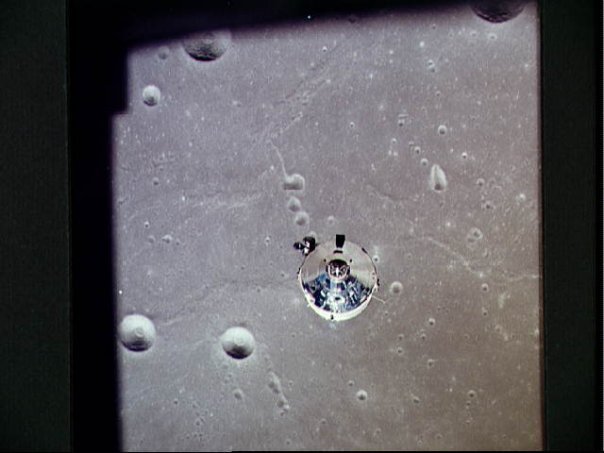
Forty one years ago today, the lunar module Eagle undocked from the command module Columbia. After a brief retrofire engine burn, the Eagle descended toward the Sea of Tranquility, a vast lava plain close to the lunar equator. With fuel running out, and the spacecraft descending toward a boulder field, Neil Armstrong took manual control of the lander and brought it down safely.

Later that evening, at 10:56PM EDT, Armstrong would become the first human to set foot on another celestial body, followed shortly after by fellow crew member Buzz Aldrin.

Forty one years later, the Constellation program, along with the Ares launchers, have been cancelled. America has no firm plan to return to the Moon, and the Canadian Space Agency has no lunar exploration initiative. But there are others who may well take on that challenge -- maybe for the wrong reasons of national pride and international prestige at first, but there is always the hope that the door once reopened won't be closed so hastily again.
Later that evening, at 10:56PM EDT, Armstrong would become the first human to set foot on another celestial body, followed shortly after by fellow crew member Buzz Aldrin.

Forty one years later, the Constellation program, along with the Ares launchers, have been cancelled. America has no firm plan to return to the Moon, and the Canadian Space Agency has no lunar exploration initiative. But there are others who may well take on that challenge -- maybe for the wrong reasons of national pride and international prestige at first, but there is always the hope that the door once reopened won't be closed so hastily again.
Earthquake Aftermath
My back yard in Toronto after the earthquake (but before the G20 protests):

Somewhere behind the upended furniture is a bottle of beer that got partially spilled. Careful observers (at least ones who talked to the photographer) might notice that this shot was staged. Guess they aren't going to be sending me any earthquake relief money...

Somewhere behind the upended furniture is a bottle of beer that got partially spilled. Careful observers (at least ones who talked to the photographer) might notice that this shot was staged. Guess they aren't going to be sending me any earthquake relief money...
Wednesday, June 23, 2010
Earthquake!
The earth moved! About ten or fifteen minutes ago, a small tremor passed through Toronto. I noticed it because my rack of disk drives started shaking, and making ticking sounds of metal under stress (the rack, not the disk drives)!
Update 1: According to the National Post blog, the tremor was felt as far away as Ottawa, Montreal, and Cleveland. According to the USGS in the same blog post, the magnitude was in the mid 4's.
Update 2: The United States Geological Survey reports on their website that the earthquake occurred at 17:41:41 UTC about 39 km north of Cumberland, ON close to the Ontario/Quebec border. This puts it around 13:41 EDT, with a slight delay before reaching Toronto. At the time, I didn't think to check the system clock on my computer. Knowing the time delay, and determining the distance from Google Maps or Google Earth, we could calculate the propagation speed of the shock wave through (mostly) shield rock. The intensity was magnitude 5.5 [changed to 5.0 on a subsequent viewing] higher than the mid 4's that I reported earlier. The USGS seismometer data also places the epicentre of the quake quite deep -- about 17 kilometers [change to 18].
Update 3: Map of epicentre location:
View Larger Map
Update 4: The Globe and Mail's blog has extensive reporting from all over the province. Various Facebook updates, as well as the verbal report of my son, indicate that offices and classrooms were briefly evacuated - a prudent move in the face of what is described as a "moderate" intensity earthquake. There are reports of a bridge (Barrage McLaren) damaged close to the epicentre, and another bridge near Bowman, PQ, closed. There have been no other damage reports so far as of 17:45, but some government facilities in Ottawa are closed. Ottawa is built on ground which can potentially amplify the effect of an earthquake, and reports (again via Facebook) from friends living there indicate that the intensity was a lot greater for them than for me. Rumours that a tsunami warning was issued for the artificial lake constructed for this week's G20 summit meeting are entirely unfounded [yes, now I am just being silly].
Summer Solstice Blues Averted!
The summer solstice in the Northern Hemisphere occurred a couple of days ago on June 21 -- longest day of the year here, and of course for the Southern Hemisphere, the shortest. I always feel a twinge on June 21, because the nights start getting longer again. But this year, I had something new to think about -- in the lead up to June 21, a number of people sent me the following e-mail:
The e-mail came with a photo:

The photo itself seems to have been inspired by the sunset on Tatooine sequence in the first-ever Star Wars movie (Episode 4 - A New Hope). It is, as you might expect, a product of the photoshopper's art, and not at all based ion reality. (Did you see two suns in the sky on June 21, or on any of the 11 days leading up to it??) The HTML in the e-mail has embedded text which reads "Fun & Info @ Keralites.net". Keralites.net actually exists, and appears to be a site promoting the state of Kerala, which is in India. Clicking on a couple of links led to dead ends, so it doesn't look like keralites.net has any significant content that I want to be looking for.
Notwithstanding the fact that I received this e-mail from respected sources, the content is total crap. (You really didn't see two suns in the sky on June 21, did you??)
What I find interesting is that people who are knowledgeable and canny are still taken in by junk like this, probably because the sky and astronomical matters in general are increasingly foreign to urban people.
Snopes, as usual, was right on top of this one. The following snippet is my favourite piece of their article:
The disconnect with the night sky in the majority of people in our modern society can likely be attributable, at least in part, to artificial lighting which makes it impossible for us to see the sky clearly at night.
But, whatever the source of the disconnect, one consequence of it is that nonsense like the "Aderoid" story gets circulated. And even more egregiously, the seeds are sown for the credulous to be taken in by more dangerous nonsense like Zecharia Sitchin's modern attempt to revive the lunacy of Immanuel Velikovsky and Erich von Daniken. Sitchin's books are likely one of the elements driving the belief in an apocalypse in 2012, a belief sufficiently widespread that NASA felt compelled to put up an educational web page about it.
This year, I spent a quiet summer solstice with my family, under a sky with only one sun. Nothing potentially world ending happened, unless you count my inability to locate my favourite chip dip.
Please watch this on 21st June
SHARE THIS WITH YOUR FRIENDS, AS NO ONE ALIVE TODAY WILL EVER SEE IT AGAIN. Two Suns on 21th June 2010
21st June - the Whole World is waiting for.............
Star Aderoid will be the brightest in the sky, starting 10 June. It will look as large as the sun from naked eye. This will culminate on 21stjune when the star comes within 34.65M miles of the earth. Be sure to watch the sky on june. 21 at 12:30 pm. It will look like the earth has 2 suns.!!
The next time Aderoid may come this close is in 2287
The e-mail came with a photo:

The photo itself seems to have been inspired by the sunset on Tatooine sequence in the first-ever Star Wars movie (Episode 4 - A New Hope). It is, as you might expect, a product of the photoshopper's art, and not at all based ion reality. (Did you see two suns in the sky on June 21, or on any of the 11 days leading up to it??) The HTML in the e-mail has embedded text which reads "Fun & Info @ Keralites.net". Keralites.net actually exists, and appears to be a site promoting the state of Kerala, which is in India. Clicking on a couple of links led to dead ends, so it doesn't look like keralites.net has any significant content that I want to be looking for.
Notwithstanding the fact that I received this e-mail from respected sources, the content is total crap. (You really didn't see two suns in the sky on June 21, did you??)
What I find interesting is that people who are knowledgeable and canny are still taken in by junk like this, probably because the sky and astronomical matters in general are increasingly foreign to urban people.
Snopes, as usual, was right on top of this one. The following snippet is my favourite piece of their article:
An object as large as a star approaching the Earth would not suddenly appear at a particular hour of a given day and then be gone; if would be visible over an extended period of time.
If a star were truly about to pass within 35 million miles of Earth, the preparations we'd be undertaking would be to get ready to meet our makers and not to marvel at the beauty of the phenomenon, as the results would be catastrophic. By way of comparison, the Earth is 93 million miles from the Sun, while the planet Mercury orbits the Sun at an average distance of 36 million miles. If a star comparable to our Sun were to travel within 34.65 million miles of the Earth, our planet would quickly become like Mercury: a barren, lifeless, deep-fried hunk of rock.
The disconnect with the night sky in the majority of people in our modern society can likely be attributable, at least in part, to artificial lighting which makes it impossible for us to see the sky clearly at night.
But, whatever the source of the disconnect, one consequence of it is that nonsense like the "Aderoid" story gets circulated. And even more egregiously, the seeds are sown for the credulous to be taken in by more dangerous nonsense like Zecharia Sitchin's modern attempt to revive the lunacy of Immanuel Velikovsky and Erich von Daniken. Sitchin's books are likely one of the elements driving the belief in an apocalypse in 2012, a belief sufficiently widespread that NASA felt compelled to put up an educational web page about it.
This year, I spent a quiet summer solstice with my family, under a sky with only one sun. Nothing potentially world ending happened, unless you count my inability to locate my favourite chip dip.
Sunday, June 06, 2010
I want one
Let me be on record with my intention that the next time I have $4 million in mad money, I am getting one of these babies .  Except that I would want extensive modifications. I would want a Bussard powerplant, when such a device becomes available. The Bussard powerplant would produce electricity, so the diesel engines would need to be stripped and replaced with electrical engines. That should improve overall performance, and should definitely improve stealth in the water. Might be good for sneaking up on whales. Or squids. Effectively unlimited electrical power would also mean that the vehicle needs equipment to make oxygen from seawater, which would definitely improve its underwater range.
And, oh yeah -- I'd also want a space drive installed. It is just too bad that the current state of knowledge about dynamics is essentially unchanged from Newton's time, and precludes any space drive that isn't dependent on the rocket principle.
So the space drive would need to be non-reaction-based technology. After all, why would you want a cool-looking vehicle like this spoiled** by being stuck onto a fuel tank hundreds of times larger than the vehicle itself? That requirement may be the deal breaker, because with that in place, the investment is going to be more than $4 million. Always assuming that the laws of physics permit such a thing: centuries of hopeful inquiry have provided not one iota of a hint that it is possible to move in space without applying the reaction principle.
In the meantime, maybe the boat, in submarine mode, could be used to fund the space drive research by being used as a courier for high value goods that need to be moved from production sites in South America to their markets in North America. What do you want to bet that some prospective buyers have just such business models in mind?
====================
** I have similar feelings about many sports cars. Every darn one of them is spoiled by the need to be on wheels. Anything that looks that good needs to float 40 centimeters off the ground.
 Except that I would want extensive modifications. I would want a Bussard powerplant, when such a device becomes available. The Bussard powerplant would produce electricity, so the diesel engines would need to be stripped and replaced with electrical engines. That should improve overall performance, and should definitely improve stealth in the water. Might be good for sneaking up on whales. Or squids. Effectively unlimited electrical power would also mean that the vehicle needs equipment to make oxygen from seawater, which would definitely improve its underwater range.
And, oh yeah -- I'd also want a space drive installed. It is just too bad that the current state of knowledge about dynamics is essentially unchanged from Newton's time, and precludes any space drive that isn't dependent on the rocket principle.
So the space drive would need to be non-reaction-based technology. After all, why would you want a cool-looking vehicle like this spoiled** by being stuck onto a fuel tank hundreds of times larger than the vehicle itself? That requirement may be the deal breaker, because with that in place, the investment is going to be more than $4 million. Always assuming that the laws of physics permit such a thing: centuries of hopeful inquiry have provided not one iota of a hint that it is possible to move in space without applying the reaction principle.
In the meantime, maybe the boat, in submarine mode, could be used to fund the space drive research by being used as a courier for high value goods that need to be moved from production sites in South America to their markets in North America. What do you want to bet that some prospective buyers have just such business models in mind?
====================
** I have similar feelings about many sports cars. Every darn one of them is spoiled by the need to be on wheels. Anything that looks that good needs to float 40 centimeters off the ground.
Thursday, June 03, 2010
Catchup
...or maybe ketchup. The latter would be what you slather on hot dogs, the former is for bloggers who who didn't do anything since late April.
April and May included a couple of events at the Merril Collection, the 11th birthday of N1S (10th birthday and 8th birthday reported previously), a party to celebrate Peter Watts' freedom, as well as the anniversary of the adventure in marriage that Jill and I embarked upon eighteen years ago. Pictures of all of this and more to follow in the next few days. Or weeks. Or months.
Ketchup on hot dogs and catchup in blogs are both tangy and sweet, one spicing up food, but the other -- ah, the other -- the catchup in this blog is like adding texture to memory. But let's be clear that I am not anxious to reread this blog through the veil of the hopefully hypothetical Alzheimers of my incipient dotage...
Monday, April 26, 2010
Peter Watts Sentencing - No Jail Time
Good news -- we heard a few minutes ago from Dave Nickle at Peter's sentencing hearing in Port Huron, MI that Peter won't be sent to jail. My understanding from Dave's partner Karen who relayed the news is that Peter was lectured extensively by the judge about how it is important to be nice to the police, and Peter will have to pay a fine. But no jail time, which is substantially better than the gloomy predictions we were making last week!
Dave and Madeline are going out for a beer with Doug Mulkoff, Peter's lawyer, and a group of other supporters. They'll be home in 5-6 hours, so expect first hand updates later this evening.
UPDATE - Dave has posted an initial report from the Quay Street Brewing Company.
The Port Huron Times-Herald had this on their website today:
Although the Times-Herald, in keeping with their past performance, tries to cast Peter in the most negative possible light, I want to make it clear that Peter was cleared of the assault charge. The officer who "testified at trial that Watts tried to choke him" had his testimony discredited during the trial by an independent witness. No assault by Peter ever took place, although Peter himself was assaulted by being punched, pepper sprayed, and knocked to the ground.
Peter was convicted of non-compliance with the orders of the border officer. The jury evidently believed that being punched and pepper sprayed should not have affected Peter's ability to follow those orders. Peter talks about that on his blog.
Both NewsFix and Quill & Quire have news coverage that more accurately reflects actual events than the Port Huron Times-Herald. However, it is the Simple Justice blog of Scott H. Greenfield which provides the most succinct analysis of Peter's travails:
There is no justice. It is all about maintaining order and conformity, because the system needs order and conformity. The Japanese aphorism about the nail that sticks out being hammered down is entirely apropos. What, you thought living in a democracy entitled you to more or less equal power relationships with officials? The people wearing the jackboots want you to remember that.
Dave and Madeline are going out for a beer with Doug Mulkoff, Peter's lawyer, and a group of other supporters. They'll be home in 5-6 hours, so expect first hand updates later this evening.
UPDATE - Dave has posted an initial report from the Quay Street Brewing Company.
The Port Huron Times-Herald had this on their website today:
Author Watts to be sentenced today
A Toronto author convicted March 19 of assaulting, resisting and obstructing a border officer at the Blue Water Bridge is expected to be sentenced today. Peter Watts is scheduled to be in St. Clair County Circuit Judge James Adair's courtroom at 2 p.m. Information his online court record shows the recommended sentence is 180 days in jail with credit for one day served and 60 days suspended upon payment of $1,600 in fines and costs. A jury found Watts guilty of refusing to comply with orders during a random inspection at the bridge. An officer testified at trial that Watts tried to choke him.
Although the Times-Herald, in keeping with their past performance, tries to cast Peter in the most negative possible light, I want to make it clear that Peter was cleared of the assault charge. The officer who "testified at trial that Watts tried to choke him" had his testimony discredited during the trial by an independent witness. No assault by Peter ever took place, although Peter himself was assaulted by being punched, pepper sprayed, and knocked to the ground.
Peter was convicted of non-compliance with the orders of the border officer. The jury evidently believed that being punched and pepper sprayed should not have affected Peter's ability to follow those orders. Peter talks about that on his blog.
Both NewsFix and Quill & Quire have news coverage that more accurately reflects actual events than the Port Huron Times-Herald. However, it is the Simple Justice blog of Scott H. Greenfield which provides the most succinct analysis of Peter's travails:
Like Cory Doctorow, I agree completely that Peter Watts' conviction is absurd and horrible. He was convicted for acting like a normal person under abnormal circumstances. He was convicted for lacking the understanding that when interacting with officials with guns and shields, one bows deeply like a supplicant, just to avoid irritating small minds.
There is no justice. It is all about maintaining order and conformity, because the system needs order and conformity. The Japanese aphorism about the nail that sticks out being hammered down is entirely apropos. What, you thought living in a democracy entitled you to more or less equal power relationships with officials? The people wearing the jackboots want you to remember that.
Weapons of Mass Distraction
Being a peaceful kind of guy, I am deeply concerned by yet another instance of weaponization, although in the spirit of scientific inquiry, I am closely following today's experiment.
Earlier this month, senior officials in the Middle East definitively identified an earthquake initiator (earlier reports here and here) which others were quick to exploit. This is the experiment which I noted earlier and which is scheduled for today, an experiment that proposes widespread attempts to induce earthquake events.
If the initial premise is correct, there is enough evidence to suggest that large portions of North America are in serious trouble, and a strong likelihood that Sydney, Australia may be swallowed by the Pacific Ocean in a seismic event that would be unprecedented in human recorded history.
In the past, similarly credible links have been made to hurricanes, although today's experiment is the first time that I am aware of where actual testing will be done. For the sake of science, I urge people to observe, and wait for the earth to move.
Saturday, April 24, 2010
Hubble is 20 Years Old!
I've been married for almost as long as the Hubble Space Telescope has been in orbit.
But talk about schedule creep. After delays in construction on a project conceived in 1969 as the "Large Space Telescope", and approved in 1977, the Hubble space telescope was finally completed by the mid 1980's, and scheduled for launch in October 1986. But then the Challenger disaster happened in January 1986 and the shuttle fleet was grounded in the aftermath of Challenger's loss. Over four years after the accident, space shuttle Discovery finally took the Hubble Space Telescope into orbit on April 24, 1990 -- twenty years ago today.
Mission STS-31 was the tenth launch of the shuttle Discovery. On board were Mission Commander Loren Shriver (replacing John Young, the originally assigned commander), Pilot Charles Bolden, and Mission Specialists Bruce McCandless, Steven Hawley, and Kathryn Sullivan. Hubble was deployed in a 380 statute mile (612 km) orbit, a record orbital altitude for shuttle missions, in order that the HST could be released near its operational altitude well above the atmosphere. The height ensured that there would be no atmospheric interference for its optics, and minimal atmospheric resistance to affect its orbit.
Shortly after the telescope was launched and saw first light in orbit, it became clear that there was a serious problem with the main mirror. Manufactured by Perkin-Elmer Corporation, the mirror had a flaw called "spherical aberration" that caused all images to be fuzzy. This problem was fixed on the first servicing mission in 1994 with a device called COSTAR -- Corrective Optics Space Telescope Axial Replacement -- which remained in place until the fourth servicing mission in 2009, by which time all Hubble instruments had built-in corrective optics. [Note: There were four servicing missions, but five actual servicing mission shuttle flights, since servicing mission 3 was performed over the course of two flights.]
During the telescope's lifetime, perhaps one of the most important images obtained by Hubble was the so-called "Deep Field" composite.

This material was presented to the 187th meeting of the American Astronomical Society in San Antonio, Texas on January 15, 1996.
Several hundred never before seen galaxies are visible in this "deepest-ever" view of the universe. Besides the classical spiral and elliptical shaped galaxies, there is a bewildering variety of other galaxy shapes and colors that are important clues to understanding the evolution of the universe. Some of the galaxies may have formed less that one billion years after the Big Bang.
Representing a narrow "keyhole" view all the way to the visible horizon of the universe, the HDF image covers a speck of sky 1/30th the diameter of the full Moon (about 25% of the entire HDF is shown in the image above). This is so narrow, just a few foreground stars in our Milky Way galaxy are visible and are vastly outnumbered by the menagerie of far more distant galaxies, some nearly as faint as 30th magnitude, or nearly four billion times fainter than the limits of human vision. (The relatively bright object with diffraction spikes just left of center may be a 20th magnitude star.) Though the field is a very small sample of sky area it is considered representative of the typical distribution of galaxies in space because the universe, statistically, looks the same in all directions.
The image was assembled from many separate exposures (342 frames total were taken, 276 were fully processed and used for this picture in 1996) with the Wide Field and Planetary Camera 2 (WFPC2), for ten consecutive days between December 18 to 28, 1995. This picture is from one of three wide-field CCD (Charged Coupled Device) detectors on the WFPC2. This "true-color" view was assembled from separate images were taken in blue, red, and infrared light. By combining these separate images into a single color picture, astronomers will be able to infer — at least statistically — the distance, age, and composition of galaxies in the field. Bluer objects contain young stars and/or are relatively close, while redder objects contain older stellar populations and/or farther away.
In 2007, while doing routine mapping of the distribution of dark matter within the galaxy cluster Cl 0024+17 (ZwCl 0024+1652), located 5 billion light-years from Earth, astronomers got an unexpected first-hand view of how dark matter behaves during a titanic collision between two galaxy clusters. The interaction created a ripple of dark matter, which is somewhat similar to a ripple formed in a pond when a rock hits the water. The ring's discovery is among the strongest evidence yet that dark matter exists.
 Credit: NASA, ESA, M.J. Jee and H. Ford (Johns Hopkins University)
Astronomers have long suspected the existence of dark matter -- a hypothesized invisible substance -- as being the source of the additional gravity that is needed to hold together galaxies and galaxy clusters. Such objects would fly apart if they relied only on the gravity from their visible stars. Although astronomers don't know what dark matter is made of, they believe that it is a type of elementary particle that pervades the universe. Over the next decade, results from the Large Hadron Collider will provide more insight into this question.
A ring-like structure is evident in a composite image of the cluster made from Hubble observations. The ring can be seen in the blue map of the cluster’s dark matter distribution, which is superimposed on an image of the cluster. This is the first time that dark matter was detected, having a unique structure different from the gas and galaxies in the cluster.The ring measures 2.6 million light-years across.
The last photo below was taken after the fourth and final servicing mission in 2009, which repaired and upgraded Hubble so that it is expected to be functional until at least 2013, and likely much later. Although NASA originally intended to return the telescope to Earth for display in the Smithsonian, Hubble will actually outlast the remaining service lifetime of the shuttle fleet, now expected to end in September of this year.

So happy 20th birthday, Hubble! We hope you can provide us with many more years of incredible imagery out to the edge of the Universe.
Update: BoingBoing has a review of a stunning new book -- Hubble: A Journey Through Space and Time by Edward J. Weiler, published by Abrams in collaboration with NASA. Much better pictures there.
But talk about schedule creep. After delays in construction on a project conceived in 1969 as the "Large Space Telescope", and approved in 1977, the Hubble space telescope was finally completed by the mid 1980's, and scheduled for launch in October 1986.
 But then the Challenger disaster happened in January 1986 and the shuttle fleet was grounded in the aftermath of Challenger's loss. Over four years after the accident, space shuttle Discovery finally took the Hubble Space Telescope into orbit on April 24, 1990 -- twenty years ago today.
Mission STS-31 was the tenth launch of the shuttle Discovery. On board were Mission Commander Loren Shriver (replacing John Young, the originally assigned commander), Pilot Charles Bolden, and Mission Specialists Bruce McCandless, Steven Hawley, and Kathryn Sullivan. Hubble was deployed in a 380 statute mile (612 km) orbit, a record orbital altitude for shuttle missions, in order that the HST could be released near its operational altitude well above the atmosphere. The height ensured that there would be no atmospheric interference for its optics, and minimal atmospheric resistance to affect its orbit.
Shortly after the telescope was launched and saw first light in orbit, it became clear that there was a serious problem with the main mirror. Manufactured by Perkin-Elmer Corporation, the mirror had a flaw called "spherical aberration" that caused all images to be fuzzy. This problem was fixed on the first servicing mission in 1994 with a device called COSTAR -- Corrective Optics Space Telescope Axial Replacement -- which remained in place until the fourth servicing mission in 2009, by which time all Hubble instruments had built-in corrective optics. [Note: There were four servicing missions, but five actual servicing mission shuttle flights, since servicing mission 3 was performed over the course of two flights.]
During the telescope's lifetime, perhaps one of the most important images obtained by Hubble was the so-called "Deep Field" composite.

This material was presented to the 187th meeting of the American Astronomical Society in San Antonio, Texas on January 15, 1996.
Several hundred never before seen galaxies are visible in this "deepest-ever" view of the universe. Besides the classical spiral and elliptical shaped galaxies, there is a bewildering variety of other galaxy shapes and colors that are important clues to understanding the evolution of the universe. Some of the galaxies may have formed less that one billion years after the Big Bang.
Representing a narrow "keyhole" view all the way to the visible horizon of the universe, the HDF image covers a speck of sky 1/30th the diameter of the full Moon (about 25% of the entire HDF is shown in the image above). This is so narrow, just a few foreground stars in our Milky Way galaxy are visible and are vastly outnumbered by the menagerie of far more distant galaxies, some nearly as faint as 30th magnitude, or nearly four billion times fainter than the limits of human vision. (The relatively bright object with diffraction spikes just left of center may be a 20th magnitude star.) Though the field is a very small sample of sky area it is considered representative of the typical distribution of galaxies in space because the universe, statistically, looks the same in all directions.
The image was assembled from many separate exposures (342 frames total were taken, 276 were fully processed and used for this picture in 1996) with the Wide Field and Planetary Camera 2 (WFPC2), for ten consecutive days between December 18 to 28, 1995. This picture is from one of three wide-field CCD (Charged Coupled Device) detectors on the WFPC2. This "true-color" view was assembled from separate images were taken in blue, red, and infrared light. By combining these separate images into a single color picture, astronomers will be able to infer — at least statistically — the distance, age, and composition of galaxies in the field. Bluer objects contain young stars and/or are relatively close, while redder objects contain older stellar populations and/or farther away.
In 2007, while doing routine mapping of the distribution of dark matter within the galaxy cluster Cl 0024+17 (ZwCl 0024+1652), located 5 billion light-years from Earth, astronomers got an unexpected first-hand view of how dark matter behaves during a titanic collision between two galaxy clusters. The interaction created a ripple of dark matter, which is somewhat similar to a ripple formed in a pond when a rock hits the water. The ring's discovery is among the strongest evidence yet that dark matter exists.
 Credit: NASA, ESA, M.J. Jee and H. Ford (Johns Hopkins University)
Astronomers have long suspected the existence of dark matter -- a hypothesized invisible substance -- as being the source of the additional gravity that is needed to hold together galaxies and galaxy clusters. Such objects would fly apart if they relied only on the gravity from their visible stars. Although astronomers don't know what dark matter is made of, they believe that it is a type of elementary particle that pervades the universe. Over the next decade, results from the Large Hadron Collider will provide more insight into this question.
A ring-like structure is evident in a composite image of the cluster made from Hubble observations. The ring can be seen in the blue map of the cluster’s dark matter distribution, which is superimposed on an image of the cluster. This is the first time that dark matter was detected, having a unique structure different from the gas and galaxies in the cluster.The ring measures 2.6 million light-years across.
The last photo below was taken after the fourth and final servicing mission in 2009, which repaired and upgraded Hubble so that it is expected to be functional until at least 2013, and likely much later. Although NASA originally intended to return the telescope to Earth for display in the Smithsonian, Hubble will actually outlast the remaining service lifetime of the shuttle fleet, now expected to end in September of this year.

So happy 20th birthday, Hubble! We hope you can provide us with many more years of incredible imagery out to the edge of the Universe.
Update: BoingBoing has a review of a stunning new book -- Hubble: A Journey Through Space and Time by Edward J. Weiler, published by Abrams in collaboration with NASA. Much better pictures there.
Sunday, April 18, 2010
Force Projection 3
This is a follow-up to earlier posts --
Force Projection, 2009 March 1
Force Projection 2, 2009 July 30
As discussed in the two earlier posts, the Chinese Navy has had a continuous presence in the Gulf of Aden since January 2009. My belief was that the Somali ant=piracy mission was an opportunity for the Chinese Navy to gain operational experience in international waters, as well as to observe the operational posture and procedures of other navies. Dr. J. Peter Pham has a column in the World Defense Review blog analyzing this position. The article dates back to March 2009, so it is a year old.
To recap -- the Chinese anti-piracy mission mission began on December 26, 2008 when the first flotilla left the naval base at Hainan Island, bound for the Gulf of Aden. This task force consisted of two missile-armed destroyers -- Haikou DDG-171 and Wuhan DDG-169 -- along with the supply ship Weishanhu.
On April 15, 2009, Wuhan and Haikou handed off to the second flotilla, consisting of the destroyer Shenzhen DDG-167 and frigate Huangshan FFG-570. The supply ship Weishanhu remained behind to provide logistics support.
A third force left Hainan Island on July 16, 2009. The guided missile frigates Zhoushan FFG-529 and Xuzhou FFG-530 along with the supply ship, Qiandaohu replaced all three of the ships on station in the Gulf of Aden. On November 1, 2009, Rear Admiral Wang Zhiguo hosted US Navy Rear Admiral Scott Sanders, the commander of the internationally constituted Combined Task Force 151, and members of Sanders' staff on board Zoushan.
Admiral Wang's problems during his tour included the capture by Somali pirates of the Chinese freighter De Xin Hai, a headache which he was able to hand to his successor. The missile frigates Ma'anshan FFG-525 and Wenzhou FFG-526 replaced Zhoushan and Xuzhou on November 12, 2009. On December 21, the missile frigate Chaohu FFG-568 joined the fourth flotilla, and a week later on December 27, a $4 million dollar ransom was paid to the Somali pirates for 25 hostages and the freighter De Xin Hai. It is assumed that Chaohu brought the ransom money.
On March 18, 2010, a handover ceremony was conducted on Ma'anshan to turn over operational responsibility to the fifth flotilla: missile destroyer Guangzhou DDG-168 and the supply ship Weishanhu joined the frigate Chaohu, relieving Ma'anshan, Wenzhou and Qiandaohu. On their way home, the three ships of the fourth flotilla were in Manila in the Philippines last week (April 13 to 17), on a five day port call, done apparently at the invitation of the Philippine Navy..

Of note for monitoring continuing operations is the fact that Weishanhu is now back in the Gulf of Aden for her second tour of duty. It appears that surface combatant vessels operate for 3 to 4 months, but the accompanying supply ship operates for 6 to 8 months. Thus far, both supply ships used to date have been units of the Qiandaohu class. Weishanhu (pennant number 887) supported the first and second flotillas, and is currently doing the same for the fifth. Qiandaohu (pennant number 886) supported the third and forth flotillas on a long (nearly eight month) deployment. There is reportedly a third ship in this class (NATO refers to it as the Fuchi class), but that ship has not been used. These ships also have their own complement of special forces troops and enough weaponry to deter attacks from pirates.
Since the Chinese Navy joined the UN anti-piracy mission in late 2008, Chinese warships have, as of the beginning of March 2010, escorted a total of 1,643 ships of various nationalities, and rescued 23 vessels from direct pirate attack. According to official Chinese government figures, more than 30 percent of China's foreign trade takes place via the Gulf of Aden route, which explains the continuing interest and ongoing commitment to providing military security.
A Belated Yuri's Night Observance
Today is the 18th, and I am 6 days overdue in blogging about Yuri's Night, the annual celebration of Yuri Gagarin's space flight on April 12, 1961 -- 49 years ago, the day when the first human being travelled beyond the Earth's atmosphere into outer space.
On Yuri's Night, 2010, there were 13 people in orbit -- one more than all the cosmonauts and astronauts who flew in the Vostok and Mercury programmes combined.
Expedition 23 on the International Space Station consisted of six people -- Mission Commander Oleg Kotov (RKA), T.J. Creamer (NASA), Soichi Noguchi (JAXA), Tracy Caldwell Dyson (NASA), Alexander Skvortsov (RKA) and Mikhail Kornienko (RKA).
At the same time, space shuttle Discovery, flying on mission STS-131 and docked at the space station from a week earlier, had seven people on board -- Commander Alan Poindexter, Pilot James P. Dutton Jr., Mission Specialists Dorothy Metcalf-Lindenburger, Stephanie Wilson, Rick Mastracchio, Clayton Anderson (all with NASA) and Naoko Yamazaki (JAXA).
Gagarin, first man in space, would have appreciated that 49 years later, there are still firsts being achieved. On this occasion, the first time that four women were in space at the same time (Caldwell Dyson, Metcalf-Lindenburger, Wilson, Yamazaki) and the first time that two Japanese astronauts were in space together (Noguchi, Yamazaki).
Subscribe to:
Posts (Atom)

 Posts


