Showing posts with label Space. Show all posts

Sunday, December 19, 2010

Dark Matter Ring

This question came up in a family discussion recently: if dark matter is, well, dark and current theory says it doesn't interact with normal matter, then how can it actually be detected? And the answer is that the dark matter isn't detected -- it is inferred from other obser- vations. This photo [Credit: NASA/ESA, M. J. Jee & H. Ford et al. (Johns Hopkins University)] of the galaxy cluster CL0024+17 in the constellation Pisces shows, in addition to galaxies that are part of the cluster, a series of repeated images of background galaxies that were created by gravitational lensing.

This lensing effect is caused by light being bent by travelling through a region where there is strong gravity before reaching us. Some analogies can be set up using everyday objects, such as looking at distant streetlights through a wine glass.

In the case of the cluster in the photograph, the lensing does not occur immediately around the edge of the cluster itself, as one might expect, but in a ring some distance away from the centre of the cluster itself. The lensing (bending of light) is being done by the gravitation associated with unseen mass. Based on the amount of lensing, a computer model was developed to determine the location of the unseen mass, which has been coloured blue in the photograph.

Here is a video which explains further, including some discussion on the origin of the ring (which at 2.5 million light years across is comparable to the distance from the Milky Way to Andromeda):

Flight of the Dragon: Animation

The first flight of the SpaceX Dragon spacecraft was an unmanned test vehicle last week on December 8. However, the ultimate goal is a human rated spacecraft. Here is a SpaceX animation showing the mission profile of a Dragon vehicle carrying a crew to the ISS:


Here is another version with a techno soundtrack:


In watching these videoe, I can't help but be struck by how similar this mission profile is to the first manned missions into space 50 years -- half a century -- earlier: launch, ascent, drop booster stages, conduct mission, drop service module, re-enter, splashdown, recover by helicopter. This technology is unsustainable even if this does happen to be the most inexpensive launcher/spacecraft combination ever built -- too much of the launcher (upper stage) and spacecraft (service module) are thrown away. Haven't we learned anything in 50 years of doing this?

Thursday, December 09, 2010

The Dragon Touches The Sky

Earlier this week, NASA announced that the last two shuttle missions, to be flown on Discovery and Endeavour, have been delayed until next year. But in the meantime, a historic first has occurred: a private company -- Space Exploration Technologies, Inc. or SpaceX -- has built, launched, and recovered a spacecraft from Earth orbit. The first Dragon spacecraft was placed into low Earth orbit yesterday by a SpaceX Falcon 9 launch vehicle, which lifted off from Cape Canaveral.

The first stage of the Falcon launcher was recovered from the Atlantic, and the Dragon spacecraft made several orbits before it re-entered the atmosphere and splashed down safely in the Pacific.

Previously, spacecraft development and launch were only within reach of national or supra-national entities -- Russia, the United States, China, Japan, India, and the European Union. Now SpaceX has joined this exclusive club, the first corporation to do so.

Initial plans are to use the Dragon vehicle in cargo-carrier configuration to ferry supplies to the International Space Station to fulfill the terms of the resupply contract that NASA has awarded to SpaceX. But cargo resupply is a stepping stone -- the ultimate goal is to build a human-rated version of Dragon which will carry up to seven astronauts.

With the uncertainty in the Constellation program and in the development of the Orion crew vehicle, it is likely that Dragon will be the de facto next generation spacecraft.


Although Dragon's stated purpose is to carry astronauts and supplies to the International Space Station, other missions for which the Orion was being considered may be possible with Dragon -- lunar orbit, lunar landing (with a lander to be developed), asteroid rendezvous, and others as needs are identified.


A movie showing a simulated rendezvous and docking with the ISS provides a window into the current thinking of SpaceX in terms of the bread-and-butter of being a service provider. However, it is not outside the realm of possibility that some variant of the Heinleinian vision of The Man Who Sold The Moon may still come true.

Friday, October 01, 2010

Contest!


NASA's Goddard Space Flight Center, through its podcast website called Blueshift, has a contest on this week. The prize is a beachball, which has been printed with the WMAP sky image, and signed by Nobel laureate John Mather. How cool is that??

I am a sucker for this sort of thing, so naturally, I entered. I only found out about this today, and the deadline is 5 o'clock ET today. If I win, I will hold the beach ball in my hand and cackle maniacally, something along the lines of "The universe! It's mine, all mine!"

Tuesday, July 20, 2010

Happy Neilsday 2010

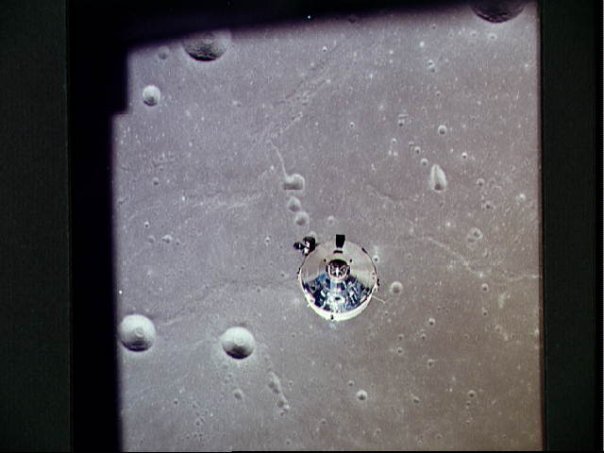
Forty one years ago today, the lunar module Eagle undocked from the command module Columbia. After a brief retrofire engine burn, the Eagle descended toward the Sea of Tranquility, a vast lava plain close to the lunar equator. With fuel running out, and the spacecraft descending toward a boulder field, Neil Armstrong took manual control of the lander and brought it down safely.

Later that evening, at 10:56PM EDT, Armstrong would become the first human to set foot on another celestial body, followed shortly after by fellow crew member Buzz Aldrin.

Forty one years later, the Constellation program, along with the Ares launchers, have been cancelled. America has no firm plan to return to the Moon, and the Canadian Space Agency has no lunar exploration initiative. But there are others who may well take on that challenge -- maybe for the wrong reasons of national pride and international prestige at first, but there is always the hope that the door once reopened won't be closed so hastily again.

Wednesday, June 23, 2010

Summer Solstice Blues Averted!

The summer solstice in the Northern Hemisphere occurred a couple of days ago on June 21 -- longest day of the year here, and of course for the Southern Hemisphere, the shortest. I always feel a twinge on June 21, because the nights start getting longer again. But this year, I had something new to think about -- in the lead up to June 21, a number of people sent me the following e-mail:
Please watch this on 21st June

SHARE THIS WITH YOUR FRIENDS, AS NO ONE ALIVE TODAY WILL EVER SEE IT AGAIN. Two Suns on 21th June 2010

21st June - the Whole World is waiting for.............

Star Aderoid will be the brightest in the sky, starting 10 June. It will look as large as the sun from naked eye. This will culminate on 21stjune when the star comes within 34.65M miles of the earth. Be sure to watch the sky on june. 21 at 12:30 pm. It will look like the earth has 2 suns.!!

The next time Aderoid may come this close is in 2287

The e-mail came with a photo:

The photo itself seems to have been inspired by the sunset on Tatooine sequence in the first-ever Star Wars movie (Episode 4 - A New Hope). It is, as you might expect, a product of the photoshopper's art, and not at all based ion reality. (Did you see two suns in the sky on June 21, or on any of the 11 days leading up to it??) The HTML in the e-mail has embedded text which reads "Fun & Info @ Keralites.net". Keralites.net actually exists, and appears to be a site promoting the state of Kerala, which is in India. Clicking on a couple of links led to dead ends, so it doesn't look like keralites.net has any significant content that I want to be looking for.

Notwithstanding the fact that I received this e-mail from respected sources, the content is total crap. (You really didn't see two suns in the sky on June 21, did you??)

What I find interesting is that people who are knowledgeable and canny are still taken in by junk like this, probably because the sky and astronomical matters in general are increasingly foreign to urban people.

Snopes, as usual, was right on top of this one. The following snippet is my favourite piece of their article:
An object as large as a star approaching the Earth would not suddenly appear at a particular hour of a given day and then be gone; if would be visible over an extended period of time.

If a star were truly about to pass within 35 million miles of Earth, the preparations we'd be undertaking would be to get ready to meet our makers and not to marvel at the beauty of the phenomenon, as the results would be catastrophic. By way of comparison, the Earth is 93 million miles from the Sun, while the planet Mercury orbits the Sun at an average distance of 36 million miles. If a star comparable to our Sun were to travel within 34.65 million miles of the Earth, our planet would quickly become like Mercury: a barren, lifeless, deep-fried hunk of rock.

The disconnect with the night sky in the majority of people in our modern society can likely be attributable, at least in part, to artificial lighting which makes it impossible for us to see the sky clearly at night.

But, whatever the source of the disconnect, one consequence of it is that nonsense like the "Aderoid" story gets circulated. And even more egregiously, the seeds are sown for the credulous to be taken in by more dangerous nonsense like Zecharia Sitchin's modern attempt to revive the lunacy of Immanuel Velikovsky and Erich von Daniken. Sitchin's books are likely one of the elements driving the belief in an apocalypse in 2012, a belief sufficiently widespread that NASA felt compelled to put up an educational web page about it.

This year, I spent a quiet summer solstice with my family, under a sky with only one sun. Nothing potentially world ending happened, unless you count my inability to locate my favourite chip dip.

Saturday, April 24, 2010

Hubble is 20 Years Old!

I've been married for almost as long as the Hubble Space Telescope has been in orbit.

But talk about schedule creep. After delays in construction on a project conceived in 1969 as the "Large Space Telescope", and approved in 1977, the Hubble space telescope was finally completed by the mid 1980's, and scheduled for launch in October 1986. But then the Challenger disaster happened in January 1986 and the shuttle fleet was grounded in the aftermath of Challenger's loss. Over four years after the accident, space shuttle Discovery finally took the Hubble Space Telescope into orbit on April 24, 1990 -- twenty years ago today.

Mission STS-31 was the tenth launch of the shuttle Discovery. On board were Mission Commander Loren Shriver (replacing John Young, the originally assigned commander), Pilot Charles Bolden, and Mission Specialists Bruce McCandless, Steven Hawley, and Kathryn Sullivan. Hubble was deployed in a 380 statute mile (612 km) orbit, a record orbital altitude for shuttle missions, in order that the HST could be released near its operational altitude well above the atmosphere. The height ensured that there would be no atmospheric interference for its optics, and minimal atmospheric resistance to affect its orbit.

Shortly after the telescope was launched and saw first light in orbit, it became clear that there was a serious problem with the main mirror. Manufactured by Perkin-Elmer Corporation, the mirror had a flaw called "spherical aberration" that caused all images to be fuzzy. This problem was fixed on the first servicing mission in 1994 with a device called COSTAR -- Corrective Optics Space Telescope Axial Replacement -- which remained in place until the fourth servicing mission in 2009, by which time all Hubble instruments had built-in corrective optics. [Note: There were four servicing missions, but five actual servicing mission shuttle flights, since servicing mission 3 was performed over the course of two flights.]

During the telescope's lifetime, perhaps one of the most important images obtained by Hubble was the so-called "Deep Field" composite.


This material was presented to the 187th meeting of the American Astronomical Society in San Antonio, Texas on January 15, 1996.

Several hundred never before seen galaxies are visible in this "deepest-ever" view of the universe. Besides the classical spiral and elliptical shaped galaxies, there is a bewildering variety of other galaxy shapes and colors that are important clues to understanding the evolution of the universe. Some of the galaxies may have formed less that one billion years after the Big Bang.

Representing a narrow "keyhole" view all the way to the visible horizon of the universe, the HDF image covers a speck of sky 1/30th the diameter of the full Moon (about 25% of the entire HDF is shown in the image above). This is so narrow, just a few foreground stars in our Milky Way galaxy are visible and are vastly outnumbered by the menagerie of far more distant galaxies, some nearly as faint as 30th magnitude, or nearly four billion times fainter than the limits of human vision. (The relatively bright object with diffraction spikes just left of center may be a 20th magnitude star.) Though the field is a very small sample of sky area it is considered representative of the typical distribution of galaxies in space because the universe, statistically, looks the same in all directions.

The image was assembled from many separate exposures (342 frames total were taken, 276 were fully processed and used for this picture in 1996) with the Wide Field and Planetary Camera 2 (WFPC2), for ten consecutive days between December 18 to 28, 1995. This picture is from one of three wide-field CCD (Charged Coupled Device) detectors on the WFPC2. This "true-color" view was assembled from separate images were taken in blue, red, and infrared light. By combining these separate images into a single color picture, astronomers will be able to infer — at least statistically — the distance, age, and composition of galaxies in the field. Bluer objects contain young stars and/or are relatively close, while redder objects contain older stellar populations and/or farther away.

In 2007, while doing routine mapping of the distribution of dark matter within the galaxy cluster Cl 0024+17 (ZwCl 0024+1652), located 5 billion light-years from Earth, astronomers got an unexpected first-hand view of how dark matter behaves during a titanic collision between two galaxy clusters. The interaction created a ripple of dark matter, which is somewhat similar to a ripple formed in a pond when a rock hits the water. The ring's discovery is among the strongest evidence yet that dark matter exists.

Credit: NASA, ESA, M.J. Jee and H. Ford (Johns Hopkins University)

Astronomers have long suspected the existence of dark matter -- a hypothesized invisible substance -- as being the source of the additional gravity that is needed to hold together galaxies and galaxy clusters. Such objects would fly apart if they relied only on the gravity from their visible stars. Although astronomers don't know what dark matter is made of, they believe that it is a type of elementary particle that pervades the universe. Over the next decade, results from the Large Hadron Collider will provide more insight into this question.

A ring-like structure is evident in a composite image of the cluster made from Hubble observations. The ring can be seen in the blue map of the cluster’s dark matter distribution, which is superimposed on an image of the cluster. This is the first time that dark matter was detected, having a unique structure different from the gas and galaxies in the cluster.The ring measures 2.6 million light-years across.

The last photo below was taken after the fourth and final servicing mission in 2009, which repaired and upgraded Hubble so that it is expected to be functional until at least 2013, and likely much later. Although NASA originally intended to return the telescope to Earth for display in the Smithsonian, Hubble will actually outlast the remaining service lifetime of the shuttle fleet, now expected to end in September of this year.


So happy 20th birthday, Hubble! We hope you can provide us with many more years of incredible imagery out to the edge of the Universe.

Update:
BoingBoing has a review of a stunning new book -- Hubble: A Journey Through Space and Time by Edward J. Weiler, published by Abrams in collaboration with NASA. Much better pictures there.

Sunday, April 18, 2010

A Belated Yuri's Night Observance

Today is the 18th, and I am 6 days overdue in blogging about Yuri's Night, the annual celebration of Yuri Gagarin's space flight on April 12, 1961 -- 49 years ago, the day when the first human being travelled beyond the Earth's atmosphere into outer space.

On Yuri's Night, 2010, there were 13 people in orbit -- one more than all the cosmonauts and astronauts who flew in the Vostok and Mercury programmes combined.

Expedition 23 on the International Space Station consisted of six people -- Mission Commander Oleg Kotov (RKA), T.J. Creamer (NASA), Soichi Noguchi (JAXA), Tracy Caldwell Dyson (NASA), Alexander Skvortsov (RKA) and Mikhail Kornienko (RKA).

At the same time, space shuttle Discovery, flying on mission STS-131 and docked at the space station from a week earlier, had seven people on board -- Commander Alan Poindexter, Pilot James P. Dutton Jr., Mission Specialists Dorothy Metcalf-Lindenburger, Stephanie Wilson, Rick Mastracchio, Clayton Anderson (all with NASA) and Naoko Yamazaki (JAXA).

Gagarin, first man in space, would have appreciated that 49 years later, there are still firsts being achieved. On this occasion, the first time that four women were in space at the same time (Caldwell Dyson, Metcalf-Lindenburger, Wilson, Yamazaki) and the first time that two Japanese astronauts were in space together (Noguchi, Yamazaki).

Thursday, January 14, 2010

Passing in the Night

An object designated 2010 AL30 was discovered on January 10, earlier this week, headed in our direction at high speed. It zipped by yesterday on January 13 at a distance of about 130,000 kilometers -- roughly a third of the distance from the Earth to the Moon. The object was discovered by the MIT-affiliated, NASA-funded LINEAR project. LINEAR is an acronym for the LIncoln Near Earth Asteroid Research program, run by MIT's Lincoln Laboratory.


You can see on the fine print on the image that it was constructed from "stacking" a series of ten images to obtain this result.

When I wrote the first paragraph above, I had some indecision about writing 126,000 versus 130,000 kilometers, because this was after all just a rough estimate. Note that my indecision represented a distance spanning a goodly fraction of the width of North America, for a chunk of space debris about the size of a moderate living room. This thing was tiny -- but still moving so fast that it would potentially have been unpleasant if it had hit the Earth.

I have no idea of the composition of 2010 AL30, but it is not much smaller than the object which is thought to have precipitated the Tunguska Event. The Tunguska precursor object, believed to be "a few tens of meters" in size, did not actually make it all the way down to the ground, but disintegrated and in so doing caused an impact explosion in the atmosphere that was a thousand times more powerful than the nuclear weapons used at Hiroshima and Nagasaki. It flattened trees over 2,150 square kilometers, and would certainly have devastated a city.

Research programs such as LINEAR are part of a loose international association of asteroid monitors called Spaceguard. The American objectives were to catalogue 90% all Near Earth Objects (NEOs) larger than 1 km in diameter by 2008, with a proposed follow-on program whose objective would be to detect 90% of all near-earth asteroids 140 meters and larger by 2028.

NOTE - The above photo was lifted from the blog of the observer team of the Remanzacco Observatory in Italy.

Thursday, December 31, 2009

The Titan Saturn System Mission

There was another five year anniversary this last week -- on Christmas Eve, 2004, the Huygens lander separated from Cassini and went on to land on the surface of Titan three weeks later. This recent Cassini image shows the glint of sunlight due to specular reflection from what is almost certainly a liquid on the surface of Titan, in the Kraken Mare region in the northern hemisphere. At the temperature and pressure on Titan's surface, the liquid is a hydrocarbon compound, probably methane.

In 2009, ESA and NASA merged their outer planets exploration concepts to move forward with a cooperative exploration venture. One of these, the Titan Saturn System Mission (TSSM) was to be a next generation successor to Cassini-Huygens. The mission would comprise three spacecraft -- the first being an American orbiter whose main focus would be on Enceladus and Titan, but also able to observe Saturn, the ring system, and the other moons. Along with the orbiter, two European Titan probes would be deployed: a balloon to be placed in the atmosphere, carrying an instrument package (presumably including cameras); and a surface probe whose objective would be to splashdown onto one of the liquid methane seas, probabaly Kraken Mare.

NASA and ESA collectively decided that the Jupiter/Europa mission had higher priority, due to higher technical feasibility. However, TSSM is ranked quite high in scientific importance, and work will move forward. Based on arrival at Saturn in the late 2020's, I'll be in my seventies by the time the first data comes back.

Note -- According to the Secret Star Trek History of the World, sometime after the 1960s, likely best guess in the 2005 to 2015 timeframe, a manned deep space expedition was sent to Saturn. The mission was led by Colonel Shawn Jeffrey Christopher, son of John Christopher, who in the latter half of the 1960s was a USAF Captain assigned to Omaha Air Force base. Unfortunately, our reality appears to have diverged substantially, although one can still see events in the timestream like the TSSM proposal that reflect the other reality. TSSM is a highly ambitious mission, but it is nowhere close to the level of complexity (and expense) required for a small group of astronauts to be sent to Saturn.

A blast from the past

This story presented the best opportunity for ending the year with a bang -- Phil Plait's Bad Astronomy blog reminds us of the story that was lost five years ago in the wreckage of human lives and property damage that occurred when a massive tsunami struck the eastern Indian Ocean on December 26, 2004. The story from a day and a half later, on December 27, 2004, got much less coverage. A massive burst of energy was observed from a magnetar, a type of neutron star. The blast was powerful enough to knock out satellites, and had it been closer, it would have potentially been an extinction level event.

The magnetar in question was SGR 1806-20, now believed to be the most powerful magnetic object known -- strength of 10E15 gauss (compared with between 1 to 5 gauss on our own Sun). 10E15 is the number 1 followed by 15 zeroes. To put this in context, a fridge magnet has a field strength of about 100 gauss, while more exotic neodymium-based magnets can be 10 to 20 times more powerful, up to 2,000 gauss. A medical NMR (Nuclear Magnetic Resonance) imaging device will generate magnetic fields from 10,000 up to 30,000 gauss. The field surrounding this particular magnetar is a hundred billion times more powerful than the NMR machine.

I thought initially that the SGR designator was a reference to its location in the sky (which would be toward the general direction of Sagittarius or SGR), but in fact SGR is a reference to "Soft Gamma Repeater". From a much greater distance, this event would have appeared as a very high energy transient event, so it is possible that events like this can help in the explanation for Gamma Ray Bursts like GRB 090423.

Something else to lie in bed awake at night thinking about: as noted in the article abstract in the journal Nature, this object released more energy in a fifth of a second than the Sun in 250,000 years. Nature doesn't do lurid speculation, but if it had been 10 instead of 50,000 light years away, its effect for everyone on the half of the world facing it would have been equivalent to being less than 10 km away from a 12 kiloton nuclear blast. Fortunately, there are no magnetars within 10,000 light years of Earth.

Sunday, December 20, 2009

The Known Universe in Six Minutes

The American Museum of Natural History has updated one of my favourite movies with their presentation of The Known Universe (suggestion - use the Fullscreen button which is the second button brom the right on the Youtube playback bar):


The Known Universe movie is based on visualization of current astronomical and astrophysical data which the American Museum of Natural History maintains through the affiliated Hayden Planetarium as part of its Digital Universe Atlas.

The favourite movie that I referred to earlier is Powers of Ten, made by Charles and Ray Eames in the 1970s. For many years, the film made as a proposal (in the late 1960s) for the final Powers of Ten film was shown in the Ontario Science Centre.

The final Powers of Ten film is a short documentary, lasting under ten minutes. Narrated by Philip Morrison, it has what I think of as a cosmic part and a quantum part. The cosmic part zooms out from a height of one meter above a couple at a picnic. Every ten seconds, the scale increases by a factor of ten. At one hundred million light years, the perspective is reversed back to the starting point one meter above the couple. At that point, the scale zooms inward, until it ends up focused on the nucleus of a carbon atom in the hand of one of the picnickers. Forty orders of magnitude are covered, and in a very compact way, the movie shows the continuity of the physical world from everyday experience to both the cosmic and quantum.


Unlike Powers of Ten, The Known Universe does not stop at 100 million light years, but instead goes all the way out to the horizon of the known universe at 13.7 billion light years -- two and a fraction orders of magnitude farther out.

Those extra orders of magnitude are due to the advances in the 32 years between the two films. The work that had been done by Allan Sandage in calibrating the cosmic distance scale had allowed distances to be derived for galaxies out to 25 and 50 million light years with objects like M100 and M101 in the 70s and 80s, more tentatively for objects at greater distances. For the state of the art in 1977, 100 million light years was a pretty substantial distance.

The revolution in available data and knowledge that came with the advent of the Hubble Space Telescope, the other Great Observatories space missions, and COBE, allowed the distance scale and the Hubble Constant to be much more firmly nailed down, and this in turn made possible the truly awesome visualization that the AMNH has done.

Sunday, October 04, 2009

Sputnik Day 2009

Fifty two years ago today, the Soviet Union launched Sputnik, the first artificial satellite.

Fifty two years later, the Soviet Union is no more, but an international crew including Canadian and European astronauts along with Russians and Americans serve on the International Space Station. Earlier in the week, Guy Laliberte, the first Canadian space tourist, founder of the Cirque du Soleil, arrived at the ISS on a Soyuz spacecraft launched from Baikonur. Canadian astronaut Robert Thirsk and the other members of Expedition 20 were on hand to greet Laliberte on his arrival.

I am waiting for the concert which Laliberte's One Drop Foundation plans later this week.


Above image: The current crew members of the ISS gathered in the Zvezda service module for a conference with family members and representatives on the ground. The crew encompass Expeditions 20, 21, and 22. From left to right, my best guess as to who's who based on their biography photos: Flight Engineer Roman Romenko, Flight Engineer Nicole Stott, Flight Engineer Frank de Winne (Expedition 21 Commander), Flight Engineer Michael Barratt, Spaceflight Participant Guy Laliberte in the foreground, Flight Engineer Robert Thirsk, Flight Engineer Maxim Suryaev, Expedition 20 Commander Gennady Padalka, Flight Engineer Jeff Williams (Expedition 22 Commander). Photo Credit: NASA TV

Wednesday, July 29, 2009

Foresight 1900 and a vision of 2100

Morlet's blog (link provided by Mike) has a post with images from circa 1900, showing life in the year 2000.

The images are wonderful. The majority of the ideas have come true, but even for the ones that have come true, their achievement was not at all in the way that they were visualized in these images.


Image Credit - Morlet's Blog - Police X-Ray Surveillance Machine

I am going by memory here, but I believe that Robert A. Heinlein, in an essay in the Expanded Universe collection, talks about how science fiction authors tend to miss the mark because they are insufficiently imaginative. Add futurists to that list - there was no such profession when Heinlein wrote that essay originally in 1950, and I don't remember whether he mentions them in his 1980 update.

Technological progress must resemble what I imagine biological evolution to be like -- a long period of relatively small adaptations for existing conditions which don't change, but then a sudden mad scramble for adaptation to a radical change in the environment. Think more or less stable conditions for a hundred million years to allow dinosaurs to evolve and adapt to almost all ecological niches, and then being blotted out by radical environmental change after the Chicxulub asteroid strike. Having seen both Tyrannosaurus Rex and Triceratops, it might have been difficult to predict polar bears and bison.

In just the same way, in 1900, it wasn't obvious about the various revolutions caused by cheap internal combustion engines, air travel, rocket flight, space travel, computers, genetics -- the list goes on.

Here in no particular order is my short, incomplete list of problems we currently face, and possible solutions. It is no great prediction that from the year 2100, readers can look back on this list with the same sort of amusement that we in the post-2000 era look back on the predictions of 1900. As with the 1900 predictions, the flaw in these will be the unknown and unanticipated discoveries (or problems) that derail these and cause the outcome to be different.

GLOBAL WARMING - at the end of the 1800s, there was a hard limit to how big a city could get, because they were already running into the problem of how to get rid of all the horse manure that a large city would create. The analogy to our present day problem with rising carbon dioxide levels due to industrialization and transportation are obvious. How does this get fixed? Prediction - a range of technologies, including bioengineered forests (think kudzu genes implanted in sequoias) to absorb atmospheric carbon dioxide. In addition, there will be technology applied to remove carbon from the atmosphere and store it.

ENERGY - The industrialized world demands an enormous amount of energy. Energy needs will increase as Asia and Africa expand their consumption to levels that approach North America or Europe. Energy sources such as coal and oil release too much carbon. Nuclear reactors create dangerous waste. Space power satellites are expensive. Prediction - fusion reactors based on compression or pinch effects -- for example, the Bussard concept.

CONFLICT AND GOVERNANCE - In the shorter to medium term, this is also about creating a way to equitably share resources - something that has more often than not resulted in conflicts. Thomas Barnett's TED talk examines the way that conflicts (for example over energy and resources) could evolve, and the possible international solutions to these problems. Prediction - armed conflict won't go away, but the scope and intensity will drop as the main international players understand that war is bad for business.


SPACE - GROUND TO ORBIT - Rockets were all right as a first step for getting things into space, but over the long term, they are dangerous, polluting monsters. Prediction - Multistage scramject launchers will be developed, but will give way to an orbital elevator. If the elevator is based on some variation on carbon nanotube technology, several of these might be a good place to use up the carbon that needs to be removed from the atmosphere.

SPACE - SOLAR SYSTEM - The problem with the rockets that are being built is that rockets fundamentally can't lift very much into space -- most of their energy output is devoted to moving their own fuel. In order to get anywhere interesting with anything of a decent size, this constraint has to be removed. Scramjet launchers will help, so will an orbital elevator. Prediction (see also ENERGY above): A Bussard-type fusion reactor (or something similar) will turn transit times of years to weeks or months, putting the solar system out to the Kuiper Belt in range of manned exploration.

SPACE - BEYOND - There are mathematical models for how to get something to move faster than light, but no one has any idea on how to implement these concepts as buildable engineering. Prediction - by 2100, we will have a better understanding of spacetime, and will be able to create devices to allow local manipulation of gravity. Faster than light travel will remain elusive.

GENETICS - The molecular basis for life was not understood in 1900, but by 2000, the genome of human beings has been determined, as well as that of some other species. Prediction - by 2100, genetic data will be so readily available that researchers will have a much better understanding of the evolutionary heritage of the majority of creatures on this planet. Some extinct species will be recreated, although a "Jurassic Park" scenario will not be achievable. However, greater understanding of cloning technologies will enable organs and other spare parts to be grown as needed. Meat will be grown in vats rather than harvested from food animals.

NANOTECH - Very primitive nanotech devices have been created, but no one really knows yet how to do really sophisticated, sexy stuff. Prediction: the nanotech revolution will go hand in hand with developments in genetics and molecular biology. There will be something like a genetic code for self-assembling machines. These machines will become ubiquitous in the environment.

ARTIFICIAL INTELLIGENCE - Even as late as the 1940s, there was a belief that computing devices would be mechanical. The computer revolution first of all needed to go electronic, and after that, took 40 years to get from the first mainframes to the internet. Having gotten to this point, it shows no sign of slowing down. If anything, the pace of development is increasing. Prediction - this one is the joker in the deck, because it affects everything else. As computers have gotten smarter over the years, we have used them as tools to allow us as individuals or groups to do more. Computer systems will continue to increase in power, and well before 2100, a computer (or computer network) will be able to match the power of a human brain. But it won't stop there - computer capabilities will continue to expand. We will share our world with AI entities who will help us to organize our data, our work, and our lives. This will affect all other human endeavours.

NEW PROBLEMS - Sure as anything, there will be unintended consequences -- stuff we didn't think of. Hopefully not fatal.

Hubble Zooms In On Jupiter Impact


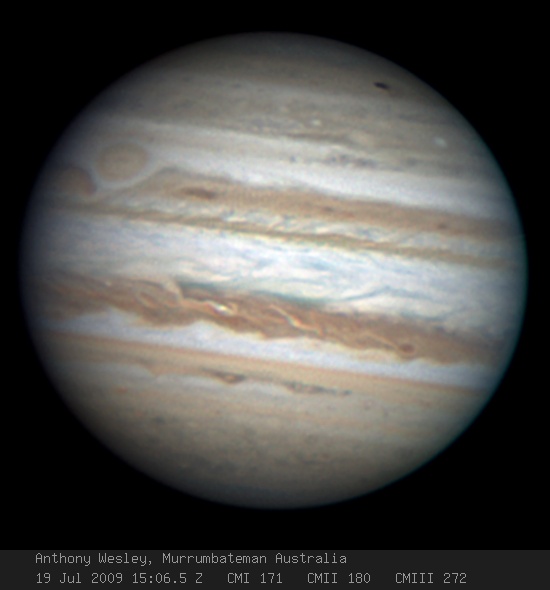
The Hubble Space Telescope, still undergoing testing after the last servicing mission back in May, was used to take a photograph of the impact site on Jupiter discovered by Anthony Wesley.

In this first science image returned from Hubble after the servicing mission, the remains of the impact in Jupiter's atmosphere are clearly visible. The blot is seen to be losing its cohesion compared with earlier photos. This smearing effect is being driven by wind in Jupiter's atmosphere.

The image was taken with the Wide Field Camera 3 on Hubble. Calibration of the camera is still in progress -- this science observation interrupted the full system checkout of Hubble that has been in progress since the shuttle Atlantis left the telescope.

Current estimates suggest that the impacting body, a comet or asteroid, was several hundred meters in diameter. The energy released was thousands of times greater than that released by the comet or asteroid that precipitated the Tunguska event in Siberia a century ago.
Image Credit above: NASA/ESA/Heidi Hammel (Space Science Institute, Boulder, CO), and the Jupiter Impact Team

Saturday, July 25, 2009

The Solar Eclipse of July 22, 2009

A total solar eclipse of the Sun occurred earlier this week on Wednesday July 22. The path of totality as illustrated by the following animation (image credit NASA/A T Sinclair), touched the Earth in India, crossed through Nepal, Bangladesh, Bhutan, Myanmar and China. After leaving mainland Asia, the path crossed Japan's Ryukyu Islands and curved southeast through the Pacific Ocean where the maximum duration of totality reached 6 min 39 sec.


The Hinode satellite captured images of the eclipse from space. Hinode is a joint science mission (also known as Solar-B) mounted by JAXA, the Japanese Aerospace Exploration Agency, and the American NASA. The following image (photo credit NASA/JAXA) shows the moon's shadow in front of a heavily filtered view of the Sun.


Another Japanese Earth-monitoring satellite MTSAT captured what I believe has to be one of the most seriously cool space images ever -- the view of the moon's shadow on the earth from geostationary orbit 35,790 km (22,240 mi) high. The image (photo credit MTSAT/GMS via Wired Science blog) shows the shadow covering the island of Taiwan. Note that Australia is pretty clear of cloud cover -- just as one would expect from the reports of drought conditions there.


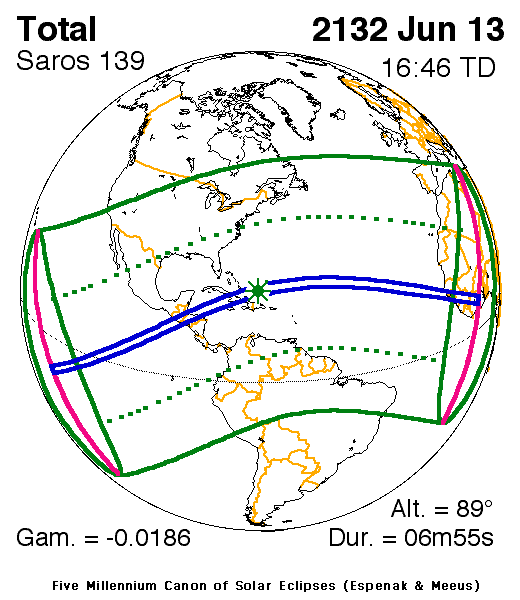
As eclipses go, this one was pretty long at nearly 7 minutes of totality. The next one having this comparable level of totality won't occur until 2132. Those of us still around will be just a bit decrepit by then :-)

For Sale - One Lunar Rover, Cheap

On Science.com's classified ads section, the following ad appears -- "For sale one Lunar Rover $500,000.00 no offers. One careful owner low mileage buyer collects. Cash offer and I will throw in a camera."


Given the original lunar rover development, manufacturing, and shipping costs, the price of half a mil is pretty good. The camera (a vintage Hasselblad, I believe) is definitely an added bonus.

A couple of problems aside from considerations of title -- the ad doesn't make clear which of three possible rovers is being offered -- there is one at Hadley Rille, one on the Descartes Highlands, and one at Taurus-Littrow. Oh, and I suppose the biggest problem given the "buyer collects" provision -- the locations of all three rovers (and the camera) are on the moon.


Photo credit above -- NASA/Apollo 15 -- photo taken by David R. Scott or James B. Irwin at the Hadley Rille on Earth's moon.

Tuesday, July 21, 2009

Jupiter Impact Update

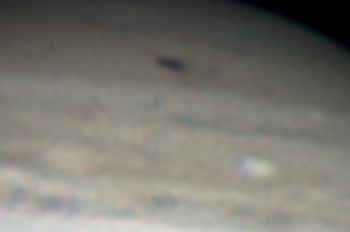
A follow-up observation with an infrared telescope on Mauna Kea confirms that the dark mark(s) discovered near Jupiter's south pole by Australian amateur astronomer Anthony Wesley were caused by an impact of a comet or asteroid. The "hole" in Jupiter's upper atmosphere is now Earth-size or larger.


Image credit: NASA/JPL/Infrared Telescope Facility - This image shows the heat signature from the impact point, glowing against the cooler background.

Monday, July 20, 2009

Jupiter Impact?

Around 1330 UT (0830 Eastern) yesterday (19 July 2009), an Australian amateur astronomer named Anthony Wesley noticed a previously unseen dark spot on Jupiter. Further observations by Mr. Wesley and other observers show several more spots in the vicinity, indicating that this is likely the result of a sizable asteroid or cometary impact on Jupiter.


If this was indeed a comet or asteroid impact, it would be much like Comet Shoemaker-Levy 9, fragments of which which hit Jupiter in July 1994.

The Spaceguard project is still cataloguing large objects in orbits which might be in a position to hit Earth. However, no one noticed the Jupiter impactor prior to Sunday. Jupiter's larger size and greater gravity causes it to sweep up a lot of material, which is a good thing for us -- every large object swept up by Jupiter is one less to fall out of the sky without warning on us.

One Giant Leap For Mankind - 40 Years Later

Today is the 40th anniversary of the first moon landing carried out by the astronauts of the Apollo 11 mission. On July 20, 1969, Neil Armstrong and Buzz Aldrin stepped out of the lunar module Eagle onto the Moon's Sea of Tranquility. While they took photographs, set up experimental equipment, and gathered rock and soil samples, their fellow astronaut Michael Collins orbited overhead in the command module Columbia.

Forty years later, there is an "Apollo 11" greasy spoon resturant here in Toronto at the corner of Bathurst and Dupont. This leads me to wonder whether the "Obama Cafe" on the Danforth will still be here by the middle of this century. The juxtaposition of restaurant names here in Toronto will be matched by a meeting of the actual people in Washington, where President Obama is scheduled to meet with Armstrong, Aldrin, and Collins later today.

Today, there are 13 astronauts on the International Space Station -- a record setting number of people in one place in space, and incidentally, one more person than the twelve men who to this point have walked on the moon. Two of those thirteen people currently in space -- Robert Thirst and Julie Payette -- are Canadians. But there are no people in high orbit, or the moon, or interplanetary space.


Photo credit NASA - Endeavour approaches the ISS on Friday, July 17. Photo taken by an Expedition 20 astronaut during the approach phase to check for possible heat shield damage.

After 1972, the Apollo 18 spacecraft was redesignated for use on the Apollo-Soyuz Test Project. Apollo 19 through 21, which included the setup for a rudimentary moonbase, were cancelled by the Nixon administration and never flown.

There are strong indications that the NASA Constellation program has fundamental design complexities and problems that may make it difficult or even impossible for NASA and its international partners to implement and use as the platform for the return to the moon, and beyond. Also, the Constellation vision is an enormous step backward in terms of technology concept. The decisions that are made now matter, and will affect whether or not there continues to be a viable human presence in space.

In the meantime, there has been a lot of 40th anniversary coverage over the last few days (click on individual links to open):

Apollo 11 mission recreated on web -- report and mission site

The debate about whether it was all worth it began even before the moon landings. Perhaps the major problem with space exploration to date is that there has been no true viable long term purpose. John F. Kennedy provided the lunar landing objectiveb when he stated in a speech that he elieved
"that this nation should commit itself to achieving the goal, before this decade is out, of landing a man on the moon and returning him safely to Earth."

But even Kennedy did not look beyond the need in the 1960s to "beat" the Russians. Elsewhere, he is on record saying to then-NASA Administrator James Webb
"This is important for political reasons, international political reasons, and this is, whether we like it or not, an intensive race. Otherwise, we shouldn't be spending this kind of money, because I'm not that interested in space."

Buzz Aldrin's rap video, intended to make space travel sexy for a new generation.

Sadly there are conspiracy theorists who believe that the landing never happened, prompting a lot of effort to demonstrate otherwise (also here and here and here). Proving a negative is hard to do, and there are always people (see also evolution debaters and 911 conspiracy theories) who choose belief over evidence.

The mission was a success from launch to lunar module liftoff to landing because many people worked on it, including small but critical contributions from unlikely people.

NASA has been working on cleaning up the Apollo 11 television footage. Here is a sample:


Finally, here is a montage video of highlights from the entire mission -- Armstrong's first words from the moon occur around 1:02. It should also be noted that Walter Cronkite, the iconic newscaster for CBS, passed away earlier last week.


Happy Neilsday 2009...