Random musings, sentimental maunderings, incoherent thoughts, stress-relieving rants, momentary enthusiasms, big ideas, and occasional awful puns from the complex life and interesting times of Do-Ming Lum.
It is instructive to look at the work of Darwin, and recognize that careful observation, interpretation and analysis form the basis of his body of work -- ideas which are still relevant to the science of Biology and all the disciplines that stem from it.
There have been many detractors, particularly in education, in the presentation and teaching of the science of evolutionary biology. The most famous of these cases perhaps being the "Scopes Monkey Trial" of 1925, and the more recent case of the Dover School Board provide an overview of how thinking on evolution has progressed. Interestingly, I know of no equivalent attempts in Canada to mandate the exclusive teaching of a creationist perspective.
"...the list of churches that have signed up for Evolution Weekend are mainly theologically liberal churches, and I added, with an inordinate number of women clergy. The particular Sacramento-area church the writer reported on has a woman pastor—who obviously doesn’t understand the difference between operational (observational) science and historical science. When clergy like this make the comment “science and faith,” they really mean that “biological, geological, and cosmological evolutionary belief” is supposedly compatible with God’s Word. "
The condemnation is clear -- only "theologically liberal" churches would advocate any co-existence with what I would call the real world. And of those churches, it is the women clergy who are at fault, presumably because they don't conform to the patriarchal model that the author of this piece would like to be the universal norm. The "Evolution Weekend" reference is to an event which encourages religious institutions to discuss the co-existence of faith and science on the weekend closest to February 12. The fact that I find this ironic will undoubtedly cause the creationist author of the critique to insist that I burn in hell.
My grandmother passed away on November 3rd. She had been in Toronto with us for as long as I have been here, which is 39 years. By the time she was found in her bed by my aunt, she had been gone for a few hours, having slipped away peacefully and painlessly.
There was a funeral visitation on Sunday, and the funeral itself was held earlier today.
Being known as the family photographer (which is to say, the annoying guy in everybody's face with a camera at every family event), I was tapped to provide photos. And I discovered that this is hard. I have photos taken at many family events. The digital archive goes back to 2000. But none of the photos I took at each family event were taken with the thought that the person I was photographing might not be alive later.
Especially so with grandma -- for 39 years, I have thought of her as akin to a force of nature.
Between me and my cousins, we came up with more than a 120 images, some of which were scans of very old photographs -- a family treasure trove which was passed to me for further scans.
Two of us spoke at the funeral earlier today: my cousin Wayne and myself. Wayne read a presentation from his sister, my cousin Anne, who lives in Mauritius. This is what Wayne read:
“le fabuleux destin de (the fabulous destiny of) Grandmere Seto” (by anne sujo - copyright 2011)
Family and friends, we are gathered here today to pay our last respects and commemorate the passing of a very important person in our lives.
It is with immense sadness and pride that I share with you some of my thoughts and memories of our great Grandma Seto. For, there is no other word that comes to mind, other than “greatness” that can describe her person.
Had Grandma Seto lived to her next birthday in January 2012, she would have reached her full 95 years. She was indeed someone, who lived her life to the fullest and enjoyed the company and love of her late husband, our Grandpa Seto (who passed away just over 10 years ago), her 3 children, Bik Sim, Wai Yu and Wai Man - and not to mention, 11 grandchildren, the spouses of her children and grandchildren, as well as 11 great-grandchildren. What can be more “great” than that? We can therefore, say that Grandma Seto was truly blessed to be so well surrounded by such a close-knit family as ours - Family, the “glue” that holds everything together.
Not only was Grandma Seto strong physically, but also mentally and spiritually. Nothing seemed to bring her down or get in her way. Not even the fact that she was hard of hearing or probably considered “too old” - When Grandma Seto had a yearning for a bit of harmless gambling and her sons were too busy to take her to the horseraces, well, her little legs would literally speedwalk her to the bus stop, and she would actually hitch a ride all the way to the Niagara Casino! Talk about fiesty and fast! I’ve never seen anyone her age who could walk so fast! So, my dear cousins, I guess we can say we certainly inherited some mighty genes!
Hardworking and loyal – she was a devoted mother, wife, grandmother and great-grandmother in many ways. Alongside her late husband, Grandma Seto was one of the pillars in the restaurant business that the two of them led for many years until their retirement. We will never forget the traditional Christmas dinner gatherings that were always held there – the late night majong, the food, the warmth, the joy and laughter. The restaurant has long closed down, but the spirit of family gathering and warmth still remains.
Generosity - another one of Grandma Seto’s many traits - whether towards her family or close friends, she would always put others before her first.
My visual memory of Grandma Seto will always be one that is positive and happy. Her physical and mental strength was evident in the way she spoke and moved about. She had a smile so bright that would stretch from ear to ear. And the twinkle in her eye showed that she was not only very alert and independent, but also very strong-willed.
The sudden passing of Grandma Seto has left a void in many of our lives and we will surely miss her. However, I believe that she has passed to us many of her qualities, and through us, her “greatness” will continue to live on.
Let us be comforted by the image of both Grandma and Grandpa Seto, now reunited in love, happiness, peace and harmony. May she forever rest in peace – God bless us all.
I spoke last. My presentation had been in the back of my mind, percolating, since Thursday night, and finally written down in first draft format by 3:30am on Monday morning. This is the edited, final version of the eulogy that I read:
I met my grandmother, Nuhan Seto, for the first time here in Toronto in 1972. I was a couple of months from turning 14 – she had already marked a half century in Canada’s Centenniel year and had added five more birthdays since.
We didn’t have a lot in common – I was her eldest grandchild, the son of her daughter Bik Sim, the boy whose only life experience to that point was northern British Columbia; she the woman whose life had begun in post Manchu China, changed through marriage, motherhood, the rise of the People’s Republic, changed again through immigration to Central America, changed yet again through immigration to Canada. But over the next 39 years, I grew to love and respect my grandmother for who she was and what she represented. She was a simple, straightforward person who wanted the best for her family. And for me, she was a link to our family’s past.
As I think about my grandma’s life, I see three important lessons. The most important lesson is that change is not only inevitable, but it is accelerating. In China in 1917 after the fall of the Manchu dynasty, the term “women’s rights” would have been met with blank stares. In Canada, there might have been outright scorn, since the right to vote for women was only a year old, and there was active resistance to this new fangled notion. Today, it would be foolhardy to suggest to any women in this room, Chinese Canadian or otherwise, that they cannot have full participation in our increasingly globalized society.
Since 1917, change has been the most important aspect of life. Think about race relations, gender roles, technology, medicine and any number of other things that matter. Now compare them between 1917 and today, 95 years later. The changes in knowledge, beliefs, attitudes, and capabilities are a part of our world and touch the lives of all of those that my grandma cared about..
But Grandma was a conservative –she may have disapproved of many or most of these changes – especially anything that she might have considered non-traditional. But I have first hand evidence that Grandma was able to accept new things that affected the lives and happiness of members of her family, in her acceptance of my own non-traditional choice in the creation of my own family.
My son Corwin is 12, a bit younger than me when I first met grandma. But like all of his cousins, great grandmother has been part of his life since he was born. And when I asked him yesterday how he would remember her, he said “Great grandma always had a smile for me. She has never frowned at me.”
While that may be true for her great grandchildren, there are others who have felt grandma’s displeasure in a more direct way. The episode of the thief on the street has become a family legend. In the early 1990s, my grandma, who was then in her 70s was walking home one day through Kensington market. As she walked, someone snatched her necklace, breaking the chain, and ran away. Grandma immediately took off after the thief, shouting imprecations, with cane upraised, intending mayhem and retribution. The thief escaped, which on the whole was fortunate, both for the thief and for the rest of us – it would have been difficult explaining to the relevant judicial authorities why he had been beaten to a pulp.
That winter, or perhaps during a winter soon after, my very non-traditional wife Jill recalls walking with grandma after a family gathering, and having her come up to a snow bank. Jill was concerned about getting grandma safely over the snow bank, but grandma solved the problem by hopping over it like a young girl.
So the second lesson of my grandma’s life is that obstacles can be surmounted with grace and style. The third important lesson is that courage is important, but dignity is not necessarily so, particularly if you are chasing down injustice.
Our fleeting lives are like flames in a brief interval wedged between the eternity of the past and the abyss of the future. If we are lucky, our way through the darkness is lit by the lives of those close to us, as we in turn light the way for those to come. In this room, in this city, on this planet, there are 25 direct descendants of my grandmother – children, grandchildren, great grandchildren – all of whose lives were directly affected by the actions and choices made by my grandmother, the light of her life spilling across generations to help show us the road leading forward.
Her light is gone now, but while it was here, it shone on many people. Because of my grandmother, all of our lives shine a little brighter.
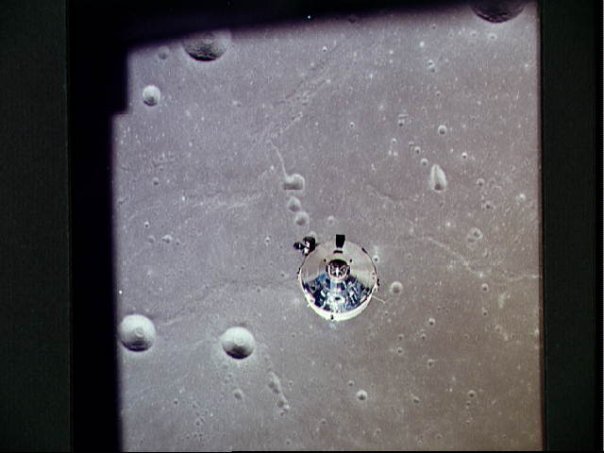
Forty one years ago today, the lunar module Eagle undocked from the command module Columbia. After a brief retrofire engine burn, the Eagle descended toward the Sea of Tranquility, a vast lava plain close to the lunar equator. With fuel running out, and the spacecraft descending toward a boulder field, Neil Armstrong took manual control of the lander and brought it down safely. Later that evening, at 10:56PM EDT, Armstrong would become the first human to set foot on another celestial body, followed shortly after by fellow crew member Buzz Aldrin. Forty one years later, the Constellation program, along with the Ares launchers, have been cancelled. America has no firm plan to return to the Moon, and the Canadian Space Agency has no lunar exploration initiative. But there are others who may well take on that challenge -- maybe for the wrong reasons of national pride and international prestige at first, but there is always the hope that the door once reopened won't be closed so hastily again.
Today -- the 100th birthday of filmmaker Akira Kurosawa (March 23,1910 to September 6, 1998), who among many other films, made The Hidden Fortress, a movie that clearly influenced Star Wars.
The Canadian Forces ship HMCS Athabaskan (DDG 282) which was just deployed to Haiti is an Iroquois-class destroyer. Ships of this class are also referred to as the "Tribal class", a tradition which dates back to the Second World War when ships of an earlier Tribal class were obtained by the Royal Canadian Navy from Great Britain.
Athabaskan was built in Quebec in 1972, and went through TRUMP (TRibal-class Upgrade and Modernization Project) in 1994. The Iroquois-class Tribals supplemented the Canadian Navy's River-class destroyer force in the 70's and 80's. Militarily, the Iroquois-class were originally designed to conduct anti-submarine warfare, but the TRUMP conversion remade them into area air defence platforms.
The current Commanding Officer of Athabaskan is Commander Peter Crain, who relieved Commander Steve Jorgensen in command of the ship in August 2009.
The ship was one of four Canadian naval vessels that took part in Exercise Joint Warrior in September/October 2009. The others were HMCS Halifax (currently deployed with Athabaskan to Haiti), HMCS Montreal, and the supply ship HMCS Preserver.
In the photo (which is from Athabaskan's photo gallery on the ship's web page), Athabaskan is leading Halifax and Montreal through the waters of the Royal Navy's Fleet Base at Scapa Flow on the morning of October 14, 2009. This procession marked the 70th anniversary of the night in 1939 when the battleship HMS Royal Oak was sunk by the German U-Boat U47 at what was supposed to be a secure anchorage.
In Haitian waters, Athabaskan will take station to the west of Port Au Prince, while Halifax will anchor off the town of Jacmel on the southern coast, about 30 kilometers away.
Michaelle Jean, the current Governor-General of Canada, is a Haitian refugee, having come to Canada at the age of 11 to escape the Duvalier regime. Jacmel, a town which is a popular tourist destination, is also the home town of Governor-General Michaelle Jean's father.
Peter McKay, the Minister of National Defense said through a spokesman that the Governor General had no hand in the decision to focus on Jacmel, which was made based "on the recommendation of the brigadier general on the ground", as well as at the request of the Haitian government.
Halifax is scheduled to arrive off Jacmel by Tuesday. There are an estimated 84,000 people homeless in the Jacmel region, and the hospital was destroyed. The dock has reportedly been damaged, which means that landings will be done via smaller craft. Earthquake damage to the road means that Jacmel has also been cut off from aid coming by truck. However, a DART complement is already working there, as well as a United Nations force from Sri Lanka.
This juxtaposition is entirely appropriate -- in the aftermath of the Indian Ocean tsunami of Christmas 2004, DART deployed to assist in Sri Lanka, although the logistics back then were much more difficult since the Canadian Forces did not have the Globemaster transport aircraft.
In addition to the Sri Lankans, the Canadian contingent are also working with search and rescue teams from Colombia and Brazil.
The Canadian military is going to Haiti to assist in relief efforts. This deployment is part of what is being described as a whole-of-government response by Canada that also involves Foreign Affairs and International Trade Canada (DFAIT) as well as the Canadian International Development Agency (CIDA).
The military response, designated Operation HESTIA, includes the destroyer HMCS Athabaskan and frigate HMCS Halifax, both expected to arrive in Haiti today, after sailing from Halifax Harbour last Thursday. Both ships are packed with relief supplies, including the result of a clothing and toy drive among the crews (scroll down when the link opens). The ships will likely anchor off the south coast, since there is a growing mass of maritime traffic in the harbour of the capital, Port Au Prince.
The Disaster Assistance Response Team (DART) has been on the ground since last week. DART equipment is maintained on standby at CFB Trenton in order to ensure proximity to the global reach provided by 8 Wing's Hercules and Globemaster transports. DART's primary mission is to provide medical care and to ensure a safe supply of drinking water.
The 200 members of the DART unit will be supplemented by 500 sailors and specialists from Athabaskan and Halifax. There are an additional 1,000 Canadian Forces soldiers who will be sent shortly. Their combined mission will be to provide aid, and to assist the civil authorities in keeping order.
Current casualty estimates place the number dead in Haiti as high as 200,000 people, with an additional 300,000 made homeless. The death and devastation has been staggering, placing this disaster on the same scale as a war.
Trust Fred Clark at Slacktivist to properly dissect and shed light on the true evil of Pat Robertson's utterances. Mr. Clark's post contains some important thoughts which bear repeating:
I'm accustomed to Pat Robertson being an unholy fool, but his remarks following the Haitian earthquake were astonishing even for him. By attributing Haiti's suffering to a supposed "pact with the devil," he manages to break two commandments simultaneously -- both bearing false witness against his neighbor and taking the name of God in vain.
That sort of double word score is typical Robertson fare, until one appreciates how utterly and explicitly he takes sides here. By labeling the revolutionary enslaved people who founded the Haitian democracy as literally demonic, Robertson sides with slave owners and against democracy, liberty and human rights. He declares that he and his god are on the side of oppression and that liberation is the Devil's work.
Wow. That this is contrary to the Bible Robertson claims to read is obvious to every tourist who has ever filed past the Liberty Bell here in Philly ("Proclaim liberty throughout all the land unto all the inhabitants thereof").
But it's worse than that. He's not just contradicting some bit of scriptural arcana here, he's cutting to the core of Christianity and setting himself in direct opposition to it.
Video: On the following two videos, Rachel Maddow does an introduction to this topic, and in the second, Raymond Joseph, the Haitian Ambassador to the United States makes some remarks that provide a pointed reminder that one should never piss off someone who understands history.
If Robertson is the devil of the piece, then the jackal is surely Rush Limbaugh, the drug-addled radio personality who has come to represent the not-so-pent-up hatred of America's bigots. In the following video, Keith Olbermann comments on statements made by both Robertson and Limbaugh:
A day later, Olbermann responds again to a fresh outrage from Limbaugh, this one also drawing a sharp reprimand from Roger Ebert which begins "You should be horse-whipped for the insult you have paid to the highest office of our nation." The Olbermann video follows:
Pat Robertson, an American televangelist, on the religious television program The 700 Club stated that Haiti and Haitians were "cursed by one thing after another" since they "swore a pact to the devil", a reference to the slave revolt which began in 1791. Robertson, as one of America's privileged elites, potentially descended from slaveholders, would of course have little sympathy for a populist uprising, particularly one where, in the words of former Haitian president Jean-Bertrand Aristide
To free themselves from the bonds of slavery, our forefathers turned to the Ancestors in the ceremony of Bois Caïman, in August 1791. In other words, to become free, the slaves prayed not to the God of his master but to the God of Ancestors.
Any rejection of the god of Pat Robertson seems like a good idea to me, so it must have been a no-brainer for men and women desperate to throw off the shackles of real oppression and slavery for which someone like Robertson would have no understanding, and clearly even less sympathy.
In the blogosphere, P. Z. Meyers (who is much admired in these parts) said it best in his own post on the subject of Robertson's "pact with the devil" remarks: "If it makes you angry, turn your outrage into something constructive and use it to motivate you to donate to Haitian relief first. Deal with the evil scumbag Robertson later."
There is no need to believe in a devil, but there is ample reason to believe in Pat Robertson, and to take a stand against all that he represents. Haiti will be hell for months and years to come, but donations to the relief effort will be our way to help the Haitian people despite Robertson and those devils like him who seek to exploit this little bit of hell on Earth.
To Haitian friends and colleagues, we hope that your families and loved ones are safe. We wish we could do more.
Morlet's blog (link provided by Mike) has a post with images from circa 1900, showing life in the year 2000.
The images are wonderful. The majority of the ideas have come true, but even for the ones that have come true, their achievement was not at all in the way that they were visualized in these images.
Image Credit - Morlet's Blog - Police X-Ray Surveillance Machine
I am going by memory here, but I believe that Robert A. Heinlein, in an essay in the Expanded Universe collection, talks about how science fiction authors tend to miss the mark because they are insufficiently imaginative. Add futurists to that list - there was no such profession when Heinlein wrote that essay originally in 1950, and I don't remember whether he mentions them in his 1980 update.
Technological progress must resemble what I imagine biological evolution to be like -- a long period of relatively small adaptations for existing conditions which don't change, but then a sudden mad scramble for adaptation to a radical change in the environment. Think more or less stable conditions for a hundred million years to allow dinosaurs to evolve and adapt to almost all ecological niches, and then being blotted out by radical environmental change after the Chicxulub asteroid strike. Having seen both Tyrannosaurus Rex and Triceratops, it might have been difficult to predict polar bears and bison.
In just the same way, in 1900, it wasn't obvious about the various revolutions caused by cheap internal combustion engines, air travel, rocket flight, space travel, computers, genetics -- the list goes on.
Here in no particular order is my short, incomplete list of problems we currently face, and possible solutions. It is no great prediction that from the year 2100, readers can look back on this list with the same sort of amusement that we in the post-2000 era look back on the predictions of 1900. As with the 1900 predictions, the flaw in these will be the unknown and unanticipated discoveries (or problems) that derail these and cause the outcome to be different.
GLOBAL WARMING - at the end of the 1800s, there was a hard limit to how big a city could get, because they were already running into the problem of how to get rid of all the horse manure that a large city would create. The analogy to our present day problem with rising carbon dioxide levels due to industrialization and transportation are obvious. How does this get fixed? Prediction - a range of technologies, including bioengineered forests (think kudzu genes implanted in sequoias) to absorb atmospheric carbon dioxide. In addition, there will be technology applied to remove carbon from the atmosphere and store it.
ENERGY - The industrialized world demands an enormous amount of energy. Energy needs will increase as Asia and Africa expand their consumption to levels that approach North America or Europe. Energy sources such as coal and oil release too much carbon. Nuclear reactors create dangerous waste. Space power satellites are expensive. Prediction - fusion reactors based on compression or pinch effects -- for example, the Bussard concept.
CONFLICT AND GOVERNANCE - In the shorter to medium term, this is also about creating a way to equitably share resources - something that has more often than not resulted in conflicts. Thomas Barnett's TED talk examines the way that conflicts (for example over energy and resources) could evolve, and the possible international solutions to these problems. Prediction - armed conflict won't go away, but the scope and intensity will drop as the main international players understand that war is bad for business.
SPACE - GROUND TO ORBIT - Rockets were all right as a first step for getting things into space, but over the long term, they are dangerous, polluting monsters. Prediction - Multistage scramject launchers will be developed, but will give way to an orbital elevator. If the elevator is based on some variation on carbon nanotube technology, several of these might be a good place to use up the carbon that needs to be removed from the atmosphere.
SPACE - SOLAR SYSTEM - The problem with the rockets that are being built is that rockets fundamentally can't lift very much into space -- most of their energy output is devoted to moving their own fuel. In order to get anywhere interesting with anything of a decent size, this constraint has to be removed. Scramjet launchers will help, so will an orbital elevator. Prediction (see also ENERGY above): A Bussard-type fusion reactor (or something similar) will turn transit times of years to weeks or months, putting the solar system out to the Kuiper Belt in range of manned exploration.
SPACE - BEYOND - There are mathematical models for how to get something to move faster than light, but no one has any idea on how to implement these concepts as buildable engineering. Prediction - by 2100, we will have a better understanding of spacetime, and will be able to create devices to allow local manipulation of gravity. Faster than light travel will remain elusive.
GENETICS - The molecular basis for life was not understood in 1900, but by 2000, the genome of human beings has been determined, as well as that of some other species. Prediction - by 2100, genetic data will be so readily available that researchers will have a much better understanding of the evolutionary heritage of the majority of creatures on this planet. Some extinct species will be recreated, although a "Jurassic Park" scenario will not be achievable. However, greater understanding of cloning technologies will enable organs and other spare parts to be grown as needed. Meat will be grown in vats rather than harvested from food animals.
NANOTECH - Very primitive nanotech devices have been created, but no one really knows yet how to do really sophisticated, sexy stuff. Prediction: the nanotech revolution will go hand in hand with developments in genetics and molecular biology. There will be something like a genetic code for self-assembling machines. These machines will become ubiquitous in the environment.
ARTIFICIAL INTELLIGENCE - Even as late as the 1940s, there was a belief that computing devices would be mechanical. The computer revolution first of all needed to go electronic, and after that, took 40 years to get from the first mainframes to the internet. Having gotten to this point, it shows no sign of slowing down. If anything, the pace of development is increasing. Prediction - this one is the joker in the deck, because it affects everything else. As computers have gotten smarter over the years, we have used them as tools to allow us as individuals or groups to do more. Computer systems will continue to increase in power, and well before 2100, a computer (or computer network) will be able to match the power of a human brain. But it won't stop there - computer capabilities will continue to expand. We will share our world with AI entities who will help us to organize our data, our work, and our lives. This will affect all other human endeavours.
NEW PROBLEMS - Sure as anything, there will be unintended consequences -- stuff we didn't think of. Hopefully not fatal.
Various news sources report that Her Majesty's Canadian Ship Fraser was returned to the Royal Canadian Navy earlier this month.
Fraser -- DDH 233 -- is the last surviving ship of the St. Laurent class of destroyers. These were the first warships designed and built in Canada, and they formed the backbone of the Royal Canadian Navy during the Cold War. From the National Historic Site historical plaque aboard Fraser
Designed in 1948-1949, they influenced naval construction internationally with their smooth above-water surfaces and distinctive convex deck. They could also be sealed to protect crews against biological and radioactive threats. All seven St. Laurent-class ships were modified during the 1960s to carry helicopters and enhance their anti-submarine capability. Launched in 1953, the HMCS Fraser is the last surviving example of this innovative class of warship.
When these ships were originally designed and built, they were intended to be newer, faster, more capable versions of the River-class destroyers that the RCN used in the Battle of the Atlantic in the Second World War. Their DDE designation marked them as Destroyer Escorts - ships intended to guard a convoy or to form part of a surface battle group. In the early 1960s, they were upgraded to add the capability of launching and recovering a Sea King helicopter, which is reflected by the change from the DDE to the DDH designator. When HMCS Bonaventure, the last RCN aircraft carrier, was retired, these ships became by default the largest units in the Canadian Navy.
Photo Credit - by Stewpendous on Flickr -- HMCS Fraser moored at Bridgewater, NS
All the ships of the St. Laurent class excluding St. Laurent herself went through the DELEX (Destroyer Lifetime Extension) program in the early 1980s. This upgrade included an electronic warfare suite that allowed these older ships constructed in the decade after World War Two to function and participate in a modern battlefield, giving them tactical datalinks to allow them to mesh with allied combatant ships and aircraft.
Throughout the 1980s, Fraser was used as a testbed to evaluate technology that would be used on the Halifax-class frigates that were then being designed. But by 1994, Fraser was retired and all the other ships of the St. Laurent class-- St. Laurent DDH 205, Saguenay DDH 206, Skeena DDH 207, Ottawa DDH 229, Margaree DDH 230, and Assiniboine DDH 234 -- were scrapped or sunk.
Originally, Fraser was intended to be either a museum, or an artificial reef -- indeed, the ship was owned by the Artificial Reef Society of Nova Scotia since the mid 1990s, until funding issues caused the ship to be returned to DND and the Navy earlier this month.
The Navy now has three options -- they could could restore Fraser (as a museum, not an operational warship), break her up and sell the remains for scrap, or turn the ship into an artificial reef.
The statement from Peter MacKay, the Defense Minister, is a typical example of political vagueness: "We remain committed to developing a longer-term solution for Fraser's future." What does this actually mean?
Today is the 40th anniversary of the first moon landing carried out by the astronauts of the Apollo 11 mission. On July 20, 1969, Neil Armstrong and Buzz Aldrin stepped out of the lunar module Eagle onto the Moon's Sea of Tranquility. While they took photographs, set up experimental equipment, and gathered rock and soil samples, their fellow astronaut Michael Collins orbited overhead in the command module Columbia.
Forty years later, there is an "Apollo 11" greasy spoon resturant here in Toronto at the corner of Bathurst and Dupont. This leads me to wonder whether the "Obama Cafe" on the Danforth will still be here by the middle of this century. The juxtaposition of restaurant names here in Toronto will be matched by a meeting of the actual people in Washington, where President Obama is scheduled to meet with Armstrong, Aldrin, and Collins later today.
Photo credit NASA - Endeavour approaches the ISS on Friday, July 17. Photo taken by an Expedition 20 astronaut during the approach phase to check for possible heat shield damage.
After 1972, the Apollo 18 spacecraft was redesignated for use on the Apollo-Soyuz Test Project. Apollo 19 through 21, which included the setup for a rudimentary moonbase, were cancelled by the Nixon administration and never flown.
There are strong indications that the NASA Constellation program has fundamental design complexities and problems that may make it difficult or even impossible for NASA and its international partners to implement and use as the platform for the return to the moon, and beyond. Also, the Constellation vision is an enormous step backward in terms of technology concept. The decisions that are made now matter, and will affect whether or not there continues to be a viable human presence in space.
In the meantime, there has been a lot of 40th anniversary coverage over the last few days (click on individual links to open):
The debate about whether it was all worth it began even before the moon landings. Perhaps the major problem with space exploration to date is that there has been no true viable long term purpose. John F. Kennedy provided the lunar landing objectiveb when he stated in a speech that he elieved
"that this nation should commit itself to achieving the goal, before this decade is out, of landing a man on the moon and returning him safely to Earth."
But even Kennedy did not look beyond the need in the 1960s to "beat" the Russians. Elsewhere, he is on record saying to then-NASA Administrator James Webb
"This is important for political reasons, international political reasons, and this is, whether we like it or not, an intensive race. Otherwise, we shouldn't be spending this kind of money, because I'm not that interested in space."
Buzz Aldrin's rap video, intended to make space travel sexy for a new generation.
Sadly there are conspiracy theorists who believe that the landing never happened, prompting a lot of effort to demonstrate otherwise (also here and here and here). Proving a negative is hard to do, and there are always people (see also evolution debaters and 911 conspiracy theories) who choose belief over evidence.
NASA has been working on cleaning up the Apollo 11 television footage. Here is a sample:
Finally, here is a montage video of highlights from the entire mission -- Armstrong's first words from the moon occur around 1:02. It should also be noted that Walter Cronkite, the iconic newscaster for CBS, passed away earlier last week.
Fifty years ago yesterday, on February 20, 1959, the Canadian government of Prime Minister John Diefenbaker cancelled the development of the CF-105 fighter plane -- the aircraft known as the Avro Arrow.
In hindsight, the Arrow was just another 1950s era fighter plane, although for its time, it was the fastest and most advanced. And while it is possible to debate the upsides and downsides of the aircraft (fast, great climb rate, potentially capable of Mach 3+ on the upside versus heavy, high drag, low manueverability on the downside) it is the cancellation of the aircraft that results in one of the "might-have-been" myths of our shared Canadian experience. What might it have been, what could we have achieved, if the Arrow had gone forward to full production?
Cancellation of the Arrow project led to a lot of engineering talent moving south, and enormously benefiting the American space program. It also ensured the loss of an entire industrial sector -- Canada never again produced its own domestic military aircraft.
The lesson is an outsourcing lesson -- the country gave up some existing capability to save money. In doing so, it also shut down some future possibilities. In just the same way, a company which outsources its IT, or its manufacturing, or its marketing in order to realize some immediate bvenefits will give up some future capabilities -- and in fact will make it impossible to travel down some possible paths.
I had a chance to hang out with Buzz Aldrin last weekend at Fan Expo. On July 20, 1969, I was not quite 11 years old when I watched on a black and white TV in Wonowon as Neil Armstrong and Buzz Aldrin became the first human beings to set foot on another world.
I didn't plan on doing this. Earlier this year, recognizing that my next birthday is my 50th, Jill decided that a VIP pass to the Fan Expo celebrity event with Dr. Aldrin might be a good early birthday present. She was right.
I arrived last Friday before 6pm for the autograph session scheuled to begin at 7pm. I was one of hundreds in the main Fan Expo room in the South Building of the Toronto Convention Centre. By virtue of arriving early and waiting for an hour and a half until the autograph session started, late, I was one of the first 25 or 30 in line. When it was my turn, I shook Dr. Aldrin's hand and told him I had been waiting 39 years to congratulate him on his feat. He autographed for me a large print of himself standing on the moon, similar to the image below, a shot taken by Neil Armstrong during the Apollo 11 mission.
The second event was a photo op. They staged it in front of a green screen. However,with no prior instructions provided, I had not realized that they were going to do this and had worn a shirt with green stripes in it. They took the shot and added the moon in as background. However, because of my green shirt, you can see the moon through my torso. And just above my belt, there is something that looks suspiciously like a fingerprint.
By the end of the photo session, I had been waiting in line over two and a half hours, and I had spent a total of 30 seconds or less with Dr, Aldrin. But, as I said to Jill, how often in your life do you get to approach a living legend?
The VIP Q&A session took place across the street in a pub. It included a complimentary dinner (sandwiches, salad, some indifferent meatballs and pasta -- the functional equivalent of rubber chicken). I managed four or five more minutes with him, although my supposed one-on-one was shared with two strangers named Anthony and Stephen. Not my choice or theirs -- we were arbitrarily grouped by one of the organizers, who redeemed himself by taking photos.
Buzz Aldrin got his doctorate from MIT for his work on orbital rendezvous. He later went on to do much more interesting work on cycler orbits. I had wanted to ask about any follow-up work that he might have done, but there was no real opportunity for a more technical chat.
Next day, Saturday, was Dr. Aldrin's presentation. I went with Corwin, and we stood with the rest of the audience to give him a standing ovation when he entered the room. Corwin fidgeted through the second half of the talk, but I did manage to get him and Dr. Aldrin in the same photo.
Dr. Aldrin provided a brief retrospective of his life and career. He expressed his concern that the earliest delivery date for the Ares/Constellation launchers in 2015 combined with the retirement of the space shuttle fleet in 2010 will result in a period when the US will only have access to space through its international partners. He hopes that the US space program will develop an alternate solution that will reach operational readiness sooner than 2015.
He also spoke of his wish that there might be a 40th anniversary reunion of the Apollo 11 crew and support group. My thought is that this is a neat idea, but if something like this is organized, it would be a convention involving potentially hundreds or thousands of people.
The organizers cut short the public question and answer session after two or three questions.
Saturday July 7 marked the 100th anniversary of the birth of Robert Anson Heinlein, the science fiction author whose work I read (and was occasionally troubled by) through my childhood, adolescence, and adulthood.
I discovered Heinlein's Rocket Ship Galileoon the shelves of the school in Wonowon when I was in Grade 4, and by the time I finished Grade 8 in Fort St. John, I had read all of his juveniles -- the books that he had written for a teen audience. I was thirteen years old when I first read Stranger in A Strange Land -- a book that I would often return to in my teens and early adulthood.
The Heinlein Centennial convention over the weekend in Kansas City would have been a great event to have attended, but to my everlasting regret, it became clear by about May that I wouldn't be able to to go.
The Space Review website has a recent article about a memo which Heinlein wrote in his final days at the Naval Air Materials Center, where he worked during World War Two. This memo, much of which in hindsight is wrong, is still nonetheless inspiring. And it is interesting to consider that 60 years later, private enterprises like SpaceX or Bigelow Aerospace are starting to do some of the things that Heinlein thought should be starting immediately after World War Two.
Through the years, many authors have been hyped by their publishers as being the successor to Robert A. Heinlein. None of these assertions have been true -- even for authors whose talent I respect. More often than not, such a statement on a cover blurb or a review has just been hype, and the author in question has demonstrated very little substance in ideas or writing to justify such a comparison to the Master.
Heinlein remains one of a kind, the quirky, visionary genius and storyteller whose work defined the field of English language science fiction for much of the twentieth century.
My cousin Tak visited for a week with his parents. They were here last week, having started out on Saturday of the American Memorial day weekend, and taking two days to drive up from Tampa. Tak had used Priceline.com to find inexpensive accommodations, and between his internet skills and his GPS, he and his parents managed to do quite well getting around in the city.
Tak and I are related in that his great grandfather was the elder brother of my great grandfather -- the man whose adopted son became my grandfather.
When my mother left China in the 1950s, she spent three months with Tak's parents in their flat in Hong Kong.
One of the first activities that Tak and his parents embarked on last Monday was to take my mother to lunch. Although we had corresponded, and spoken on the phone, I had never met Tak. This changed on Monday night when Tak arrived at our house. We spent the evening getting acquainted and talking about family history.
Later in the week, on Wednesday, May 28, Corwin and I took my mother, Tak, and Tak's parents to dinner. Jill, who was down with a severe cold, had to miss the dinner, which was at the North York branch of Asian Legend. [Thumbnail review -- excellent food, good prices, recommended]
On Thursday evening, Tak dropped by, and we again spent the evening talking.
Their drive back to Tampa started on Saturday morning, with the plan to take three days rather than two, to make it an easier drive. That being the case, they got home today (or are about to get home).
This week was a great opportunity to talk face to face with my cousin Tak, to visit with his parents, and to gain further insight into our joint family history.
Tak and his parents in our back yard:
Tak and me -- photo taken by Corwin:
Tak's parents, Corwin, and my mother. The young techno dude is engrossed in playing with a Gameboy.
UPDATE: Got an e-mail from Tak this morning - despite being caught by Tropical Storm Barry in Virginia, they made it home safely late Monday night.
Hall's Food and Gas in Wonowon, B.C. was destroyed by a fire on Friday, May 25, 2007. Jill and I stayed here in August 1996 when we did our BC visit. I was here for the 2000 Wonowon Community Reunion, and all three of us were here for the 2005 Reunion.
These photos were taken in the morning and mid-afternoon of July 17, 2005.
Back in the 1960s and '70s, when it was Wonowon Services rather than Hall's, it was owned by the Close family. The Lum family lived in part of the hotel when my parents operated the restaurant here.
Thanks to Laurie Dowd for sending the news, and providing a link to Moose-FM for news updates.
Wonowon is located on the Alaska Highway. In this link to an article in the Vancouver Sun, there is mention of closing the highway. The Moose-FM piece indicates that the highway was closed in both directions for five hours. From the Sun article:
A local state of emergency was declared Friday in the northern B.C. village of Wonowon after fire broke out at a hotel and gas station.
Most residents of the community, which has a population of about 200, were ordered evacuated because of fears propane and gasoline tanks in the filling station attached to the hotel might explode.
The RCMP also closed the Alaska Highway that runs through the village.
Evacuees from the village, which used to be called Blueberry, were taken to Fort St. John, about 100 kilometres to the south.
Witnesses say everyone safely escaped the burning building without injury.
...
The tiny community has no fire protection so the building was allowed to burn itself out.
UPDATE - Laurie went up to Wonowon with Dave and Hattie on Sunday the 27th. She sent the following pictures and gave permission to post them here. The damage looks like it is total -- very sad.




 Posts
Posts


