Random musings, sentimental maunderings, incoherent thoughts, stress-relieving rants, momentary enthusiasms, big ideas, and occasional awful puns from the complex life and interesting times of Do-Ming Lum.
My cousin Cindy and her fiance, Alex, were married on Sunday September 6 over the Labour Day weekend. I shot over 700 images at their wedding. A selected subset of photos are posted on Facebook in this publicly available album. Over the next days/weeks, I plan on adding commentary to the individual photos in the album.
The condensed highlights of the wedding are represented by the photos posted here. The wedding was outside, so after the ceremony was over, there was a photo op in the park beside the tent where the banquet was to be held later.
Jill was sick that weekend, so it was only Corwin and I who went.
The day belonged to Cindy and Alex, and they were a beautiful and delightful couple. My cousin is talented, as well as a babe -- she made the cake and in fact, her bridesmaid and sister Bonnie told me that they had been decorating the cake up until 2am the night previously.
As is the custom in Chinese weddings, the bride went through a number of clothing changes. The final dress that Cindy wore was one that she herself had designed and made -- a clear case where career skills came in handy in personal life.
To my beautiful cousin and her new husband -- may you have a long and happy life together!
I didn't blog at all in August, but that was because August was pretty event filled:
1 - Our friend Annalee arrived on the first Sunday in August. I picked her up from the airport, while Jill, Michael, Kate, and Sherry conducted a tech writing seminar in the back yard.
2 - A couple of days later, we all headed out to Anticipation, the World Science Fiction Convention in Montreal. We used a rental van, and with six occupants (the three of us plus Annalee plus Michael and Lorna), luggage, and several cases of wine for the Friends of Merril/SF Canada party, the van was pretty packed. In the leadup to departure, I discovered that my driver's license had expired last year. My renewal letter had likely gotten lost in the mail, and I never noticed.
3 - After seven days sampling the delights of the Worldcon and the city of Montreal, we returned to Toronto on a Tuesday. My driver's license renewal was a priority. Annalee returned home to the US a couple of days later on Thursday Aug 13. On Friday, we packed the car, did some final household maintenance, and on Saturday morning headed off to northern Ontario, to our usual spot just south of the town of Temagami.
4 - At Lake Herridge, we had two weeks with friends -- 26 of us the first week, 16 the second. Two weeks later, rested from fresh air, sleep, swimming, starwatching and satellite spotting at night, many fine meals, and an unending array of wine and cocktails and beer, we returned refreshed and renewed. The experience was marred somewhat by Corwin getting sick a couple of days before coming home. His cold escalated to fever, nausea, and vomiting, although after two miserable nights he was on the the mend by the time we began our return trip. The drive home was not the nightmare that I expected it to be - in all, a good thing.
5 - Back home in Toronto, we ended the month of August and moved into the first week of September with unpacking, doing laundry, coping with the aftermath of the garbage strike, getting Corwin ready to start school (which happens tomorrow!), going to the Exhibition and generally getting life organized.
6 - My cousin Cindy got married yesterday. She and her fiance (now husband) Alex had announced their wedding months ago. The wedding took place on a perfect summer day, but unfortunately Jill was sick (still is) and didn't make it. I went with Corwin, and took hundreds of pictures yesterday. The downside of all those pictures is that I will have to sort them. However, the last time we had a large family gathering was for David's funeral. It was good to get together with the family on a happy occasion.
7 - And of course, there are photos from Worldcon as well as Temagami that need to sorted as well.
Those of us who understand the True and Secret Star Trek History of The World also understand that transparent aluminum first appeared at a small manufacturing company in San Francisco in the early 1990s. In some (very confused) accounts, credit for the transparent aluminum process is sometimes attributed to a Professor Montgomery Scott of Edinburgh. However, no such individual with such knowledge of materials science was at the University of Edinburgh, or for that matter, in Scotland during the relevant time period.
Now, nearly twenty years later, Physorg.com reports that transparent aluminum was created by bombarding aluminum with a high intensity x-ray laser, causing an electron to be simultaneously knocked out of every aluminum atom in the sample, without disrupting the crystalline structure. You can think of this as the atomic equivalent of whipping a table cloth off the table so quickly and deftly that none of the place settings are affected.
According to the researchers, this is an exotic state of matter never before observed. It is as if all the aluminum atoms were suddenly changed to silicon, at least with respect to their electron properties. As you might expect, this state of matter was very unstable and fleeting.
It is possible that further work with this may provide some insight into the physics of planetary cores, stellar interiors,or nuclear fusion.
I, however, want transparent aluminum for viewports on the hull of my starship.
On April 1st the Canadian frigate HMCS Winnipeg FFH-338 joined Standing NATO Maritime Group 1 (SNMG1) in the Gulf of Aden, to participate in Operation ALLIED PROTECTOR to conduct counter-piracy operations.
Photo Credit - Department of National Defense - Canada
Winnipeg was there for an operational mission that was only to last a few weeks, but this grew to a two month operation (talk about scope creep!).
During Winnipeg's mission in the Gulf of Aden she conducted over 100 hails, 20 investigations of suspicious craft, 12 approach operations, 5 boardings and 8 close escorts. During boarding operations, Winnipegencountered persons suspected of conducting piracy and ended up seizing large caches of weapons, which included AK-47’s, Rocket Propelled Grenade Launchers and warheads, M-16 assault rifles, and other assorted firearms and ammunition.
While patrolling the International Recommended Transportation Corridor (IRTC), Winnipeg escorted many ships, including two specific vessels of particular significance to Canada - a supply ship for the World Food Program carrying food relief to Somalia, and a freighter with supplies for Canadian troops in Afghanistan.
On the 31st of May, after completing two months of counter-piracy and escort operations, Winnipeg departed the Gulf of Aden in a "sail past" ceremony with the SNMG1 Flagship NRP Corte Real.
Photo Credit - Department of National Defense - Canada. HMCS Winnipeg sails into the sunset on May 31, 2009, leaving the Gulf of Aden for the waters of Australia
Winnipeg is now on the next phase of her deployment, Exercise TALISMAN SABER, which will take place in late July on the east coast of Australia and which will be conducted with naval units from both the United States and Australia. Winnipeg is expected home at Esquimalt, BC in late August.
Around the same time that HMCS Winnipeg arrived in the Gulf of Aden, the Chinese Navy sent a second flotilla to the same part of the world. The destroyer Shenzhen DDG-167 and frigate Huangshan FFG-570 were sent to replace the destroyers Haikou DDG-169 and Wuhan DDG-171, which had been on station along with the supply ship Weishanhu since early January.
Since it appears that Chinese Navy combatant ship deployments average about three to four months or so, the second flotilla are going home very shortly, having been in the Gulf of Aden May, June, and July. They will be replaced by the third flotilla (also here and video here). The guided missile frigates Zhoushan FFG-529 and Xuzhou FFG-530 have enhanced stealth capabilities compared with other Chinese naval units. Between them, the two ships carry two helicopters and a Special Forces unit.
A new supply ship, Qiandaohu, will replace Weishanhu, which sailed with the first flotilla in January and has been in Somali waters for more than six months.
Since the beginning of the Chinese Navy's mission to the Gulf of Aden on December 26, 2008, eight ships and their crews have been provided with the opportunity to operate far away from Chinese home waters. They have needed to put into practice everything that they know about underway replenishment, helicopter operations, small craft boarding operations, and working with foreign civilian shipping. This kind of experience can't be taught, must exist for any blue water navy, and is vitally important for global strategic goals. I have the definite sense that without the UN resolution, the Chinese military leadership would probably have done this anyway, in order to get the operational experience.
I am pretty fond of fried chicken. Salt, grease, sugar (in the form of carbs in the breading) -- with 3 out of the 4 major geek food groups (only caffeine is missing) what's not to like?
Current.com has a recent article on "secret" ingredients in commercial items like Coca Cola or KFC chicken. The conclusion? In this day of CSI forensic analysis, not to mention corporate liability for injuries from food allergies, there are no "secret" ingredients. In the case of KFC, the breading is 4 rather 11 ingredients -- the 4 being flour, salt, pepper, and MSG.
English mix 1 tsp smoked paprika 1 tsp mustard powder 1 tsp sage 1 tsp celery seeds 1 tsp sugar 1 tsp dried onion flakes 2 tsp salt 1 tsp ground black pepper 1 tsp ground white pepper
Mix up one of the mixes above, and combine with a cup (possibly two cups?) of flour. (For experimental follow-up - we need to try this with spelt flour, and then for those with extreme wheat intolerance, with corn starch).
Get some chicken. Marinate chicken pieces in milk overnight. (Alternative - try this with coconut milk).
Poach the chicken in the milk by bringing to a rapid boil, and then simmering on low heat for 20 minutes.
Coat each piece of chicken in the flour/herb mix. Dip each coated piece in milk again, and apply a second coat.
Deep fry each piece in a deep fryer until golden brown. (Those of us with no deep fryer as well as concerns about the hazards of deep frying will do shallow frying instead.)
The Word of Mouth article and associated video says that comparing fried chicken prepared this way with KFC chicken is like comparing a real peach to canned peaches -- they are clearly the same thing, and both are good, but the real peach (or in this case, the homemade chicken) is good in a way that is unmatched by the canned peach (KFC fast food).
Morlet's blog (link provided by Mike) has a post with images from circa 1900, showing life in the year 2000.
The images are wonderful. The majority of the ideas have come true, but even for the ones that have come true, their achievement was not at all in the way that they were visualized in these images.
Image Credit - Morlet's Blog - Police X-Ray Surveillance Machine
I am going by memory here, but I believe that Robert A. Heinlein, in an essay in the Expanded Universe collection, talks about how science fiction authors tend to miss the mark because they are insufficiently imaginative. Add futurists to that list - there was no such profession when Heinlein wrote that essay originally in 1950, and I don't remember whether he mentions them in his 1980 update.
Technological progress must resemble what I imagine biological evolution to be like -- a long period of relatively small adaptations for existing conditions which don't change, but then a sudden mad scramble for adaptation to a radical change in the environment. Think more or less stable conditions for a hundred million years to allow dinosaurs to evolve and adapt to almost all ecological niches, and then being blotted out by radical environmental change after the Chicxulub asteroid strike. Having seen both Tyrannosaurus Rex and Triceratops, it might have been difficult to predict polar bears and bison.
In just the same way, in 1900, it wasn't obvious about the various revolutions caused by cheap internal combustion engines, air travel, rocket flight, space travel, computers, genetics -- the list goes on.
Here in no particular order is my short, incomplete list of problems we currently face, and possible solutions. It is no great prediction that from the year 2100, readers can look back on this list with the same sort of amusement that we in the post-2000 era look back on the predictions of 1900. As with the 1900 predictions, the flaw in these will be the unknown and unanticipated discoveries (or problems) that derail these and cause the outcome to be different.
GLOBAL WARMING - at the end of the 1800s, there was a hard limit to how big a city could get, because they were already running into the problem of how to get rid of all the horse manure that a large city would create. The analogy to our present day problem with rising carbon dioxide levels due to industrialization and transportation are obvious. How does this get fixed? Prediction - a range of technologies, including bioengineered forests (think kudzu genes implanted in sequoias) to absorb atmospheric carbon dioxide. In addition, there will be technology applied to remove carbon from the atmosphere and store it.
ENERGY - The industrialized world demands an enormous amount of energy. Energy needs will increase as Asia and Africa expand their consumption to levels that approach North America or Europe. Energy sources such as coal and oil release too much carbon. Nuclear reactors create dangerous waste. Space power satellites are expensive. Prediction - fusion reactors based on compression or pinch effects -- for example, the Bussard concept.
CONFLICT AND GOVERNANCE - In the shorter to medium term, this is also about creating a way to equitably share resources - something that has more often than not resulted in conflicts. Thomas Barnett's TED talk examines the way that conflicts (for example over energy and resources) could evolve, and the possible international solutions to these problems. Prediction - armed conflict won't go away, but the scope and intensity will drop as the main international players understand that war is bad for business.
SPACE - GROUND TO ORBIT - Rockets were all right as a first step for getting things into space, but over the long term, they are dangerous, polluting monsters. Prediction - Multistage scramject launchers will be developed, but will give way to an orbital elevator. If the elevator is based on some variation on carbon nanotube technology, several of these might be a good place to use up the carbon that needs to be removed from the atmosphere.
SPACE - SOLAR SYSTEM - The problem with the rockets that are being built is that rockets fundamentally can't lift very much into space -- most of their energy output is devoted to moving their own fuel. In order to get anywhere interesting with anything of a decent size, this constraint has to be removed. Scramjet launchers will help, so will an orbital elevator. Prediction (see also ENERGY above): A Bussard-type fusion reactor (or something similar) will turn transit times of years to weeks or months, putting the solar system out to the Kuiper Belt in range of manned exploration.
SPACE - BEYOND - There are mathematical models for how to get something to move faster than light, but no one has any idea on how to implement these concepts as buildable engineering. Prediction - by 2100, we will have a better understanding of spacetime, and will be able to create devices to allow local manipulation of gravity. Faster than light travel will remain elusive.
GENETICS - The molecular basis for life was not understood in 1900, but by 2000, the genome of human beings has been determined, as well as that of some other species. Prediction - by 2100, genetic data will be so readily available that researchers will have a much better understanding of the evolutionary heritage of the majority of creatures on this planet. Some extinct species will be recreated, although a "Jurassic Park" scenario will not be achievable. However, greater understanding of cloning technologies will enable organs and other spare parts to be grown as needed. Meat will be grown in vats rather than harvested from food animals.
NANOTECH - Very primitive nanotech devices have been created, but no one really knows yet how to do really sophisticated, sexy stuff. Prediction: the nanotech revolution will go hand in hand with developments in genetics and molecular biology. There will be something like a genetic code for self-assembling machines. These machines will become ubiquitous in the environment.
ARTIFICIAL INTELLIGENCE - Even as late as the 1940s, there was a belief that computing devices would be mechanical. The computer revolution first of all needed to go electronic, and after that, took 40 years to get from the first mainframes to the internet. Having gotten to this point, it shows no sign of slowing down. If anything, the pace of development is increasing. Prediction - this one is the joker in the deck, because it affects everything else. As computers have gotten smarter over the years, we have used them as tools to allow us as individuals or groups to do more. Computer systems will continue to increase in power, and well before 2100, a computer (or computer network) will be able to match the power of a human brain. But it won't stop there - computer capabilities will continue to expand. We will share our world with AI entities who will help us to organize our data, our work, and our lives. This will affect all other human endeavours.
NEW PROBLEMS - Sure as anything, there will be unintended consequences -- stuff we didn't think of. Hopefully not fatal.
The Hubble Space Telescope, still undergoing testing after the last servicing mission back in May, was used to take a photograph of the impact site on Jupiter discovered by Anthony Wesley.
In this first science image returned from Hubble after the servicing mission, the remains of the impact in Jupiter's atmosphere are clearly visible. The blot is seen to be losing its cohesion compared with earlier photos. This smearing effect is being driven by wind in Jupiter's atmosphere.
The image was taken with the Wide Field Camera 3 on Hubble. Calibration of the camera is still in progress -- this science observation interrupted the full system checkout of Hubble that has been in progress since the shuttle Atlantis left the telescope.
Current estimates suggest that the impacting body, a comet or asteroid, was several hundred meters in diameter. The energy released was thousands of times greater than that released by the comet or asteroid that precipitated the Tunguska event in Siberia a century ago.
Image Credit above: NASA/ESA/Heidi Hammel (Space Science Institute, Boulder, CO), and the Jupiter Impact Team
Years ago -- in fact, more than a decade ago -- when Jill and I attended a particular church in North York (the same one we were married in), the minister delivered sermons that sounded great. Whenever I woke up during the service, and focused on the last sentence I heard, it was always an interesting thought, that had been delivered with confidence and no hesitation whatsoever, in a fine public speaking voice. But there was a problem -- whenever I stayed awake enough to actually listen to more than one sentence, I concluded that the sermon was a series of more or less related thoughts, but there was little or no internal coherence at all between sentences. The sermon may have been intended to evoke images, but was certainly not a logically constructed argument, not an an essay on some aspect of faith or the human condition (or both!) delivered from the pulpit. That was a lack that I felt, because there wasn't any real content there for me.
Sarah Palin is sort of like that -- except that her internal coherence gets lost between clauses within each sentence.
However, if you suppress all your left brain processing, and think of my former minister's sermons and Sarah Palin's speeches as blank verse poetry, then it totally works. Conan O'Brien earlier this week on the Tonight Show had William Shatner read Sarah Palin's farewell speech as if it were blank verse.
Even if you thought it wasn't much of a speech, you'd have to agree that it was marginally more acceptable as poetry.
UPDATE (Aug 2, 2009) - The original link to the Conan O'Brien video on Youtube has been removed. Here is a replacement, which will hopefully last longer:
Various news sources report that Her Majesty's Canadian Ship Fraser was returned to the Royal Canadian Navy earlier this month.
Fraser -- DDH 233 -- is the last surviving ship of the St. Laurent class of destroyers. These were the first warships designed and built in Canada, and they formed the backbone of the Royal Canadian Navy during the Cold War. From the National Historic Site historical plaque aboard Fraser
Designed in 1948-1949, they influenced naval construction internationally with their smooth above-water surfaces and distinctive convex deck. They could also be sealed to protect crews against biological and radioactive threats. All seven St. Laurent-class ships were modified during the 1960s to carry helicopters and enhance their anti-submarine capability. Launched in 1953, the HMCS Fraser is the last surviving example of this innovative class of warship.
When these ships were originally designed and built, they were intended to be newer, faster, more capable versions of the River-class destroyers that the RCN used in the Battle of the Atlantic in the Second World War. Their DDE designation marked them as Destroyer Escorts - ships intended to guard a convoy or to form part of a surface battle group. In the early 1960s, they were upgraded to add the capability of launching and recovering a Sea King helicopter, which is reflected by the change from the DDE to the DDH designator. When HMCS Bonaventure, the last RCN aircraft carrier, was retired, these ships became by default the largest units in the Canadian Navy.
Photo Credit - by Stewpendous on Flickr -- HMCS Fraser moored at Bridgewater, NS
All the ships of the St. Laurent class excluding St. Laurent herself went through the DELEX (Destroyer Lifetime Extension) program in the early 1980s. This upgrade included an electronic warfare suite that allowed these older ships constructed in the decade after World War Two to function and participate in a modern battlefield, giving them tactical datalinks to allow them to mesh with allied combatant ships and aircraft.
Throughout the 1980s, Fraser was used as a testbed to evaluate technology that would be used on the Halifax-class frigates that were then being designed. But by 1994, Fraser was retired and all the other ships of the St. Laurent class-- St. Laurent DDH 205, Saguenay DDH 206, Skeena DDH 207, Ottawa DDH 229, Margaree DDH 230, and Assiniboine DDH 234 -- were scrapped or sunk.
Originally, Fraser was intended to be either a museum, or an artificial reef -- indeed, the ship was owned by the Artificial Reef Society of Nova Scotia since the mid 1990s, until funding issues caused the ship to be returned to DND and the Navy earlier this month.
The Navy now has three options -- they could could restore Fraser (as a museum, not an operational warship), break her up and sell the remains for scrap, or turn the ship into an artificial reef.
The statement from Peter MacKay, the Defense Minister, is a typical example of political vagueness: "We remain committed to developing a longer-term solution for Fraser's future." What does this actually mean?
Imagine this situation - you spend thousands of dollars to outfit your home with solar panels, as well as the necessary DC-to-AC conversion technology. You do this because over the lifetime of the solar panels and associated infrastructure, you expect to buy substantially less power from the power company. In fact, this is how you would justify the purchase of the solar panels -- if you do it right, you will make back more than the cost of the technology in savings on your electricity bill.
Well, there is a utility out there (Xcel Energy in Colorado) who proposes that their customers with solar panels on their homes be charged for the electricity that they don't use -- see links here and here and here. You might expect that there is an outcry about this.
One of Xcel's customers noted of his solar panel installation that
“Mine are generating enough to feed five or six houses around me electricity, so there's no free ride.”
A solar energy consultant pointed out
“That's less energy that Xcel Energy has to produce. That's less coal that they have to burn.”
This is one of those times where you encounter something and you just have to shake your head and wonder what the heck they were thinking? In this case, think of this as a tax on progress.
A total solar eclipse of the Sun occurred earlier this week on Wednesday July 22. The path of totality as illustrated by the following animation (image credit NASA/A T Sinclair), touched the Earth in India, crossed through Nepal, Bangladesh, Bhutan, Myanmar and China. After leaving mainland Asia, the path crossed Japan's Ryukyu Islands and curved southeast through the Pacific Ocean where the maximum duration of totality reached 6 min 39 sec.
The Hinode satellite captured images of the eclipse from space. Hinode is a joint science mission (also known as Solar-B) mounted by JAXA, the Japanese Aerospace Exploration Agency, and the American NASA. The following image (photo credit NASA/JAXA) shows the moon's shadow in front of a heavily filtered view of the Sun.
Another Japanese Earth-monitoring satellite MTSAT captured what I believe has to be one of the most seriously cool space images ever -- the view of the moon's shadow on the earth from geostationary orbit 35,790 km (22,240 mi) high. The image (photo credit MTSAT/GMS via Wired Science blog) shows the shadow covering the island of Taiwan. Note that Australia is pretty clear of cloud cover -- just as one would expect from the reports of drought conditions there.
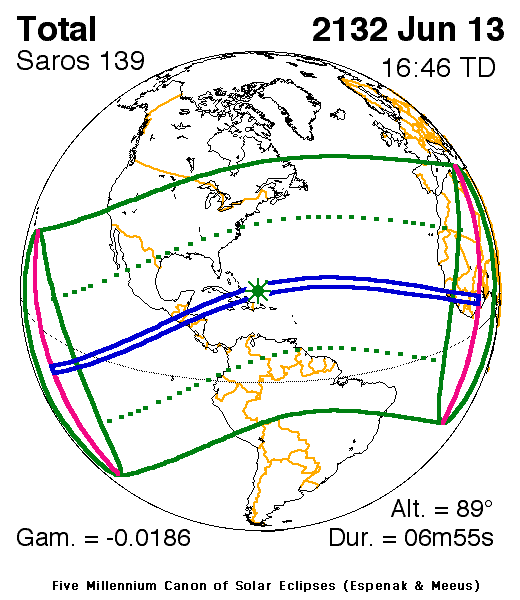
As eclipses go, this one was pretty long at nearly 7 minutes of totality. The next one having this comparable level of totality won't occur until 2132. Those of us still around will be just a bit decrepit by then :-)
Clicking on individual thumbnails in each post will open up the page for reading.
Part 1, which was the only part available when I did my original post, was pretty funny, and so perhaps expectations may have been set too high for parts 2 and 3. It is hard to do "funny" consistently, but the entire story was well done and definitely worth taking the time to read. [1]
A couple of minor editorial quibbles -- I noticed that at least once, the word "manic" was used instead of the correct "maniac". These text problems didn't really detract from the story, because there weren't too many. They may have been due to the artist's understandable desire to finish the friggen thing.
My favourite bits were the ongoing gag of Dick's adolescent reaction to busty superheroines in skintight costumes (pages 4, 9, 17, 19, 35) and the reunion of the Batbaby with its mother (page 44).
My one question (which will undoubtedly cause me to lose all my comic book nerd street cred) is - who was Cassandra (page 11)?
The real reason why I like this story is the underlying warning against overcoming one's own inadequacies or solving one's own issues by passing these things down one generation and having one's son(s) bear the weight of expectation to do it properly. As the story illustrates, this not a good model of child-rearing at all.
Not a bad bit of insight from something meant to be funny and fluffy.
Notes [1] The assumptions I make, of course, are that the prospective reader have a sense of humour and at least some affinity for and knowledge of the DC Comics universe, of which Batman and Sons in general and this story "Rivalry" specifically are a parody.
On Science.com's classified ads section, the following ad appears -- "For sale one Lunar Rover $500,000.00 no offers. One careful owner low mileage buyer collects. Cash offer and I will throw in a camera."
Given the original lunar rover development, manufacturing, and shipping costs, the price of half a mil is pretty good. The camera (a vintage Hasselblad, I believe) is definitely an added bonus.
A couple of problems aside from considerations of title -- the ad doesn't make clear which of three possible rovers is being offered -- there is one at Hadley Rille, one on the Descartes Highlands, and one at Taurus-Littrow. Oh, and I suppose the biggest problem given the "buyer collects" provision -- the locations of all three rovers (and the camera) are on the moon.
Photo credit above -- NASA/Apollo 15 -- photo taken by David R. Scott or James B. Irwin at the Hadley Rille on Earth's moon.
UPDATE - I added the link to Second Draft in "the Usual Suspects" section with a "Jill Lum" description, and in the "Skiffy" section with a "Michael Skeet and Jill Snider Lum" description.
As far as the first one, not very many of them are actually available in Canada. However, I am sure we have substitutes. The Domino’s Chicken Carbonara Pasta Bread Bowl, for example, sounds a lot like like something introduced at KFC recently -- a bowl (but not a bread bowl) with fried chicken, mashed potato, corn, gravy, and cheese -- just the thing to make up for a lipid deficiency. And I am happy to put a Double Big Mac up against a Triple Whopper with cheese.
Bad though they are, these are all best selling products because we are evolved to want sugar (in this case carbs) and fat -- and these products mainline their delivery to us like heroin from a junkie's needle.
Based on the other list, it sounds like one of the best food experiences that we could have would be to start outside on a sunny day with an edamame bean appetizer leading up to eating a lot of turkey. The accompaniments would be a lentil salad and a spinach salad, followed by a chocolate banana dessert. The sunny day would allow us the manufacture vitamin D through direct exposure to sunlight. All the other foods would max out tryptophan and folate (a vitamin B compound), and the net result would be a lot of happy people. Gotta try this...
My cousin Anne sent photos of the combined birthday celebration held this past Sunday the 19th for Nina (age 4 at the beginning of August) and Leo (age 2 last week).
Anne reports that she had a hard time trying to get Leo to wear his birthday shirt (he usually wears cotton tshirts) - however, as soon as he saw his cake, he was so mesmerised, he finally allowed it to be buttoned up! Leo tried to pick all the decorations and candle off of his cake - clearly a young man with an eye to the main chance. Nina was a little princess with her dress and her "grown up shoes"!
Thanks to Anne for sharing the party pictures. It is wonderful to get these by e-mail. Have I mentioned recently that I love technology??


 Posts
Posts