Recently, I had to buy a length of network cable for $22 from Staples. I resented the price, until I saw this offering:
For *only* $500 you can buy a cable made by Denon, composed of "pure copper". Presumably that price is in US dollars so all us Canuckie types will need to add roughly 20 percent - call it $600 loonies for discussion purposes.
And why would anyone pay $600 for a cable?
Well -- this product will allow you to "Get the purest signal from multi-channel DVD and CD playback through Denon receiver". One way that it achieves this is that the "Connector and cable structure designed to thoroughly eliminate adverse effects from vibration". Because, ya know, vibration causes all those little electrons to jostle together and not get to where they are supposed to go. Clearly, a product designed for audiophiles who operate at a level that I can barely imagine.
But don't take my word for this -- read the reviews. There are others, who like me, stand in awe and amazement at this product, and anyone who would buy it.
UPDATE - Audioquest make an ultra-deluxe speaker cable for $6800. This relegates the Denon offering to the little leagues. The $22 network cable I was bitching about doesn't even register. People who use this product probably aren't even in the same species as those of us who meet our cabling needs from the Dollar Store.
Sunday, May 24, 2009


Wednesday, May 20, 2009
The Dangers of Re-use
In complete contravention of what the bottled water people say is safe usage, I re-use my plastic water bottle many times before it usually ends up being thrown out, typically by someone else. Of course, bottlers of water have no vested interest in making sure that you buy more bottles instead of using the one you have, nosirree.
The latest study from the plastics industry (news article here) showing health problems with re-usable bags strikes me the same way. No bias from this source, either.
On the other hand, I am probably not going to be incredibly sympathetic to someone who got sick because because they brought vegetables home in a bag that they had previously used to transport used diapers. Those cloth bags are in fact washable as well as re-usable.
Sunday, May 10, 2009
Finally, the Star Trek movie!
This movie is worth seeing, and probably more than once. We watched this down at the Beaches Cinema yesterday. All three of us thought this was a good movie, although (as usual) I have issues. I had vague thoughts about taking the day off to line up and watch the first showing on Friday, but those never got past the vague thoughts stage. If this were 20 years ago, I would have done it, no question.
The review in the Toronto Star is generally positive.
Here are some of the issues (possible spoiler warnings) --
Delta Vega is fairly close to the energy barrier at the galaxy's edge, not between Earth and Vulcan.
"Red Matter"? WTF? This substance is used to initiate a black hole collapse. It should have been straightforward to insert a reference to dark matter here.
Replacing a planet with an equivalent mass black hole doesn't create an instant "vacuum cleaner" effect.
Most serious - a supernova explosion won't destroy a planet in the way that it is shown to occur.
However, the rationale behind the "reboot" is well done -- it allows therm to acknowledge all of the existing history without necessarily being tied to it.
After the disasters of Star Trek Insurrection and Star Trek Nemesis, this movie franchise needed a good entry to lift it back up - and this movie is it. Star Trek nerds can rejoice.
Tuesday, May 05, 2009
Cinco de Mayo, times ten
Today is Cinco de Mayo, a holiday held in high regard by our friends Angel and Bill on account of Angel's Mexican roots and Bill's many years of traveling there. But today is also Corwin's tenth birthday, which will occur at 8:26AM, about half an hour from when I am writing this.
Ten years ago at this moment, Jill was having the worst part of her labour, having already gone through more than twelve hours of it. To get to the hospital in time to be part of my son's birth, I had left my project in Detroit, and had traveled back by car overnight.
From those first moments of that small, helpless baby, it is amazing to think that ten years have gone by, and the wisecracking boy of today is the same child.
Friday, May 01, 2009
May Day baby
Our friends Dave and Marianna, whose wedding we attended a couple of years ago, had a baby girl overnight!
Congratulations to Marianna (who did all the recent hard work) and Dave, and welcome to Maia Willow!

Corwin's response to the photo above was "Mwaaahaaahaaa! Soon, another geek like us!"
Congratulations to Marianna (who did all the recent hard work) and Dave, and welcome to Maia Willow!

Corwin's response to the photo above was "Mwaaahaaahaaa! Soon, another geek like us!"
Thursday, April 30, 2009
Things That Go BANG In The Night
A gamma ray burster detected a week ago by the NASA Swift satellite and designated GRB 090423 (CNN article here) marked the discovery of the oldest known object in the Universe -- a supernova of a giant star about 600 million years after the beginning of the Universe itself. This object is about 13 billion light years away (red shift z = 8.2), about a billion or more light years more distant that the most distant quasars (z around 5 or 6). This object is important because it and others like it will provide a way to probe the earliest generations of stars formed in the cosmos.
A more recent bang in the sky was SN 1006 -- a star about 7,000 light years away that went supernova on April 30, 1006 -- 1,003 years ago. For calendar nazis, I understand that today is not the actual anniversary due to the Julian-to-Gregorian conversion. This object was somewhat smaller in scale than the GRB 090423 blast, but still pretty substantial, making it very probably the brightest star (other than the sun) seen by human eyes.

Above, the Chandra image in x-rays of the supernova remnant a thousand years after the blast. The bubble has expanded to a diameter of 20 parsecs -- over 60 light years. Below, a Hubble image of a ribbon of gas and dust from the same nebula.

A more recent bang in the sky was SN 1006 -- a star about 7,000 light years away that went supernova on April 30, 1006 -- 1,003 years ago. For calendar nazis, I understand that today is not the actual anniversary due to the Julian-to-Gregorian conversion. This object was somewhat smaller in scale than the GRB 090423 blast, but still pretty substantial, making it very probably the brightest star (other than the sun) seen by human eyes.
Above, the Chandra image in x-rays of the supernova remnant a thousand years after the blast. The bubble has expanded to a diameter of 20 parsecs -- over 60 light years. Below, a Hubble image of a ribbon of gas and dust from the same nebula.
Monday, April 27, 2009
Tracking Swine Flu using Google Maps
View H1N1 Swine Flu in a larger map
Infectious cases of the H1N1 Swine Flu—a mutation of a pork virus that jumped from pigs to humans—happened in Mexico City in March, and are spreading over the world thanks to the ubiquity of modern air travel.
On the map, the pink markers are suspect, the purple markers are confirmed, and deaths don't have a black dot in the marker. The yellow markers are negative.
People in Toronto are all too familiar with this, having gone through the SARS near-pandemic from 2002 to 2003. As of today, the number of swine flu cases worldwide exceed 2,000 -- a substantial percentage of the total SARS cases (over 8,000).
SARS had a pretty significant negative impact on the economy of the city of Toronto, and more generally, the world. The current swine flu outbreak is happening in the midst of a global recession, so I expect it will be a force acting to make the overall economic impact worse.
I have no idea who the creator of the map is, although the profile of the anonymous creator shows a reference to biomedical research.
Sunday, April 26, 2009
Star Trek Advance Reviews
The hype machine has ramped up this week. An advance review on CNET dated April 22 from a writer who describes herself as a Star Trek virgin provides reassurance that the new Star Trek movie will appeal to people who have never seen any of the series or the movies.
For hardcore fans like all in this household, the Gizmodo review is more meaningful. "Star Trek will disappoint no one." he begins, and goes on to enumerate the reasons why. My favourite quotes from the review:
The Star Wars cheap shot --
On updating the look and feel --
To paraphrase one of the Usual Suspects, I like thighs. They're juicier.
For hardcore fans like all in this household, the Gizmodo review is more meaningful. "Star Trek will disappoint no one." he begins, and goes on to enumerate the reasons why. My favourite quotes from the review:
The Star Wars cheap shot --
As the lights dimmed and the familiar Star Trek Federation logo slid on screen, the emotion of all those hours of watching Next Generation reruns as a kid came sloshing back into my brain, dripping out of my eyes as tears of pure happiness. I expect that it was essentially the same emotion Star Wars fans felt during the opening credits of Episode 1, but without the massive letdown afterwards. (Ha ha, suckers.)
On updating the look and feel --
That's not to say Star Trek is now gritty—it's just more...modern. And more sexy. Like when you upgrade from a six piece KFC meal to a 12 piece bucket: you're going to get more breast and thigh.
To paraphrase one of the Usual Suspects, I like thighs. They're juicier.
Saturday, April 11, 2009
Just Call Me Joe-Bob
A few days ago, Ramey Ko of the Association of Chinese Americans was testifying before the State Elections Committee of the State of Texas in the US. In response to Ko's testimony regarding problems that Americans of Chinese, Japanese, and Korean descent have in voter identification in elections, State Representative Betty Brown, a Republican member of the Texas State Legislature representing District 4 (Athens/Terrell) said the following:
Additional source for this story here.
I am not Texan, or even American, but I just have to comment on this.
Brown's remarks undoubtedly summarize the intellectual position of at least some portion of the American population. And there are bound to be people of similar minds on this side of the border. I am reminded of the difficulties that I had growing up with a Chinese name -- one that was very different from the Anglo-Saxon mainstream. At my first job when I was a teenager, the advice given to me (I worked in in a telephone sweatshop) was that I should identify myself using a name that was more consumer-friendly.
However, that was then and this is now. Brown's colleague, Representative Trey Martinez Fischer and the people who run the Rum and Monkeys website have made available the "Betty Brown Name Generator", a web application that will help anyone with a name that is non traditional (or at least non traditional in Betty Brown's judgement) replace their name with one that people like Ms. Brown would understand and would identify with.
I am very pleased to report the following result from the Betty Brown Name Generator for me:
Y'all should call me "Joe-Bob", although if we are in a business meeting together, you could call me "J.B." At parties and in public, I will continue to respond to "hey you". While I have issues with being called "WalMart", y'all could call me "Wally" if y'all needed a nickname.
I can't help thinking that Betty Brown's problem with some names might be due to their (relatively larger) number of syllables as well as cultural context with which Ms. Brown may lack familiarity, even though she is an elected government official in a state of the wealthiest (and theoretically best educated) nation on Earth.
The Betty Brown Name generator can be seen to therefore have some wider application. In addition to the modifications to biology and astronomy textbooks that will be required to implement the position taken by the Board of Education of the State of Texas on intelligent design versus conventional scientific theories of cosmic origin and biological evolution, there could be similar rewritings of history textbooks as follows:
- replace "George Washington" with Forrest "Pabst Blue Ribbon" Brown. Even though General Washington is a Founding Father of the great nation of America, his name does have too many syllables in it for easy comprehension. Also, if this change is made, George Washington Carver can be Forrest Blue Brown Carver. Texas history books could thus immediately identify Dr. Carver as a man of colour by his name alone.
- replace "Benjamin Netanyahu" with Billy-Ray "Chicken and Dumplings" Brown. Although a long-time ally of the United States, Mr. Netanyahu's Hebrew name also has way too many syllables and "Benjamin" just makes him sound stuck up. Discussing Middle East history of the last few decades and how they were driven by an American ally named Billy-Ray should make this subject both more comprehensible and sympathetic to students in Betty Brown's Texas. Also, the "Chicken and Dumplings" nickname can be a vehicle by which the Texas educational system introduces the richness of Jewish heritage and culture and in particular, matzoh ball soup to ordinary Americans. But instead of forcing those ordinary Americans to learn the Hebrew word "matzoh", they could move with immediate understanding to "Chicken and Dumplings".
- don't replace "J. Robert Oppenheimer" with Joe-Bob "Cracker Barrel" Brown. Even though this distinguished American physicist and I share the same Betty Brown approved name (except for the nickname), Oppenheimer was attacked by Senator Joseph McCarthy, and in a Betty Brown world, it would be inappropriate to give him a name that makes him more like a "real American". (In the Sarah Palin sense of the term "real American").
- replace "Subrahmanyan Chandrasekhar" with Billy-Ray "Cracker Barrel" Brown. This American physicist of Indian origin for whom the Chandra Space Telescope is named clearly has way too many syllables in a name which would be incomprehensible to people living in the world of Betty Brown. Therefore, physics textbooks in Texas can make reference to the "Cracker-Barrel Limit" instead of the Chandrasekhar Limit for calculation of the upper bound of stars which can collapse to form a white dwarf star. Keep in mind though that all this long-hair stuff is only a theory -- you know, like evolution. Or the Germ Theory of Disease. Or gravitation.
- and for goodness sake, definitely replace the names of Samuel Chao Chung Ting, Yao Ming and Kalpana Chawla. Real Americans in Betty Brown's Texas can't believe that people with names like these could win a Nobel Prize and be on the staff of a major scientific facility intended to be in Texas, or play basketball in Texas, or die in a space shuttle accident over Texas.
Betty Brown's remarks have done a lot to demonstrate the care and commitment that she feels toward people of Chinese descent, as well as to show the seriousness and credibility of some members of the Texas State Legislature. I, Joe-Bob Brown, her spiritual brother, wish her the very best political future that her remarks have shown that she deserves.
"Rather than everyone here having to learn Chinese — I understand it's a rather difficult language — do you think that it would behoove you and your citizens to adopt a name that we could deal with more readily here?"
Additional source for this story here.
I am not Texan, or even American, but I just have to comment on this.
Brown's remarks undoubtedly summarize the intellectual position of at least some portion of the American population. And there are bound to be people of similar minds on this side of the border. I am reminded of the difficulties that I had growing up with a Chinese name -- one that was very different from the Anglo-Saxon mainstream. At my first job when I was a teenager, the advice given to me (I worked in in a telephone sweatshop) was that I should identify myself using a name that was more consumer-friendly.
However, that was then and this is now. Brown's colleague, Representative Trey Martinez Fischer and the people who run the Rum and Monkeys website have made available the "Betty Brown Name Generator", a web application that will help anyone with a name that is non traditional (or at least non traditional in Betty Brown's judgement) replace their name with one that people like Ms. Brown would understand and would identify with.
I am very pleased to report the following result from the Betty Brown Name Generator for me:
My Betty Brown Approved Name is Joe-Bob "WalMart" Brown.
Try The Betty Brown Name Generator yourself!
Created with Rum and Monkey's Name Generator Generator.
Y'all should call me "Joe-Bob", although if we are in a business meeting together, you could call me "J.B." At parties and in public, I will continue to respond to "hey you". While I have issues with being called "WalMart", y'all could call me "Wally" if y'all needed a nickname.
I can't help thinking that Betty Brown's problem with some names might be due to their (relatively larger) number of syllables as well as cultural context with which Ms. Brown may lack familiarity, even though she is an elected government official in a state of the wealthiest (and theoretically best educated) nation on Earth.
The Betty Brown Name generator can be seen to therefore have some wider application. In addition to the modifications to biology and astronomy textbooks that will be required to implement the position taken by the Board of Education of the State of Texas on intelligent design versus conventional scientific theories of cosmic origin and biological evolution, there could be similar rewritings of history textbooks as follows:
- replace "George Washington" with Forrest "Pabst Blue Ribbon" Brown. Even though General Washington is a Founding Father of the great nation of America, his name does have too many syllables in it for easy comprehension. Also, if this change is made, George Washington Carver can be Forrest Blue Brown Carver. Texas history books could thus immediately identify Dr. Carver as a man of colour by his name alone.
- replace "Benjamin Netanyahu" with Billy-Ray "Chicken and Dumplings" Brown. Although a long-time ally of the United States, Mr. Netanyahu's Hebrew name also has way too many syllables and "Benjamin" just makes him sound stuck up. Discussing Middle East history of the last few decades and how they were driven by an American ally named Billy-Ray should make this subject both more comprehensible and sympathetic to students in Betty Brown's Texas. Also, the "Chicken and Dumplings" nickname can be a vehicle by which the Texas educational system introduces the richness of Jewish heritage and culture and in particular, matzoh ball soup to ordinary Americans. But instead of forcing those ordinary Americans to learn the Hebrew word "matzoh", they could move with immediate understanding to "Chicken and Dumplings".
- don't replace "J. Robert Oppenheimer" with Joe-Bob "Cracker Barrel" Brown. Even though this distinguished American physicist and I share the same Betty Brown approved name (except for the nickname), Oppenheimer was attacked by Senator Joseph McCarthy, and in a Betty Brown world, it would be inappropriate to give him a name that makes him more like a "real American". (In the Sarah Palin sense of the term "real American").
- replace "Subrahmanyan Chandrasekhar" with Billy-Ray "Cracker Barrel" Brown. This American physicist of Indian origin for whom the Chandra Space Telescope is named clearly has way too many syllables in a name which would be incomprehensible to people living in the world of Betty Brown. Therefore, physics textbooks in Texas can make reference to the "Cracker-Barrel Limit" instead of the Chandrasekhar Limit for calculation of the upper bound of stars which can collapse to form a white dwarf star. Keep in mind though that all this long-hair stuff is only a theory -- you know, like evolution. Or the Germ Theory of Disease. Or gravitation.
- and for goodness sake, definitely replace the names of Samuel Chao Chung Ting, Yao Ming and Kalpana Chawla. Real Americans in Betty Brown's Texas can't believe that people with names like these could win a Nobel Prize and be on the staff of a major scientific facility intended to be in Texas, or play basketball in Texas, or die in a space shuttle accident over Texas.
Betty Brown's remarks have done a lot to demonstrate the care and commitment that she feels toward people of Chinese descent, as well as to show the seriousness and credibility of some members of the Texas State Legislature. I, Joe-Bob Brown, her spiritual brother, wish her the very best political future that her remarks have shown that she deserves.
Tuesday, March 31, 2009
Coraline - Two Thumbs Up
We went on a family expedition down to the Beaches theatre on Saturday to see Coraline. It was a fine movie, and despite the fact that it is a true horror film, did not cause any squickiness.
It has been a while since I read Neil Gaiman's (children's) novel on which this movie is based. All of the important elements are present: Coraline's busy parents (whom I seem to remember were computer programmers in the book not gardeners as they are in the movie), the aging actress sisters, the mouse circus trainer. And of course, Coraline's Other Mother on the other side of the doorway. The horror is elegant and gradual, like a slowly tightening web.
Coraline is brave, determined, and intelligent -- exactly what every parent hopes their own child will be. She makes mistakes, but she works to overcome their consequences.
For most of the movies I watch, I generally have quibbles about the story they tell. Usually, writers or directors manage to do something to break my suspension of disbelief. I did not have any quibbles about this one.
This movie is definitely recommended.
Monday, March 30, 2009
A Modest Art Installation Proposal
We drove by the Art Gallery of Ontario earlier on Sunday. The new renovation has been completed and is open. Seeing this got me to thinking about the neighbourhood. The Ontario College of Art and Design is immediately south of the Art Gallery and the Sharp Centre For Design, part of OCAD, is also a striking piece of architecture -- it is built to resemble a giant table, looming over the other buildings around it.
I first saw this OCAD building a few years back from a vantage point further south, when I was visiting my cousin at a place he was looking after for a friend.
Given that the OCAD building resembles a table, I propose the following art installation:
On the roof of the OCAD building, at each of the sides of this giant table, create a place setting at an appropriate scale, consisting of a plate, a cup, a bowl, a knife, a fork, and chopsticks.
These place settings would be visible from all around the OCAD building - basically, from any structure higher than its roof. Each place setting would represent a particular group - for example, politicians, the economic elite, homeowners, and the homeless. But I propose sufficient ambiguity in the design to allow viewers to create their own symbolic OCAD dinner party.
I can't possibly be the first one to have had this idea -- someone should do it!
Tuesday, March 24, 2009
2009 Hugo Nominations
The 2009 Hugo Award nominations list has been out for nearly a week. Among the Usual Suspects, it was not surprisingly (but disappointing nonetheless) Jill's and Michael's story didn't make the cut. Nor did Dave's story. However, what was very very surprising (and very very disappointing) was that Karl's novel Pirate Sun failed to make it onto the ballot.
The good news, however, is that Metatropolis, an audiobook that Karl co-authored, was nominated -- the first audiobook to be nominated for the Hugo.
Tesseracts Twelve contributor Gord Sellar is up for the John W. Campbell award.
And finally, local fan artist Taral Wayne whom I have known for nearly thirty years, was nominated for the Fan Artist Hugo.
Sunday, March 08, 2009
Latest Star Trek trailer!
The last movie was a disaster. This movie, upcoming, is supposed to reboot the series. I am looking forward to it, although with some trepidation.
Saturday, March 07, 2009
Chang'e Lunar Mission Ends, Kepler Launched
Earlier this week, the Chang'e 1 lunar reconnaissance mission came to an end when controllers crashed the spacecraft onto the lunar surface. Launched by the Chinese National Space Agency on October 24, 2007, the probe spent 16 months sending back high resolution surface images of the moon. The moon has been the focus of a number of recent Asian space probes -- in addition to Chang'e, Japan's SELENE and India's Chandraayan are both still in lunar orbit and operational.
Late yesterday, NASA launched the Kepler spacecraft. Eventually destined for an orbit trailing the Earth around the sun, Kepler's mission is to conduct a telescopic search for planets around other stars by measuring tiny brightness fluctuations in a large number of stars over a period of years.

The above photo shows the Delta 2 rocket (Image credit: NASA/Jack Pfaller) carrying the Kepler spacecraft just after liftoff from Cape Canaveral last night.
Wednesday, March 04, 2009
That's no moon....
A new moon of Saturn is discovered.

In the sequence of three images above, obtained by NASA's Cassini spacecraft over the course of about 10 minutes on October 27, 2008, you can see the path of a newly found moonlet in a bright arc of Saturn's faint G ring. The moonlet was initially seen in Cassini images from last August.
In each image, a small streak of light within the ring is visible. Unlike the streaks in the background, which are distant stars smeared by the camera's long exposure time of 46 seconds, this streak is aligned with the G ring and moves along the ring as expected for an object embedded in the ring.
Cassini scientists interpret the moving streak to be reflected light from a tiny moon half a kilometer wide that is likely a major source of material in the arc and the rest of the G ring. Debris knocked off this moon forms a relatively bright arc of material near the inner edge of the G ring, the most visible part of the ring in these images. That arc, in turn, leaks material to form the entire ring.
This view looks toward the un-illuminated side of the rings from about 5 degrees above the ringplane. The view was acquired at a distance of approximately 1.2 million kilometers from Saturn and at a sun-Saturn-spacecraft, or phase, angle of 23 degrees.
Image scale for the first image is 7 kilometers (4 miles) per pixel. The second and third images were taken at further reduced resolution. This is definitely nowhere near the level of detail required to show surface features.
The Cassini mission has been extended until 2010, and if the spacecraft continues to function correctly, may be extended again.

Image credit: NASA/JPL/Space Science Institute
In the sequence of three images above, obtained by NASA's Cassini spacecraft over the course of about 10 minutes on October 27, 2008, you can see the path of a newly found moonlet in a bright arc of Saturn's faint G ring. The moonlet was initially seen in Cassini images from last August.
In each image, a small streak of light within the ring is visible. Unlike the streaks in the background, which are distant stars smeared by the camera's long exposure time of 46 seconds, this streak is aligned with the G ring and moves along the ring as expected for an object embedded in the ring.
Cassini scientists interpret the moving streak to be reflected light from a tiny moon half a kilometer wide that is likely a major source of material in the arc and the rest of the G ring. Debris knocked off this moon forms a relatively bright arc of material near the inner edge of the G ring, the most visible part of the ring in these images. That arc, in turn, leaks material to form the entire ring.
This view looks toward the un-illuminated side of the rings from about 5 degrees above the ringplane. The view was acquired at a distance of approximately 1.2 million kilometers from Saturn and at a sun-Saturn-spacecraft, or phase, angle of 23 degrees.
Image scale for the first image is 7 kilometers (4 miles) per pixel. The second and third images were taken at further reduced resolution. This is definitely nowhere near the level of detail required to show surface features.
The Cassini mission has been extended until 2010, and if the spacecraft continues to function correctly, may be extended again.
Hugo Nominations
I almost forgot to submit my nominations ballot for the Hugo Awards by the midnight February 28 deadline. But I did manage to get my ballot in with about a half hour to spare (gotta love online voting). Now to see whether the rest of the world agrees with me...
Sunday, March 01, 2009
Force Projection
I went to the Ontario Science Centre with Corwin's class field trip on Friday. There is a special exhibit on currently called Sultans of Science, and one of the displays reminded me of something that I noted over Christmas and had been meaning to write about.
The display that got my attention was about Zhang He -- born to a Hui Muslim family in Yunnan Province but captured as a boy and delivered to the imperial capital in Beijing where he grew up to become one of the greatest mariners in history. Zhang He was the admiral who led 7 Chinese expeditions consisting of hundreds of ships and thousands of men into the Indian Ocean in the early 1400's, and possibly around the Cape of Good Hope into the Atlantic. The last of these expeditions was in 1433. After Zhang He's time, the Ming dynasty gave up naval development, and Chinese sea power became a thing of the past.
In late December 2008 -- 575 yesrs after the last voyage of Zhang He -- the Chinese navy sent a flotilla consisting of two destroyers and a supply ship to join the international force currently patrolling the Gulf of Aden off the coast of Somalia. This area has achieved some notoriety by the actions of Somali based pirates who have attacked shipping, and captured various merchant ships which have been held for ransom.
Canada had a naval presence here, in the form of Task Force Arabian Sea, consisting of (mid 2008) the frigates HMCS Ville de Québec and HMCS Calgary; the destroyer (and command ship) HMCS Iroquois; the supply ship HMCS Protecteur. Canada led Combined Task Force (CTF) 150 from the beginning of June 2008 until handing off to the Danes in the middle of September. CTF 150 was a multinational naval coalition that operated from the Red Sea to the Strait of Hormuz, through the Gulf of Aden, the Gulf of Oman and the Arabian Sea as far south as the coast of Kenya. The Canadian part of this effort was called Operation Altair. In January 2009, CTF 150 was replaced by CTF 151, an American-led international initiative.

Chinese participation in the protection of merchant shipping in the Gulf of Aden consists of the missile-armed destroyers DDG-171 Haikou (photo above) and DDG-169 Wuhan, and the supply ship Weishanhu. These are reported to be among China’s most sophisticated vessels, having all entered service this decade. They will operate alongside other international warships, including the Canadian frigate HMCS Charlottetown, patrolling the area near the Gulf of Aden, part of the Suez Canal route.
The Chinese news agency Xinhua has said that the fleet will mainly protect Chinese vessels, including those from Hong Kong, Macau and Taiwan, but will also escort foreign ships passing through the area on request. After three months the ships will be replaced by another flotilla, depending on UN Security Council decisions and the situation at the time. China has said its warships will investigate any suspected pirate vessels, and approach them and demand that they show their relevant documents and certificates.
The three ships of the Chinese flotilla left Hainan Island on December 26, and within days passed through the Strait of Malacca, arriving in Somali waters by January 6. Upon arrival, they immediately began their escort duties. In the last two months, they have conducted over twenty escort runs each involving multiple ships, including protection of at least one Taiwanese ship and rescue of an Italian freighter.
These types of operations will give the Chinese navy an opportunity to develop and practice their blue water capability -- the ability to operate far from home for extended periods of time. The developing Chinese space program will make similar demands, requiring tracking ships to be deployed at long distances to support communications with orbital missions.
Tuesday, February 24, 2009
Comet Lulin Appears
Comet Lulin (C/2007 N3) is a comet discovered by Quanzhi Ye, a student at Sun Yat Sen Universty from sky photos taken at Taiwan's Lulin Observatory. About 20 hours ago around 0300 ET in the early morning of Feb 24, the comet made its closest approach to Earth at a distance of 0.41 AU.
The comet appears to be a first time visitor to the inner solar system. The NASA Swift Ultraviolet and X-Ray Explorer has been used to get images of the comet at ultraviolet and x-ray wavelengths. The data from Swift shows that it is shedding water at a rate of 3,000 litres per second (enough to fill an Olympic-sized swimming pool in about 15 minutes), and surrounded by a Jupiter-sized cloud of cyanogen and diatomic carbon, glowing green as these compounds fluoresces in sunlight.
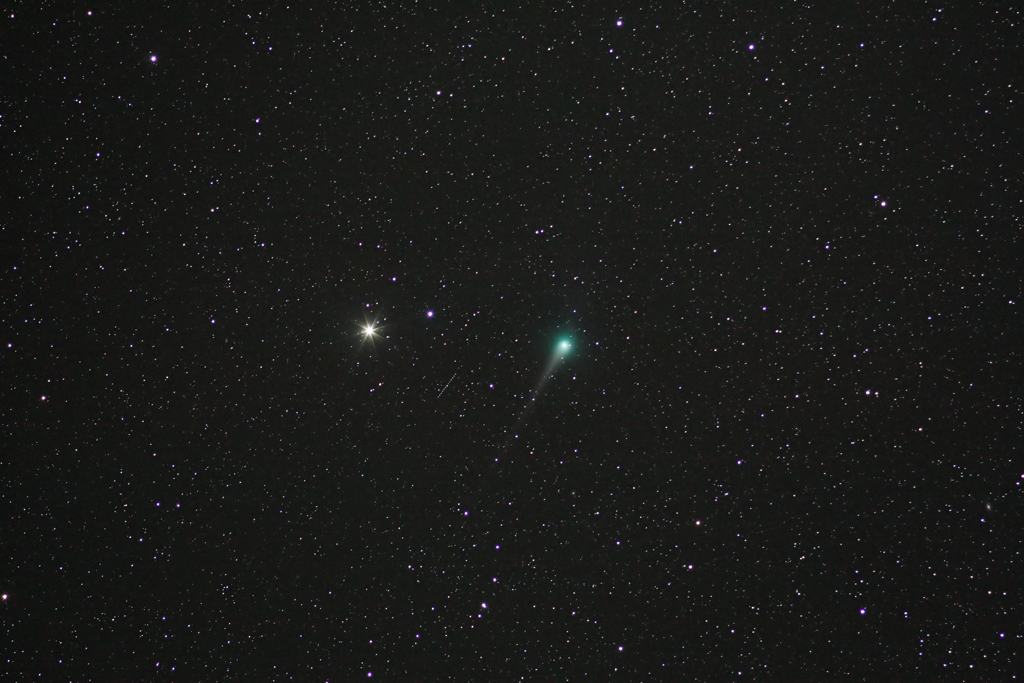
This amazing photo was taken by Joe Wheelock of Fort Davis, Texas, USA, a couple of hours before the closest approach. He has the following notes:
The orbital path of Comet Lulin can also be visualized using the small body database maintained by JPL.
Comet Lulin currently has a brightness of visual magnitude +5.5. This level of brightness will drop over time for two reasons - first, due to increasing distance as the comet gets farther away from us. The second reason for a drop in brightness is a change in the amount of light reflected by the comet. As the comet reaches perihelion and starts moving farther from the sun, the amount of material blown off by heat and solar radiation will decrease, and the comet's extended halo and tail will decrease in size resulting in less light being reflected.
At +5.5, Comet Lulin will be difficult to spot in Toronto with the naked eye, although it should be fairly easy to see with binoculars for the next few days. Darker locations away from the middle of a city, like Lake Herridge, or Almonte, or the middle of Saskatchewan will be more ideal.
The comet appears to be a first time visitor to the inner solar system. The NASA Swift Ultraviolet and X-Ray Explorer has been used to get images of the comet at ultraviolet and x-ray wavelengths. The data from Swift shows that it is shedding water at a rate of 3,000 litres per second (enough to fill an Olympic-sized swimming pool in about 15 minutes), and surrounded by a Jupiter-sized cloud of cyanogen and diatomic carbon, glowing green as these compounds fluoresces in sunlight.
This amazing photo was taken by Joe Wheelock of Fort Davis, Texas, USA, a couple of hours before the closest approach. He has the following notes:
I think I caught a tumbling satellite in between Comet Lulin and Saturn in this picture. Photo Details: Comet Lulin and Saturn Taken on Feb. 24, 2009 (12:05 A.M. CST) with 105mm Sigma telephoto piggybacked on my 16inch F/4.5 Newtonian Telescope Canon XSi DSLR 120sec. exp @ISO 1600 f/3.5. Image processed with Adobe Photoshop CS3, Digital Photo Professional, Blackframe Noise Reduction and Neat Image. In between Saturn and the comet appears to be a tumbling satellite?
The orbital path of Comet Lulin can also be visualized using the small body database maintained by JPL.
Comet Lulin currently has a brightness of visual magnitude +5.5. This level of brightness will drop over time for two reasons - first, due to increasing distance as the comet gets farther away from us. The second reason for a drop in brightness is a change in the amount of light reflected by the comet. As the comet reaches perihelion and starts moving farther from the sun, the amount of material blown off by heat and solar radiation will decrease, and the comet's extended halo and tail will decrease in size resulting in less light being reflected.
At +5.5, Comet Lulin will be difficult to spot in Toronto with the naked eye, although it should be fairly easy to see with binoculars for the next few days. Darker locations away from the middle of a city, like Lake Herridge, or Almonte, or the middle of Saskatchewan will be more ideal.
Monday, February 23, 2009
Feedback Controls
A big chunk of my work life has been in the automotive finance industry, but I can't really say that I am a car guy. A car is a necessary evil, not the raison d'etre of existence.
So it was that in early January, after delivering our friend Annalee to the airport, I noticed an instrument panel light that I had never seen before. A quick check showed no flames or smoke or other serious issues, so I continued driving, and got the car home before I hauled out the manual.
This particular problem, it said, was related to the exhaust system, prompting dark thoughts about the expense of replacing a catalytic converter. According to the manual, this problem was serious and needed fixing. Or Bad Things Would Happen.
The mechanic at our favourite garage was more enlightening. It wasn't the catalytic converter -- instead, it was an oxygen sensor. Of which there were three -- two in the engine itself, one in the exhaust. Our failure was the one in the exhaust.
At which point a light came on over my head. The oxygen sensor in the exhaust is the last part of a feedback loop providing information to the car's onboard computer. The computer adjusts the fuel mix until it achieves a preset level of oxygen in the exhaust, indicating that a predesgned fuel to air ratio had been achieved. The system is designed to monitor the output so that the input can be tweaked. Leaving this uncorrected would have meant that the car would have been doing strange things to the fuel mixture -- potentially damaging the engine, but certainly not optimizing for fuel consumption efficiency.
So, a feedback loop. A useful idea -- one could imagine monitoring the activity of, say, a financial institution and its effect on the economy. Then tweaking the government bailout money going in until the required output goals were achieved. Or one could imagine feeding bailout money into the auto industry based on what kind of vehicles it was producing -- set the feedback loop to optimize for fuel efficiency and low carbon emissions.
Saturday, February 21, 2009
The Avro Arrow

Fifty years ago yesterday, on February 20, 1959, the Canadian government of Prime Minister John Diefenbaker cancelled the development of the CF-105 fighter plane -- the aircraft known as the Avro Arrow.
In hindsight, the Arrow was just another 1950s era fighter plane, although for its time, it was the fastest and most advanced. And while it is possible to debate the upsides and downsides of the aircraft (fast, great climb rate, potentially capable of Mach 3+ on the upside versus heavy, high drag, low manueverability on the downside) it is the cancellation of the aircraft that results in one of the "might-have-been" myths of our shared Canadian experience. What might it have been, what could we have achieved, if the Arrow had gone forward to full production?
Cancellation of the Arrow project led to a lot of engineering talent moving south, and enormously benefiting the American space program. It also ensured the loss of an entire industrial sector -- Canada never again produced its own domestic military aircraft.
The lesson is an outsourcing lesson -- the country gave up some existing capability to save money. In doing so, it also shut down some future possibilities. In just the same way, a company which outsources its IT, or its manufacturing, or its marketing in order to realize some immediate bvenefits will give up some future capabilities -- and in fact will make it impossible to travel down some possible paths.

Subscribe to:
Posts (Atom)

 Posts


