Tuesday, July 28, 2009

HMCS Fraser

Various news sources report that Her Majesty's Canadian Ship Fraser was returned to the Royal Canadian Navy earlier this month.

Fraser -- DDH 233 -- is the last surviving ship of the St. Laurent class of destroyers. These were the first warships designed and built in Canada, and they formed the backbone of the Royal Canadian Navy during the Cold War. From the National Historic Site historical plaque aboard Fraser
Designed in 1948-1949, they influenced naval construction internationally with their smooth above-water surfaces and distinctive convex deck. They could also be sealed to protect crews against biological and radioactive threats. All seven St. Laurent-class ships were modified during the 1960s to carry helicopters and enhance their anti-submarine capability. Launched in 1953, the HMCS Fraser is the last surviving example of this innovative class of warship.

When these ships were originally designed and built, they were intended to be newer, faster, more capable versions of the River-class destroyers that the RCN used in the Battle of the Atlantic in the Second World War. Their DDE designation marked them as Destroyer Escorts - ships intended to guard a convoy or to form part of a surface battle group. In the early 1960s, they were upgraded to add the capability of launching and recovering a Sea King helicopter, which is reflected by the change from the DDE to the DDH designator. When HMCS Bonaventure, the last RCN aircraft carrier, was retired, these ships became by default the largest units in the Canadian Navy.


Photo Credit - by Stewpendous on Flickr -- HMCS Fraser moored at Bridgewater, NS


All the ships of the St. Laurent class excluding St. Laurent herself went through the DELEX (Destroyer Lifetime Extension) program in the early 1980s. This upgrade included an electronic warfare suite that allowed these older ships constructed in the decade after World War Two to function and participate in a modern battlefield, giving them tactical datalinks to allow them to mesh with allied combatant ships and aircraft.

Throughout the 1980s, Fraser was used as a testbed to evaluate technology that would be used on the Halifax-class frigates that were then being designed. But by 1994, Fraser was retired and all the other ships of the St. Laurent class-- St. Laurent DDH 205, Saguenay DDH 206, Skeena DDH 207, Ottawa DDH 229, Margaree DDH 230, and Assiniboine DDH 234 -- were scrapped or sunk.

Originally, Fraser was intended to be either a museum, or an artificial reef -- indeed, the ship was owned by the Artificial Reef Society of Nova Scotia since the mid 1990s, until funding issues caused the ship to be returned to DND and the Navy earlier this month.

The Navy now has three options -- they could could restore Fraser (as a museum, not an operational warship), break her up and sell the remains for scrap, or turn the ship into an artificial reef.

The statement from Peter MacKay, the Defense Minister, is a typical example of political vagueness: "We remain committed to developing a longer-term solution for Fraser's future." What does this actually mean?

Worst Business Model Ever

Imagine this situation - you spend thousands of dollars to outfit your home with solar panels, as well as the necessary DC-to-AC conversion technology. You do this because over the lifetime of the solar panels and associated infrastructure, you expect to buy substantially less power from the power company. In fact, this is how you would justify the purchase of the solar panels -- if you do it right, you will make back more than the cost of the technology in savings on your electricity bill.

Well, there is a utility out there (Xcel Energy in Colorado) who proposes that their customers with solar panels on their homes be charged for the electricity that they don't use -- see links here and here and here. You might expect that there is an outcry about this.

One of Xcel's customers noted of his solar panel installation that
“Mine are generating enough to feed five or six houses around me electricity, so there's no free ride.”
A solar energy consultant pointed out
“That's less energy that Xcel Energy has to produce. That's less coal that they have to burn.”

This is one of those times where you encounter something and you just have to shake your head and wonder what the heck they were thinking? In this case, think of this as a tax on progress.

Saturday, July 25, 2009

The Solar Eclipse of July 22, 2009

A total solar eclipse of the Sun occurred earlier this week on Wednesday July 22. The path of totality as illustrated by the following animation (image credit NASA/A T Sinclair), touched the Earth in India, crossed through Nepal, Bangladesh, Bhutan, Myanmar and China. After leaving mainland Asia, the path crossed Japan's Ryukyu Islands and curved southeast through the Pacific Ocean where the maximum duration of totality reached 6 min 39 sec.


The Hinode satellite captured images of the eclipse from space. Hinode is a joint science mission (also known as Solar-B) mounted by JAXA, the Japanese Aerospace Exploration Agency, and the American NASA. The following image (photo credit NASA/JAXA) shows the moon's shadow in front of a heavily filtered view of the Sun.


Another Japanese Earth-monitoring satellite MTSAT captured what I believe has to be one of the most seriously cool space images ever -- the view of the moon's shadow on the earth from geostationary orbit 35,790 km (22,240 mi) high. The image (photo credit MTSAT/GMS via Wired Science blog) shows the shadow covering the island of Taiwan. Note that Australia is pretty clear of cloud cover -- just as one would expect from the reports of drought conditions there.


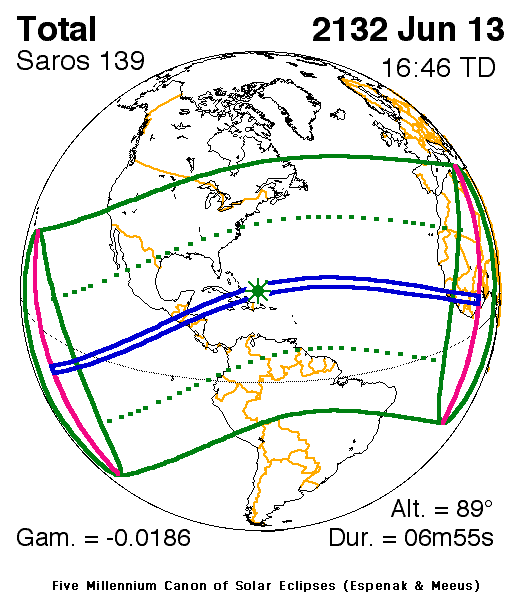
As eclipses go, this one was pretty long at nearly 7 minutes of totality. The next one having this comparable level of totality won't occur until 2132. Those of us still around will be just a bit decrepit by then :-)

Batman and Sons - Webcomic

I posted earlier about a webcomic called Batman and Sons, done by fan artist the dark cat.

He (or perhaps she) has now finished the "Rivalry" story, and it is available on the dark cat's Blogspot blog:

Part 1
Part 2
Part 3 - Conclusion

Clicking on individual thumbnails in each post will open up the page for reading.

Part 1, which was the only part available when I did my original post, was pretty funny, and so perhaps expectations may have been set too high for parts 2 and 3. It is hard to do "funny" consistently, but the entire story was well done and definitely worth taking the time to read. [1]

A couple of minor editorial quibbles -- I noticed that at least once, the word "manic" was used instead of the correct "maniac". These text problems didn't really detract from the story, because there weren't too many. They may have been due to the artist's understandable desire to finish the friggen thing.

My favourite bits were the ongoing gag of Dick's adolescent reaction to busty superheroines in skintight costumes (pages 4, 9, 17, 19, 35) and the reunion of the Batbaby with its mother (page 44).

My one question (which will undoubtedly cause me to lose all my comic book nerd street cred) is - who was Cassandra (page 11)?

The real reason why I like this story is the underlying warning against overcoming one's own inadequacies or solving one's own issues by passing these things down one generation and having one's son(s) bear the weight of expectation to do it properly. As the story illustrates, this not a good model of child-rearing at all.

Not a bad bit of insight from something meant to be funny and fluffy.

Notes
[1] The assumptions I make, of course, are that the prospective reader have a sense of humour and at least some affinity for and knowledge of the DC Comics universe, of which Batman and Sons in general and this story "Rivalry" specifically are a parody.

For Sale - One Lunar Rover, Cheap

On Science.com's classified ads section, the following ad appears -- "For sale one Lunar Rover $500,000.00 no offers. One careful owner low mileage buyer collects. Cash offer and I will throw in a camera."


Given the original lunar rover development, manufacturing, and shipping costs, the price of half a mil is pretty good. The camera (a vintage Hasselblad, I believe) is definitely an added bonus.

A couple of problems aside from considerations of title -- the ad doesn't make clear which of three possible rovers is being offered -- there is one at Hadley Rille, one on the Descartes Highlands, and one at Taurus-Littrow. Oh, and I suppose the biggest problem given the "buyer collects" provision -- the locations of all three rovers (and the camera) are on the moon.


Photo credit above -- NASA/Apollo 15 -- photo taken by David R. Scott or James B. Irwin at the Hadley Rille on Earth's moon.

Thursday, July 23, 2009

Guess Who Started Blogging??

OK, so perhaps it isn't momentous news in the grand scheme of things, but I think it is pretty cool.

My wife the author -- and now, blogger!

UPDATE - I added the link to Second Draft in "the Usual Suspects" section with a "Jill Lum" description, and in the "Skiffy" section with a "Michael Skeet and Jill Snider Lum" description.

Not immoral or illegal, just incredibly fattening

Divine Caroline has an article about the Ten Worst Artery Cloggers in America. At the same time, they also have an article on Ten Foods That Will Improve Your Mood.

As far as the first one, not very many of them are actually available in Canada. However, I am sure we have substitutes. The Domino’s Chicken Carbonara Pasta Bread Bowl, for example, sounds a lot like like something introduced at KFC recently -- a bowl (but not a bread bowl) with fried chicken, mashed potato, corn, gravy, and cheese -- just the thing to make up for a lipid deficiency. And I am happy to put a Double Big Mac up against a Triple Whopper with cheese.

Bad though they are, these are all best selling products because we are evolved to want sugar (in this case carbs) and fat -- and these products mainline their delivery to us like heroin from a junkie's needle.

Based on the other list, it sounds like one of the best food experiences that we could have would be to start outside on a sunny day with an edamame bean appetizer leading up to eating a lot of turkey. The accompaniments would be a lentil salad and a spinach salad, followed by a chocolate banana dessert. The sunny day would allow us the manufacture vitamin D through direct exposure to sunlight. All the other foods would max out tryptophan and folate (a vitamin B compound), and the net result would be a lot of happy people. Gotta try this...

Tuesday, July 21, 2009

Sarcasm

This was pretty funny....

Birthdays in Mauritius

My cousin Anne sent photos of the combined birthday celebration held this past Sunday the 19th for Nina (age 4 at the beginning of August) and Leo (age 2 last week).


Anne reports that she had a hard time trying to get Leo to wear his birthday shirt (he usually wears cotton tshirts) - however, as soon as he saw his cake, he was so mesmerised, he finally allowed it to be buttoned up! Leo tried to pick all the decorations and candle off of his cake - clearly a young man with an eye to the main chance. Nina was a little princess with her dress and her "grown up shoes"!


Thanks to Anne for sharing the party pictures. It is wonderful to get these by e-mail. Have I mentioned recently that I love technology??

Jupiter Impact Update

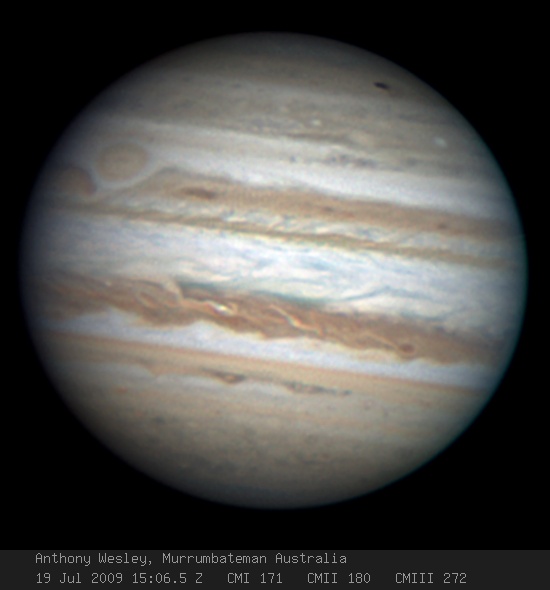
A follow-up observation with an infrared telescope on Mauna Kea confirms that the dark mark(s) discovered near Jupiter's south pole by Australian amateur astronomer Anthony Wesley were caused by an impact of a comet or asteroid. The "hole" in Jupiter's upper atmosphere is now Earth-size or larger.


Image credit: NASA/JPL/Infrared Telescope Facility - This image shows the heat signature from the impact point, glowing against the cooler background.

Monday, July 20, 2009

Jupiter Impact?

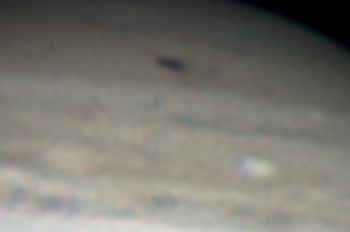
Around 1330 UT (0830 Eastern) yesterday (19 July 2009), an Australian amateur astronomer named Anthony Wesley noticed a previously unseen dark spot on Jupiter. Further observations by Mr. Wesley and other observers show several more spots in the vicinity, indicating that this is likely the result of a sizable asteroid or cometary impact on Jupiter.


If this was indeed a comet or asteroid impact, it would be much like Comet Shoemaker-Levy 9, fragments of which which hit Jupiter in July 1994.

The Spaceguard project is still cataloguing large objects in orbits which might be in a position to hit Earth. However, no one noticed the Jupiter impactor prior to Sunday. Jupiter's larger size and greater gravity causes it to sweep up a lot of material, which is a good thing for us -- every large object swept up by Jupiter is one less to fall out of the sky without warning on us.

One Giant Leap For Mankind - 40 Years Later

Today is the 40th anniversary of the first moon landing carried out by the astronauts of the Apollo 11 mission. On July 20, 1969, Neil Armstrong and Buzz Aldrin stepped out of the lunar module Eagle onto the Moon's Sea of Tranquility. While they took photographs, set up experimental equipment, and gathered rock and soil samples, their fellow astronaut Michael Collins orbited overhead in the command module Columbia.

Forty years later, there is an "Apollo 11" greasy spoon resturant here in Toronto at the corner of Bathurst and Dupont. This leads me to wonder whether the "Obama Cafe" on the Danforth will still be here by the middle of this century. The juxtaposition of restaurant names here in Toronto will be matched by a meeting of the actual people in Washington, where President Obama is scheduled to meet with Armstrong, Aldrin, and Collins later today.

Today, there are 13 astronauts on the International Space Station -- a record setting number of people in one place in space, and incidentally, one more person than the twelve men who to this point have walked on the moon. Two of those thirteen people currently in space -- Robert Thirst and Julie Payette -- are Canadians. But there are no people in high orbit, or the moon, or interplanetary space.


Photo credit NASA - Endeavour approaches the ISS on Friday, July 17. Photo taken by an Expedition 20 astronaut during the approach phase to check for possible heat shield damage.

After 1972, the Apollo 18 spacecraft was redesignated for use on the Apollo-Soyuz Test Project. Apollo 19 through 21, which included the setup for a rudimentary moonbase, were cancelled by the Nixon administration and never flown.

There are strong indications that the NASA Constellation program has fundamental design complexities and problems that may make it difficult or even impossible for NASA and its international partners to implement and use as the platform for the return to the moon, and beyond. Also, the Constellation vision is an enormous step backward in terms of technology concept. The decisions that are made now matter, and will affect whether or not there continues to be a viable human presence in space.

In the meantime, there has been a lot of 40th anniversary coverage over the last few days (click on individual links to open):

Apollo 11 mission recreated on web -- report and mission site

The debate about whether it was all worth it began even before the moon landings. Perhaps the major problem with space exploration to date is that there has been no true viable long term purpose. John F. Kennedy provided the lunar landing objectiveb when he stated in a speech that he elieved
"that this nation should commit itself to achieving the goal, before this decade is out, of landing a man on the moon and returning him safely to Earth."

But even Kennedy did not look beyond the need in the 1960s to "beat" the Russians. Elsewhere, he is on record saying to then-NASA Administrator James Webb
"This is important for political reasons, international political reasons, and this is, whether we like it or not, an intensive race. Otherwise, we shouldn't be spending this kind of money, because I'm not that interested in space."

Buzz Aldrin's rap video, intended to make space travel sexy for a new generation.

Sadly there are conspiracy theorists who believe that the landing never happened, prompting a lot of effort to demonstrate otherwise (also here and here and here). Proving a negative is hard to do, and there are always people (see also evolution debaters and 911 conspiracy theories) who choose belief over evidence.

The mission was a success from launch to lunar module liftoff to landing because many people worked on it, including small but critical contributions from unlikely people.

NASA has been working on cleaning up the Apollo 11 television footage. Here is a sample:


Finally, here is a montage video of highlights from the entire mission -- Armstrong's first words from the moon occur around 1:02. It should also be noted that Walter Cronkite, the iconic newscaster for CBS, passed away earlier last week.


Happy Neilsday 2009...

Sunday, July 19, 2009

Alien encounter - the Chmido

At yesterday's Chandra event, in the Alien By Design workshop that Julie Czerneda ran, I worked with Chris and Michael to construct an alien that would live in an environment specified by Julie.

These were Julie's conditions:
- Daytime temperatures up to +50C, nighttime down to -10C
- Strong and gusty winds up to 100 kn/hr
- extreme dryness for months at a time, followed by a brief interval of heavy rain and flooding
- gravity about 0.75 Earth normal

And, with a table filled with goodies that Julie supplied, the additional requirement was that we had to build a model of the creature as well. This is what we came up with:


The Chmido (first two letters of each of our three names) has a vaguely manta-ray shaped body plan. They are omnivorous aerial predators, hunting in small packs during the day. At night, Chmido family groups and individuals seek shelter in caves on high cliff faces close to the ocean. Chmido wings are integrated, manta-like, into their body. They have a total of 8 limbs. They can stand upright on two rear appendages. The next set of two appendages have a cluster of fleshy manipulator digits at the end. There are two pairs of appendages with an attached web like structure next to the sharklike mouth, allowing a chmido to capture prey (or aerial plant life) in flight.

Chmido have four eyes, which point groundward and ahead while they are in flight, and which point forward when they stand on the ground. They also have two photosensitive spots on their back which allow them to react to predators behind or above them. They breathe through gill slits on their back, moving air through a pumping action. They breathe out through orifices along the trailing edge of their wings. There are specialized organs that produce sound for communication.

Because they are flying creatures, Chmido are quite light for their size, but they are very strong.


Chmido mating rituals involve 3 sexes participating in a complex aerial dance. The three particpants have specialized functions - one to produce sperm, one to produce ova, and one optimized to gestate the fertilized ovum. They bear live young.

Culturally, the Chmido are at a mid-industrial tech level, so no spaceships yet. They understand machines, but have religious objections against building machines that fly. However, their culture is based on striving to be higher than the rest of the pack -- an urge that will eventually drive them into space, once they get over their religion-imposed limits.

The most desirable caves are the ones on the leeward side of cliffs. Because these are rare, the first Chmido forays into technology involved channeling the flood waters during the wet season to use in carving out additional habitats. Through the generations, they have become accomplished hydraulic engineers.

For the model that we built, much of the allotted time was spent discussing the basic creature and agreeing on details. Michael constructed the outer layer, I carved the internal sponge that gave the body shape, Chris did the finicky job of making and attaching the limbs.

Having designed the alien, Julie threw a curve at us. Matching up two groups at random, we were to come up with a First Contact scnario. Michael, Chris, and I were paired up with Lindsay, one of Lorna's staff members, and her partner for this exercise.

In our scenario, the Chmido, in the course of exploring another continent on the same planet, encounter a sentient species which moves through several different forms during its life cycle. A flying form is a juvenile stage which the Chmido initially encounter. Because the Chmido are pack hunters, this probably doesn't end well for the peaceful, telepathic, solitary flying creature. It is likely that the initial Chmido response is "lunch". However, the subterranean-dwelling elders with their enhanced telepathy will allow both species to eventually communicate and reach an understanding. The ability of the others to tunnel deeply into the ground and extract metals is something the Chmido are not well suited for -- this is a partnership which will act to drive both species' technological capability.


And of course, in the process of working through their interspecies cooperation issues over generations, the Chmido and their partners achieve something which could be described as a culturally hard-wrired propensity toward diversity. It is this which allow the Chmido and their partners to get past the serious errors made by human merchants 200 years later when a Chmido starship is mistakenly attacked.

Chandra X-Ray Observatory event at Merril


The Merril Collection hosted a triple barrelled event on Friday evening and Saturday involving a presentation from the Chandra X-Ray Observatory, a book launch for Julie Czerneda, and a space art retrospective by Jean-Pierre Normand.


Friday's science summary of the work done by Chandra for the last ten years was presented by the Observatory's Lead Education Officer, Donna L. Young, an enthusiastic and knowledgeable speaker. One of the hightlights for me was the composite photo of M101 in Ursa Major -- a giant spiral galaxy seen nearly head-on from our vantage point, and historically used as a marker for establishing the cosmic distance scale.


Photo credit -- X-ray: NASA/CXC/JHU/K.Kuntz et al.; Optical: NASA/ESA/STScI/JHU/K. Kuntz et al; IR: NASA/JPL-Caltech/STScI/K. Gordon. Image Scale -- Image is 18 arcmin (114,000 light years) across


The second half of Friday was a book launch and book signing, with a reading from Julie Czerneda, for her novel Rift In The Sky, the third book in a three book series written as a prequel to her Trade Pact Chronicles. Julie had some insightful things to say about the difficulties and pitfalls in writing a prequel trilogy for a trilogy that had already been written and published. I wish Geotge Lucas had considered these things with the same degree of care.

Saturday morning's activities started shortly after 9:30 with some introductory remarks by Professor John R. Percy of U of T and the RASC. Donna spoke some more, and then turned things over to Jean-Pierre for a space art retrospective.

Shortly after this began, Corwin experienced severe stomach cramping and vomiting, and had to be taken home by Jill. I carried him out of the building and across the street, until my arms gave out. Jill took over, while I tried to retrieve the car, from its parking spot underneath the Addiction Research Foundation north across College Street. What I discovered was that there were no regular entrances that allowed one back down to the parking garage, so I circled the building and walked down using the vehicle ramp. Jill and Corwin headed home, and I went back to the library.

Whatever Norwalk-like stomach bug had gotten Corwin continued to make him periodically sick over the next four or five hours until it subsided in the afternoon. By evening he was keeping down liquids and able to eat the official Lum family sick rations of macaroni and soy sauce.

Back at the library, Jean-Pierre concluded his space art slide show, and Donna ran a Stellar Evolution workshop, highlighting the various pathways along which stars could be born and evolve and end.

In the afternoon, Julie ran an Alien By Design workshop session. The lesson of evolution is that life adapts to its environment, and adapts again when things change. The physiological features that we see in life forms are there for valid environment-related reasons. For purposes of the workshop, Julie specified some environmental conditions, and our task was to design an alien being that could plausibly live in that environment and develop intelligence. I did this in conjunction with Michael and Chris, two of the Usual Suspects who also attended this event.

After the Alien By Design workshop, Jean-Pierre did a truly amazing retrospective of his cover and illustration art over nearly thirty years.

In the course of the afternoon, I got Corwin's copy of Orbiter signed by Julie, by Jean-Pierre, and by Eric Choi, author of one of the stories in the collection. I also got a couple of copies of Jean-Pierre's book of artwork, Science Fiction Illustrations, again signed, one of which will go to our friend Hicaru in Japan.

At the end of the day, Julie sent a package of alien-making materials for Corwin. By the time I got home, Corwin was well enough to appreciate it. It will be interesting to see what he comes up with when we (or he by himself) does this exercise.

Saturday, July 18, 2009

Phyllis Gotlieb - 1926 to 2009


Phyllis Gotlieb, noted Canadian poet and science fiction author passed away earlier this week on July 15. She was 82 years old. We last saw Phyllis the previous year on June 5th 2008 at the Merril Collection, at a special event where she was honoured with a Lifetime Achievement award by SF Canada.

Phyllis' novel O Master Caliban had been published shortly before I began participating in organized science fiction related activities. In all of our encounters, I remember her as unfailingly warm and gracious.

Monday, July 13, 2009

How Cats Manipulate Humans

Researchers have determined that there is an audible component to the exercise of the feline mind control field on the Afflicted. The article is here.

The following result is possibly significant:
In a series of playback experiments with those calls, they found that humans judged the purrs recorded while cats were actively seeking food as more urgent and less pleasant than those made in other contexts, even if they had never had a cat themselves.

If the Afflicted could somehow be shielded from the audio emanations, it is possible that the mind control field might be less effective, and an Afflicted person might be broken free. Obviously, more research is necessary. But it is in such small breakthroughs that the hope continues to be maintained that the possibility of throwing off the feline yoke on humanity's Afficted might be achievable.

Sunday, July 12, 2009

AS YOU PUPPET is Best of the Fringe!

I am shilling for my cousin, who sez

Last performance of AS YOU PUPPET is on Sunday @ 7:05pm at the Palmerston Library.

"*****"UTTERLY DELIGHTFUL...this is a show for EVERYBODY" -
Eye Weekly, NNNN
Critic's Pick, Now Magazine

If you miss this performance, you can catch us at THE BEST OF FRINGE: July 23, 24 & 25, 7pm at the Berkeley Street Theatre!


They deserved to be selected as Best of the Fringe!

Saturday, July 11, 2009

Search and Rescue from the Toy Eating Tree

Our Tuesday evening get-together earlier this week at Chris and Liza's house ran unexpectedly late.


While the adults ate the excellent chicken salad provided by Lorna and Michael, and talked about boring stuff like job hunting, or writing, or music suitable for a drive to Temagami, or organ transplantation, or the economics and strategies behind the current city workers' strike, the kids were busy doing doing much more important things. Recognizing the Megaforce motto of "Deeds, Not Words", the boys went off to the park to try out Cameron's new radio controlled airplane, and therein lies the story.


By the time everyone was gone, and we went to retrieve the children, we discovered the aftermath of an airplane disaster.

The airplane was a model of an F18 fighter, perhaps 20 or 25 cm long, made of molded styrofoam, with control circuitry, a battery, and motors embedded in the body. The motors turned two propellers on the trailing edge of the wings, and the battery was charged by attaching the aircraft's charging port to a cable on the remote control device. The aircraft was light, and reasonably fragile. It was much more interesting than any toy I ever had as a kid (isn't that always the way?), and more importantly, was totally unsuited for the nefarious purposes of the boys, which would undoubtedly have involved mounting a wireless webcam and at least one nerf dart launcher.

In the course of their flight trials, another little boy from the neighbourhood had inadvertently steered the airplane into the high branches of a tree. As Corwin pointed out later on the drive home, out of all possible directions that he could have flown the plane, he picked the worst one.

As the sun set, Chris and I, along with a couple of other guys from the neighbourhood tried to retrieve the airplane by trying to knock it loose. Prior to our arrival, these attempts had been made with a rubber ball, a tennis ball, and a football -- now all stuck in the tree as well. Chris and I added to the Buster Keatonesque air of these proceedings. A hockey stick, tossed into the branches to shake things loose also got stuck and had to be knocked loose by a rope. The rope on a subsequent attempt got stuck and had to be retrieved with the hockey stick. We ultimately made repeated attempts with the rope being tossed into the branches while the other end was tied to the hockey stick -- anchoring the rope and solving our alternating loss of tools problem.

Our innovations failed to loosen the airplane, but provided much amusement for Jill, Liza and the mother of the little boy whose directional malfunction had treed the plane. Liza was heard to suggest tossing a bicycle which had been left on the playground. Eventually, we did manage to knock loose all the stuck balls, including the football. Deepening twilight caused us to suspend the search and rescue operation for the airplane.

The story ends well. Late next day, we got the following e-mail from Chris:

Search and rescue efforts were suspended July 7th after 10PM EDT when low light levels made attempts to even locate the downed aircraft difficult.

On July 8th, at 7:30 AM crews returned to the incident site. The aircraft was located, but it was determined that it was inaccessible given the resource constraints on crews at that point. However, it was determined that the aircraft was unlikely to shift to be in further jeopardy, as the surrounding foliage was acting to secure the aircraft against shifts due to any inclement weather.

On July 8th at 8:15PM, crews established that the aircraft was unmoved from its morning position, and returned to the site with elevation enhancement equipment [1], as well as reach extensors [2]. Careful movement of the aircraft using both pieces of gear resulted in the aircraft being freed of the entrapment of the foliage. Further movements caused the aircraft to come free and shift to a point [3] where recovery of the vehicle intact was possible, with only minor cosmetic damage.

Recovery equipment and the vehicle were returned to storage and maintenance, respectively. The vehicle was inspected and refueled, and engine run up tests were done. All systems appear to be fully functional. A flight test and return to service is expected after the flight crew returns to duty tomorrow from an off-site mission.

[1: wooden step ladder]
[2: twelve foot fly pole from tent]
[3: drop from the tree to the ground]

Wednesday, July 08, 2009

More about As You Puppet

Corwin and I went to see As You Puppet, a production in the Toronto Fringe Festival, on Monday. It wasn't what I expected, but it was still a most enjoyable show.

The Spring Gala on the second last day at Corwin's school was to have been Shakespeare's A Midsummer Night's Dream, as adapted by Jill. Corwin was to have played Bottom. However, the play at school failed to happen - the day before the performance, five or six children came down with flu symptoms, and in light of the current pandemic concerns about H1N1, the decision was made to cancel the performance.

Unlike Corwin's heavily adapted school play, in As You Puppet, the actual dialogue and scenes from As You Like It were used. This was Corwin's first introduction to the actual language of Shakespeare, and despite my concerns, he had no trouble following the story.

In my earlier post, I noted that both Eye and Now had given this play very good reviews. Having actually seen the play, I can see why. What struck me was the tremendous energy and intelligence in this production. Other than abridgment for length to make the entire production an hour long, it made no other concession in terms of the dialogue. I was gratified that Corwin followed it, despite the use of the archaic original Shakespearian language, but also, apparently all or most of the other children in the audience did so as well.

Both the principal performers -- Jane McClelland and Mike Petersen -- were obviously putting a lot of energy, thought, and effort into their performances. It was clear that they both knew this play cold, but also that they had real Shakespearian experience as well. My cousin Wayne Sujo, who was (among other things) the stage manager for this production, told me that they had spent two months rehearsing. The rehearsal time definitely showed. Despite the minimalist sets, and the stuffed animal actor surrogates, the story moved along briskly, with no hesitations or visible problems.

There aren't many performances left, but this play is highly recommended by both Corwin and myself.
THUR JULY 9, 3:45PM
SAT JULY 11, 12:25PM
SUN JULY 12, 7:05PM
(at the Palmerston Library -- further details on Facebook here and on the Toronto Fringe Festival website here)

A final thought - it would be great if this production went on tour in Toronto's (or other jurisdiction's) elementary schools. This would be a great way to introduce younger childern to Shakespeare, and to do it well before high school.

Sunday, July 05, 2009

As You Puppet

My cousin Wayne is stage manager on a production of Shakespeare's As You Like It, done with puppets and stuffed animals. The production is called As You Puppet, part of this year's Toronto Fringe Festival, and Corwin and I are going to see it tomorrow.

It opened last week, and Eye Weekly gave them a five star review. Now Magazine was stingier, giving them only 4 N's out of a possible 5 (NNNN=Sustained Applause as opposed to NNNNN=Standing Ovation).

Here is the press release for As You Puppet:

Hear ye, hear ye!! Hank's Toybox Theatre is at the Kids' Fringe Festival in Toronto this summer!

Come and marvel at AS YOU PUPPET - an abridged version of Shakespeare's As You Like It, as told by stuffed animals.

A technique known as “table top puppetry” brings the plush toys to life, wherein the performers remain fully visible while the puppets flop and frolic on table-high settings.

Shakespeare’s language has been carefully preserved, and puppeteers Jane McClelland and Mike Petersen create lush settings by transforming ordinary boxes, blankets and tables into everything from royal palace courtyards to sun-dappled meadows.

They are directed by Ken MacDougall and Tom McHale, with lighting designed by Michael Kruse, sound design by Saul Pincus, and stage management by Wayne Sujo.

***CLICK HERE TO JOIN OUR FACEBOOK GROUP!


HANK'S TOYBOX THEATRE presents
AS YOU PUPPET
(WILLIAM SHAKESPEARE'S AS YOU LIKE IT with Puppets!)

adapted & performed by
JANE McCLELLAND & MIKE PETERSEN

directed by KEN MacDOUGALL & TOM McHALE
lighting design MICHAEL KRUSE sound design SAUL PINCUS
stage manager WAYNE SUJO

SHAKESPEARE FOR KIDS AGED 5-105!

PALMERSTON LIBRARY THEATRE
560 Palmerston Ave (2 blks W of Bathurst/Bloor)

THUR JULY 2, 4:50PM
FRI JULY 3, 8:05PM
SAT JULY 4, 2:20PM
MON JULY 6, 12:40PM
WED JULY 8, 5:40PM
THUR JULY 9, 3:45PM
SAT JULY 11, 12:25PM
SUN JULY 12, 7:05PM

$10 adults / $5 kids
fringe hotline: 416-966-1062
www.fringetoronto.com
NO LATECOMERS ADMITTED

Saturday, July 04, 2009

Reflections on David

Yesterday was the visitation for David and today was the funeral. David was 15 years younger than me -- nothing like an untimely death to bring home a sense of one's own mortality. I dislike funerals, but the experience is particularly awful when it is someone I know and care about.

My cousin Linda asked for people to write down their stories and memories of David, so that she could give them to Nicole and Matthew when they are older. That is a great idea - the only truly meaningful way in which we live on is through the effect that we have had on others, and the memories that we have created. David was one of those people who had an enormous positive effect on everyone around him.

Monday, June 29, 2009

RIP David Chow

Sad news -- a great tragedy in our family this past week.


From my cousin Linda:

Dear Friends and Family,

It is with great regret that I inform you that my husband, David Chow, passed away on Thursday, June 25th, 2009 at the Toronto General Hospital. He was a wonderful man, a loving husband and an amazing father to our two beautiful children, Nicole and Matthew.

The Visitation and Service will be held at The Simple Alternative – Pickering Chapel, 1057 Brock Road, Pickering, Ontario, L1W 3T7

Visitation: Friday, July 3rd, 2009, 5pm-9pm
Service: Saturday, July 4th, 2009, 11am

In lieu of flowers, a donation box will be set up at the funeral home for either:
1) Peter Munk Cardiac Centre
2) Toronto Sick Kids Hospital

For further information, please contact David’s brother, Gary.

Thank you for being a part of David’s life.

Linda


I was on the way to a Flex user group meeting last week on June 26 when I heard about this from my cousin Wayne (Linda's brother). I have been in shock and running on autopilot ever since. Clearly, there are worse things than to be out of work.

This is so unfair -- David was so much younger than me. And he was such a great person.

Tuesday, June 09, 2009

On The Beach

SF readers will recognize "On The Beach" as the title of a Neville Shute novel from the 1960s about the bleak aftermath of a nuclear war. To be "on the beach" is also a euphemism used by contractors and consultants to describe being between assignments, which is my current situation. My client, a company operating in the automotive finance industry, chose not to extend my contract past May 29.

The analogy between Shute's landscape of nuclear devastation and the current economic environment is uncomfortably close. However, I have prospects -- I have had talks with potential clients that have been maddeningly elusive in terms of materializing into anything solid. Note to self - need to work on closing deals. Also a reminder -- change is good. And things could be worse -- I could have been an auto worker.

So, time to clear up and organize some things, and think about what to do next. In the meantime, find doors, and push on them.

Monday, June 08, 2009

Another Tesseracts Twelve Review

From Claude Lalumiere, a link to a new review of T12 by Michael Mirella on the Rover Montreal website.

Bottom line? he likes 5 out of the 7 stories in the collection, and concludes
Overall, Lalumière does a good job of presenting a set of stories that represent various aspects of what has come to be called “fantastic fiction.” Perhaps not to the taste of those who prefer a clearer strain of SF, but definitely a way to break open the ghetto [of science fiction].

Tuesday, June 02, 2009

Twins!

Big congratulations to my cousin Amy and her husband Jeff -- twin boys born on June 1!

Dylan was born around 0315 EDT and weighed in at 4.2 lbs.

Adrian was born 12 minutes later at 0327 EDT and weighed in at 4.6 lbs.

As a point of comparison, Corwin (who was a premature birth) was 4.5 lbs, and just long enough to fit on my forearm.

I had gotten the news on Monday afternoon (from Mom) via the intra-familial packet-switched occasional-sneaker net. Thanks to my cousin Cindy (Amy's sister) for providing photos and details.

Amy and Jeff don't look nearly gobsmacked enough :-) Good job, guys! And of course, a rousing welcome to Dylan and Adrian!

Sunday, May 24, 2009

Cables Make All The Difference

Recently, I had to buy a length of network cable for $22 from Staples. I resented the price, until I saw this offering:

For *only* $500 you can buy a cable made by Denon, composed of "pure copper". Presumably that price is in US dollars so all us Canuckie types will need to add roughly 20 percent - call it $600 loonies for discussion purposes.

And why would anyone pay $600 for a cable?

Well -- this product will allow you to "Get the purest signal from multi-channel DVD and CD playback through Denon receiver". One way that it achieves this is that the "Connector and cable structure designed to thoroughly eliminate adverse effects from vibration". Because, ya know, vibration causes all those little electrons to jostle together and not get to where they are supposed to go. Clearly, a product designed for audiophiles who operate at a level that I can barely imagine.

But don't take my word for this -- read the reviews. There are others, who like me, stand in awe and amazement at this product, and anyone who would buy it.

UPDATE - Audioquest make an ultra-deluxe speaker cable for $6800. This relegates the Denon offering to the little leagues. The $22 network cable I was bitching about doesn't even register. People who use this product probably aren't even in the same species as those of us who meet our cabling needs from the Dollar Store.

Wednesday, May 20, 2009

The Dangers of Re-use

In complete contravention of what the bottled water people say is safe usage, I re-use my plastic water bottle many times before it usually ends up being thrown out, typically by someone else. Of course, bottlers of water have no vested interest in making sure that you buy more bottles instead of using the one you have, nosirree.

The latest study from the plastics industry (news article here) showing health problems with re-usable bags strikes me the same way. No bias from this source, either.

On the other hand, I am probably not going to be incredibly sympathetic to someone who got sick because because they brought vegetables home in a bag that they had previously used to transport used diapers. Those cloth bags are in fact washable as well as re-usable.

Sunday, May 10, 2009

Finally, the Star Trek movie!

This movie is worth seeing, and probably more than once. We watched this down at the Beaches Cinema yesterday. All three of us thought this was a good movie, although (as usual) I have issues. I had vague thoughts about taking the day off to line up and watch the first showing on Friday, but those never got past the vague thoughts stage. If this were 20 years ago, I would have done it, no question.

The review in the Toronto Star is generally positive.

Here are some of the issues (possible spoiler warnings) --

Delta Vega is fairly close to the energy barrier at the galaxy's edge, not between Earth and Vulcan.

"Red Matter"? WTF? This substance is used to initiate a black hole collapse. It should have been straightforward to insert a reference to dark matter here.

Replacing a planet with an equivalent mass black hole doesn't create an instant "vacuum cleaner" effect.

Most serious - a supernova explosion won't destroy a planet in the way that it is shown to occur.

However, the rationale behind the "reboot" is well done -- it allows therm to acknowledge all of the existing history without necessarily being tied to it.

After the disasters of Star Trek Insurrection and Star Trek Nemesis, this movie franchise needed a good entry to lift it back up - and this movie is it. Star Trek nerds can rejoice.

Tuesday, May 05, 2009

Cinco de Mayo, times ten

Today is Cinco de Mayo, a holiday held in high regard by our friends Angel and Bill on account of Angel's Mexican roots and Bill's many years of traveling there. But today is also Corwin's tenth birthday, which will occur at 8:26AM, about half an hour from when I am writing this.

Ten years ago at this moment, Jill was having the worst part of her labour, having already gone through more than twelve hours of it. To get to the hospital in time to be part of my son's birth, I had left my project in Detroit, and had traveled back by car overnight.

From those first moments of that small, helpless baby, it is amazing to think that ten years have gone by, and the wisecracking boy of today is the same child.

Friday, May 01, 2009

May Day baby

Our friends Dave and Marianna, whose wedding we attended a couple of years ago, had a baby girl overnight!

Congratulations to Marianna (who did all the recent hard work) and Dave, and welcome to Maia Willow!


Corwin's response to the photo above was "Mwaaahaaahaaa! Soon, another geek like us!"

Thursday, April 30, 2009

Things That Go BANG In The Night

A gamma ray burster detected a week ago by the NASA Swift satellite and designated GRB 090423 (CNN article here) marked the discovery of the oldest known object in the Universe -- a supernova of a giant star about 600 million years after the beginning of the Universe itself. This object is about 13 billion light years away (red shift z = 8.2), about a billion or more light years more distant that the most distant quasars (z around 5 or 6). This object is important because it and others like it will provide a way to probe the earliest generations of stars formed in the cosmos.

A more recent bang in the sky was SN 1006 -- a star about 7,000 light years away that went supernova on April 30, 1006 -- 1,003 years ago. For calendar nazis, I understand that today is not the actual anniversary due to the Julian-to-Gregorian conversion. This object was somewhat smaller in scale than the GRB 090423 blast, but still pretty substantial, making it very probably the brightest star (other than the sun) seen by human eyes.


Above, the Chandra image in x-rays of the supernova remnant a thousand years after the blast. The bubble has expanded to a diameter of 20 parsecs -- over 60 light years. Below, a Hubble image of a ribbon of gas and dust from the same nebula.

Monday, April 27, 2009

Tracking Swine Flu using Google Maps


View H1N1 Swine Flu in a larger map

Infectious cases of the H1N1 Swine Flu—a mutation of a pork virus that jumped from pigs to humans—happened in Mexico City in March, and are spreading over the world thanks to the ubiquity of modern air travel.

On the map, the pink markers are suspect, the purple markers are confirmed, and deaths don't have a black dot in the marker. The yellow markers are negative.

People in Toronto are all too familiar with this, having gone through the SARS near-pandemic from 2002 to 2003. As of today, the number of swine flu cases worldwide exceed 2,000 -- a substantial percentage of the total SARS cases (over 8,000).

SARS had a pretty significant negative impact on the economy of the city of Toronto, and more generally, the world. The current swine flu outbreak is happening in the midst of a global recession, so I expect it will be a force acting to make the overall economic impact worse.

I have no idea who the creator of the map is, although the profile of the anonymous creator shows a reference to biomedical research.

Sunday, April 26, 2009

Star Trek Advance Reviews

The hype machine has ramped up this week. An advance review on CNET dated April 22 from a writer who describes herself as a Star Trek virgin provides reassurance that the new Star Trek movie will appeal to people who have never seen any of the series or the movies.

For hardcore fans like all in this household, the Gizmodo review is more meaningful. "Star Trek will disappoint no one." he begins, and goes on to enumerate the reasons why. My favourite quotes from the review:

The Star Wars cheap shot --
As the lights dimmed and the familiar Star Trek Federation logo slid on screen, the emotion of all those hours of watching Next Generation reruns as a kid came sloshing back into my brain, dripping out of my eyes as tears of pure happiness. I expect that it was essentially the same emotion Star Wars fans felt during the opening credits of Episode 1, but without the massive letdown afterwards. (Ha ha, suckers.)

On updating the look and feel --
That's not to say Star Trek is now gritty—it's just more...modern. And more sexy. Like when you upgrade from a six piece KFC meal to a 12 piece bucket: you're going to get more breast and thigh.

To paraphrase one of the Usual Suspects, I like thighs. They're juicier.

Saturday, April 11, 2009

Just Call Me Joe-Bob

A few days ago, Ramey Ko of the Association of Chinese Americans was testifying before the State Elections Committee of the State of Texas in the US. In response to Ko's testimony regarding problems that Americans of Chinese, Japanese, and Korean descent have in voter identification in elections, State Representative Betty Brown, a Republican member of the Texas State Legislature representing District 4 (Athens/Terrell) said the following:
"Rather than everyone here having to learn Chinese — I understand it's a rather difficult language — do you think that it would behoove you and your citizens to adopt a name that we could deal with more readily here?"

Additional source for this story here.

I am not Texan, or even American, but I just have to comment on this.

Brown's remarks undoubtedly summarize the intellectual position of at least some portion of the American population. And there are bound to be people of similar minds on this side of the border. I am reminded of the difficulties that I had growing up with a Chinese name -- one that was very different from the Anglo-Saxon mainstream. At my first job when I was a teenager, the advice given to me (I worked in in a telephone sweatshop) was that I should identify myself using a name that was more consumer-friendly.

However, that was then and this is now. Brown's colleague, Representative Trey Martinez Fischer and the people who run the Rum and Monkeys website have made available the "Betty Brown Name Generator", a web application that will help anyone with a name that is non traditional (or at least non traditional in Betty Brown's judgement) replace their name with one that people like Ms. Brown would understand and would identify with.

I am very pleased to report the following result from the Betty Brown Name Generator for me:

My Betty Brown Approved Name is Joe-Bob "WalMart" Brown.
Try The Betty Brown Name Generator yourself!
Created with Rum and Monkey's Name Generator Generator.


Y'all should call me "Joe-Bob", although if we are in a business meeting together, you could call me "J.B." At parties and in public, I will continue to respond to "hey you". While I have issues with being called "WalMart", y'all could call me "Wally" if y'all needed a nickname.

I can't help thinking that Betty Brown's problem with some names might be due to their (relatively larger) number of syllables as well as cultural context with which Ms. Brown may lack familiarity, even though she is an elected government official in a state of the wealthiest (and theoretically best educated) nation on Earth.

The Betty Brown Name generator can be seen to therefore have some wider application. In addition to the modifications to biology and astronomy textbooks that will be required to implement the position taken by the Board of Education of the State of Texas on intelligent design versus conventional scientific theories of cosmic origin and biological evolution, there could be similar rewritings of history textbooks as follows:

- replace "George Washington" with Forrest "Pabst Blue Ribbon" Brown. Even though General Washington is a Founding Father of the great nation of America, his name does have too many syllables in it for easy comprehension. Also, if this change is made, George Washington Carver can be Forrest Blue Brown Carver. Texas history books could thus immediately identify Dr. Carver as a man of colour by his name alone.

- replace "Benjamin Netanyahu" with Billy-Ray "Chicken and Dumplings" Brown. Although a long-time ally of the United States, Mr. Netanyahu's Hebrew name also has way too many syllables and "Benjamin" just makes him sound stuck up. Discussing Middle East history of the last few decades and how they were driven by an American ally named Billy-Ray should make this subject both more comprehensible and sympathetic to students in Betty Brown's Texas. Also, the "Chicken and Dumplings" nickname can be a vehicle by which the Texas educational system introduces the richness of Jewish heritage and culture and in particular, matzoh ball soup to ordinary Americans. But instead of forcing those ordinary Americans to learn the Hebrew word "matzoh", they could move with immediate understanding to "Chicken and Dumplings".

- don't replace "J. Robert Oppenheimer" with Joe-Bob "Cracker Barrel" Brown. Even though this distinguished American physicist and I share the same Betty Brown approved name (except for the nickname), Oppenheimer was attacked by Senator Joseph McCarthy, and in a Betty Brown world, it would be inappropriate to give him a name that makes him more like a "real American". (In the Sarah Palin sense of the term "real American").

- replace "Subrahmanyan Chandrasekhar" with Billy-Ray "Cracker Barrel" Brown. This American physicist of Indian origin for whom the Chandra Space Telescope is named clearly has way too many syllables in a name which would be incomprehensible to people living in the world of Betty Brown. Therefore, physics textbooks in Texas can make reference to the "Cracker-Barrel Limit" instead of the Chandrasekhar Limit for calculation of the upper bound of stars which can collapse to form a white dwarf star. Keep in mind though that all this long-hair stuff is only a theory -- you know, like evolution. Or the Germ Theory of Disease. Or gravitation.

- and for goodness sake, definitely replace the names of Samuel Chao Chung Ting, Yao Ming and Kalpana Chawla. Real Americans in Betty Brown's Texas can't believe that people with names like these could win a Nobel Prize and be on the staff of a major scientific facility intended to be in Texas, or play basketball in Texas, or die in a space shuttle accident over Texas.

Betty Brown's remarks have done a lot to demonstrate the care and commitment that she feels toward people of Chinese descent, as well as to show the seriousness and credibility of some members of the Texas State Legislature. I, Joe-Bob Brown, her spiritual brother, wish her the very best political future that her remarks have shown that she deserves.

Tuesday, March 31, 2009

Coraline - Two Thumbs Up

We went on a family expedition down to the Beaches theatre on Saturday to see Coraline. It was a fine movie, and despite the fact that it is a true horror film, did not cause any squickiness.


It has been a while since I read Neil Gaiman's (children's) novel on which this movie is based. All of the important elements are present: Coraline's busy parents (whom I seem to remember were computer programmers in the book not gardeners as they are in the movie), the aging actress sisters, the mouse circus trainer. And of course, Coraline's Other Mother on the other side of the doorway. The horror is elegant and gradual, like a slowly tightening web.

Coraline is brave, determined, and intelligent -- exactly what every parent hopes their own child will be. She makes mistakes, but she works to overcome their consequences.

For most of the movies I watch, I generally have quibbles about the story they tell. Usually, writers or directors manage to do something to break my suspension of disbelief. I did not have any quibbles about this one.

This movie is definitely recommended.

Monday, March 30, 2009

A Modest Art Installation Proposal

We drove by the Art Gallery of Ontario earlier on Sunday. The new renovation has been completed and is open. Seeing this got me to thinking about the neighbourhood. The Ontario College of Art and Design is immediately south of the Art Gallery and the Sharp Centre For Design, part of OCAD, is also a striking piece of architecture -- it is built to resemble a giant table, looming over the other buildings around it.

I first saw this OCAD building a few years back from a vantage point further south, when I was visiting my cousin at a place he was looking after for a friend.

Given that the OCAD building resembles a table, I propose the following art installation:

On the roof of the OCAD building, at each of the sides of this giant table, create a place setting at an appropriate scale, consisting of a plate, a cup, a bowl, a knife, a fork, and chopsticks.

These place settings would be visible from all around the OCAD building - basically, from any structure higher than its roof. Each place setting would represent a particular group - for example, politicians, the economic elite, homeowners, and the homeless. But I propose sufficient ambiguity in the design to allow viewers to create their own symbolic OCAD dinner party.

I can't possibly be the first one to have had this idea -- someone should do it!

Tuesday, March 24, 2009

2009 Hugo Nominations

The 2009 Hugo Award nominations list has been out for nearly a week. Among the Usual Suspects, it was not surprisingly (but disappointing nonetheless) Jill's and Michael's story didn't make the cut. Nor did Dave's story. However, what was very very surprising (and very very disappointing) was that Karl's novel Pirate Sun failed to make it onto the ballot.

The good news, however, is that Metatropolis, an audiobook that Karl co-authored, was nominated -- the first audiobook to be nominated for the Hugo.

Tesseracts Twelve contributor Gord Sellar is up for the John W. Campbell award.

And finally, local fan artist Taral Wayne whom I have known for nearly thirty years, was nominated for the Fan Artist Hugo.

Sunday, March 08, 2009

Latest Star Trek trailer!

The last movie was a disaster. This movie, upcoming, is supposed to reboot the series. I am looking forward to it, although with some trepidation.

Saturday, March 07, 2009

Chang'e Lunar Mission Ends, Kepler Launched

Earlier this week, the Chang'e 1 lunar reconnaissance mission came to an end when controllers crashed the spacecraft onto the lunar surface. Launched by the Chinese National Space Agency on October 24, 2007, the probe spent 16 months sending back high resolution surface images of the moon. The moon has been the focus of a number of recent Asian space probes -- in addition to Chang'e, Japan's SELENE and India's Chandraayan are both still in lunar orbit and operational.

Late yesterday, NASA launched the Kepler spacecraft. Eventually destined for an orbit trailing the Earth around the sun, Kepler's mission is to conduct a telescopic search for planets around other stars by measuring tiny brightness fluctuations in a large number of stars over a period of years.


The above photo shows the Delta 2 rocket (Image credit: NASA/Jack Pfaller) carrying the Kepler spacecraft just after liftoff from Cape Canaveral last night.

Wednesday, March 04, 2009

That's no moon....

A new moon of Saturn is discovered.


Image credit: NASA/JPL/Space Science Institute

In the sequence of three images above, obtained by NASA's Cassini spacecraft over the course of about 10 minutes on October 27, 2008, you can see the path of a newly found moonlet in a bright arc of Saturn's faint G ring. The moonlet was initially seen in Cassini images from last August.

In each image, a small streak of light within the ring is visible. Unlike the streaks in the background, which are distant stars smeared by the camera's long exposure time of 46 seconds, this streak is aligned with the G ring and moves along the ring as expected for an object embedded in the ring.

Cassini scientists interpret the moving streak to be reflected light from a tiny moon half a kilometer wide that is likely a major source of material in the arc and the rest of the G ring. Debris knocked off this moon forms a relatively bright arc of material near the inner edge of the G ring, the most visible part of the ring in these images. That arc, in turn, leaks material to form the entire ring.

This view looks toward the un-illuminated side of the rings from about 5 degrees above the ringplane. The view was acquired at a distance of approximately 1.2 million kilometers from Saturn and at a sun-Saturn-spacecraft, or phase, angle of 23 degrees.

Image scale for the first image is 7 kilometers (4 miles) per pixel. The second and third images were taken at further reduced resolution. This is definitely nowhere near the level of detail required to show surface features.

The Cassini mission has been extended until 2010, and if the spacecraft continues to function correctly, may be extended again.

Hugo Nominations

I almost forgot to submit my nominations ballot for the Hugo Awards by the midnight February 28 deadline. But I did manage to get my ballot in with about a half hour to spare (gotta love online voting). Now to see whether the rest of the world agrees with me...

Sunday, March 01, 2009

Force Projection

I went to the Ontario Science Centre with Corwin's class field trip on Friday. There is a special exhibit on currently called Sultans of Science, and one of the displays reminded me of something that I noted over Christmas and had been meaning to write about.

The display that got my attention was about Zhang He -- born to a Hui Muslim family in Yunnan Province but captured as a boy and delivered to the imperial capital in Beijing where he grew up to become one of the greatest mariners in history. Zhang He was the admiral who led 7 Chinese expeditions consisting of hundreds of ships and thousands of men into the Indian Ocean in the early 1400's, and possibly around the Cape of Good Hope into the Atlantic. The last of these expeditions was in 1433. After Zhang He's time, the Ming dynasty gave up naval development, and Chinese sea power became a thing of the past.

In late December 2008 -- 575 yesrs after the last voyage of Zhang He -- the Chinese navy sent a flotilla consisting of two destroyers and a supply ship to join the international force currently patrolling the Gulf of Aden off the coast of Somalia. This area has achieved some notoriety by the actions of Somali based pirates who have attacked shipping, and captured various merchant ships which have been held for ransom.

Canada had a naval presence here, in the form of Task Force Arabian Sea, consisting of (mid 2008) the frigates HMCS Ville de Québec and HMCS Calgary; the destroyer (and command ship) HMCS Iroquois; the supply ship HMCS Protecteur. Canada led Combined Task Force (CTF) 150 from the beginning of June 2008 until handing off to the Danes in the middle of September. CTF 150 was a multinational naval coalition that operated from the Red Sea to the Strait of Hormuz, through the Gulf of Aden, the Gulf of Oman and the Arabian Sea as far south as the coast of Kenya. The Canadian part of this effort was called Operation Altair. In January 2009, CTF 150 was replaced by CTF 151, an American-led international initiative.


Chinese participation in the protection of merchant shipping in the Gulf of Aden consists of the missile-armed destroyers DDG-171 Haikou (photo above) and DDG-169 Wuhan, and the supply ship Weishanhu. These are reported to be among China’s most sophisticated vessels, having all entered service this decade. They will operate alongside other international warships, including the Canadian frigate HMCS Charlottetown, patrolling the area near the Gulf of Aden, part of the Suez Canal route.

The Chinese news agency Xinhua has said that the fleet will mainly protect Chinese vessels, including those from Hong Kong, Macau and Taiwan, but will also escort foreign ships passing through the area on request. After three months the ships will be replaced by another flotilla, depending on UN Security Council decisions and the situation at the time. China has said its warships will investigate any suspected pirate vessels, and approach them and demand that they show their relevant documents and certificates.

The three ships of the Chinese flotilla left Hainan Island on December 26, and within days passed through the Strait of Malacca, arriving in Somali waters by January 6. Upon arrival, they immediately began their escort duties. In the last two months, they have conducted over twenty escort runs each involving multiple ships, including protection of at least one Taiwanese ship and rescue of an Italian freighter.

These types of operations will give the Chinese navy an opportunity to develop and practice their blue water capability -- the ability to operate far from home for extended periods of time. The developing Chinese space program will make similar demands, requiring tracking ships to be deployed at long distances to support communications with orbital missions.